GATE Test Guide: Which Tests Districts Use and What They Measure
There is no single “GATE test.” When parents hear their child will take the GATE test, it usually means one of a handful of ability tests—most often the CogAT, the NNAT3, the OLSAT 8, or the Naglieri General Ability Tests—chosen by the district. This guide explains which GATE test districts use, what each one measures, how scores work, and what the questions look like.
- What it is
- A group ability (reasoning) test used to screen for GATE—not one specific test
- Most common tests
- CogAT or CogAT Screener, NNAT3, OLSAT 8, Naglieri General Ability Tests
- Typical length
- About 30–75 minutes, depending on the test and level
- Who chooses it
- Each district—there is no statewide GATE test in California
- Main scores
- A standard score with a mean of 100, plus percentile ranks and stanines
What is the GATE test?
The GATE test is whichever ability test your district uses to decide which students to consider for its gifted program; it is a role, not a product name. The California Department of Education (CDE) says GATE is under “local control,” so each district sets its own identification guidelines (CDE page last reviewed December 5, 2025; checked November 9, 2026). Separate state GATE funding ended in 2013, so there is no state-required GATE test; our parent guide to GATE programs explains that history.
In practice, a GATE test is usually:
- A group test given at school, often on a computer or tablet.
- An ability test, meaning it measures reasoning and problem solving rather than what a child has been taught. Pearson describes the OLSAT 8 as showing “how well a student learns, not what has been learned.”
- One piece of evidence alongside grades, state tests, or teacher input—see GATE program identification in California.
Which tests do California districts use for GATE?
California districts most often use the CogAT, the NNAT3, the OLSAT 8, or the Naglieri General Ability Tests, and two neighboring districts can use different tests in different grades. These examples come from each district’s own GATE page:
| District | GATE test named | Who takes it | Year verified |
|---|---|---|---|
| San Diego Unified | CogAT Screener | All 2nd graders; new students in grades 3–5 | Page checked Nov 9, 2026 (window starting 2026) |
| Long Beach Unified | CogAT, with other measures | Grade 2 and/or grade 4 | 2026–27 (checked Nov 8, 2026) |
| Sacramento City Unified | CogAT Form 7 | All 1st and 3rd graders | 2025–26 (latest posted) |
| Tustin Unified | Naglieri General Ability Tests (grade 3); OLSAT 8 (grades 4 and 6) | All 3rd graders; 4th and 6th graders by referral | 2026–27 |
| Capistrano Unified | NNAT (Naglieri Nonverbal Ability Test) | All 3rd graders; some 4th and 5th graders | 2025–26 |
| Eureka Union School District | NNAT3 | Students in grades 2–7 who sign up | Spring 2026 testing |
Because so many districts screen in second grade, we wrote a separate guide to the GATE test in 2nd grade, with district windows and age-appropriate practice questions.
CogAT, NNAT3, OLSAT 8, and Naglieri compared
The four common GATE tests all report reasoning ability, but they differ in how much language they use and how many areas they score separately. Details below come from each publisher’s current product pages, checked November 9, 2026:
| Test | Publisher | Grades | What it measures | Length |
|---|---|---|---|---|
| CogAT (Form 7 / Form 8) | Riverside Insights | K–12, ten levels | Verbal, Quantitative, and Nonverbal batteries; nine subtests in all | Full test in several sessions; the Screener uses three subtests |
| NNAT3 | Pearson | K–12, levels A–G | General ability through shape-and-color matrix puzzles only | 48 items, about 30 minutes |
| OLSAT 8 | Pearson | K–12, levels A–G (online from grade 2) | Verbal, Nonverbal, and Quantitative clusters | Untimed, 75-minute maximum |
| Naglieri General Ability Tests | MHS | K–9 | Separate Verbal, Nonverbal, and Quantitative tests, each usable alone | About 30–35 minutes per test |
CogAT: three batteries of reasoning
The CogAT measures reasoning in three batteries—Verbal, Quantitative, and Nonverbal—each with three subtests such as analogies, number series, figure matrices, and paper folding. In kindergarten through grade 2 the questions are pictures. Form 8 was built to the same specifications as Form 7 with entirely new items, according to Riverside Insights, and the two forms’ scores are directly comparable. Many districts give the shorter CogAT Screener, which reports one score. See our CogAT test guide and battery guides for Verbal, Quantitative, and Nonverbal.
NNAT3: shape puzzles with no words
The NNAT3 measures general reasoning using only shapes and colors, so a child does not need to read, write, or speak English to answer. Each level has 48 multiple-choice matrix puzzles and takes about 30 minutes, according to Pearson’s product page. Its main score, the Naglieri Ability Index, has a mean of 100 and a standard deviation of 16. Districts often choose it because it reduces the role of vocabulary, and Pearson presents it as useful for students who are learning English. More in our NNAT3 test guide.
OLSAT 8: verbal, nonverbal, and quantitative clusters
The OLSAT 8 mixes verbal, nonverbal, and quantitative items in one test. Pearson’s overview brochure lists seven levels from kindergarten (Level A) through grade 12 (Level G), with item types such as verbal analogies, picture series, pattern matrices, and number series. The product page describes it as untimed with a 75-minute maximum, available on paper for all grades and online for grades 2–12; it reports a School Ability Index, percentile ranks, and stanines.
Naglieri General Ability Tests: three separate tests
The Naglieri General Ability Tests are three separate tests—Verbal, Nonverbal, and Quantitative—that a district can give alone or together. MHS, the publisher, says directions are given through animated videos and that the tests aim to measure ability while minimizing the influence of language, culture, and academic knowledge. Each test takes about 30 to 35 minutes. The MHS brochure describes the Verbal test as picture-based—finding the picture that does not share a concept with the others—so it, too, avoids reading. They are a different product from the NNAT3.
What GATE tests measure—and what they don’t
GATE tests measure how well a child reasons with new problems, not how much the child knows, usually in three areas:
- Verbal: analogies, odd-one-out, sentence completion.
- Quantitative: number series, number analogies, balance problems.
- Nonverbal: matrices, figure series, paper folding.
They do not test reading level, math facts, creativity, or effort, and one session can be affected by sleep, nerves, or an unfamiliar format—one reason most districts add other evidence. Researchers also caution against treating any one test type as a cure-all: in a 2005 monograph for the National Research Center on the Gifted and Talented, David Lohman argued that a test with smaller score gaps between groups is not automatically “a better tool for identifying academically talented students.”
How GATE test scores work
GATE test scores compare your child with children of the same age or grade, usually on a scale where 100 is average (the CogAT’s Standard Age Score, the NNAT3’s Naglieri Ability Index, the OLSAT 8’s School Ability Index). Two terms matter most:
- Percentile rank: the share of children in the comparison group who scored lower. A 96th percentile means the child scored higher than about 96 out of 100 peers—not that they got 96% of questions right.
- Local norms: some districts compare children with students in the same district or school instead of a national sample, which changes what a given percentile means.
There is no universal passing score. In 2025–26, Capistrano Unified identified third graders at the 96th percentile or higher on the NNAT and offered a portfolio route at the 92nd–95th percentiles. Eureka Union required a Naglieri Ability Index of 132 (98th percentile) for its 2026 testing. San Diego Unified starts from the CogAT Screener score and adds matrix points for achievement and other factors. Qualifying scores get their own article later in this series; for the basics, see our gifted testing guide for parents.
GATE test practice questions
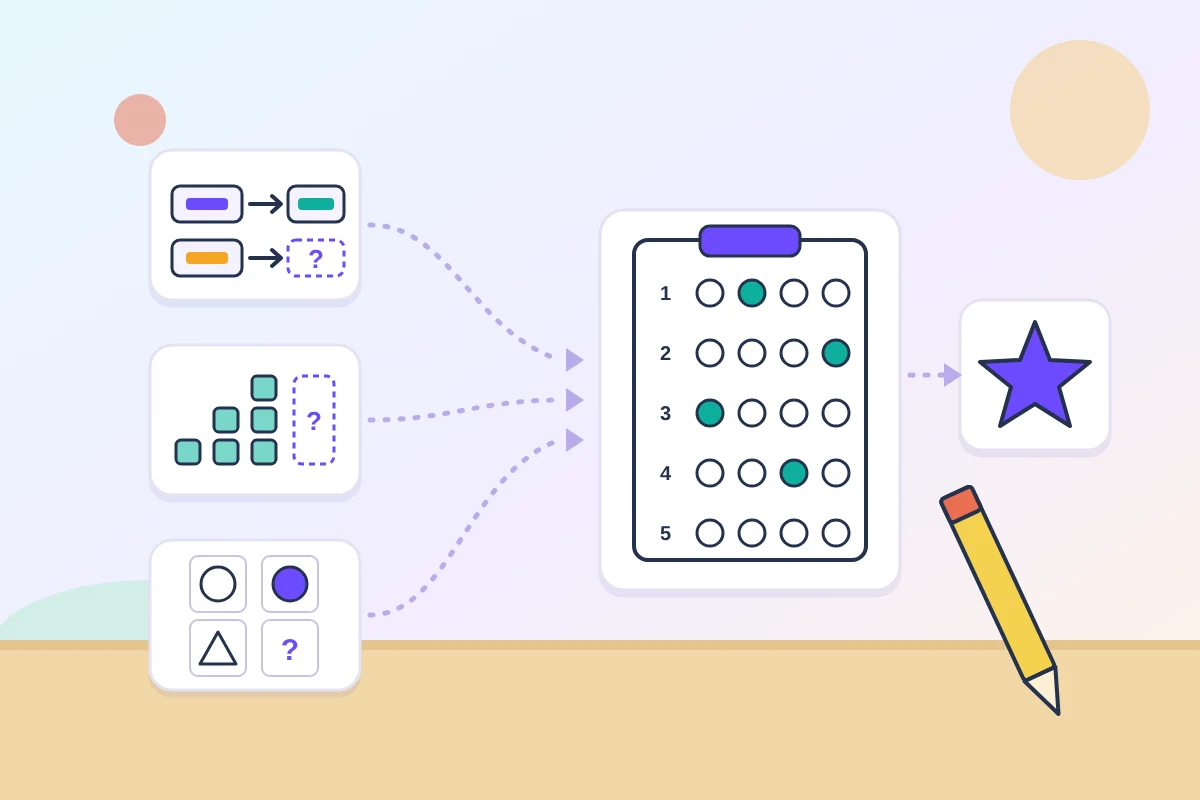
GATE test questions usually ask a child to spot a rule and apply it. These five items show common formats; they do not predict any score.
Original FocusPlay practice items—not real test questions. They are not taken or adapted from any test publisher, prep book, or forum. Each answer was checked with code.
1. Which word completes the pair? (verbal analogy)
Read aloud: “A thermometer is used to measure temperature. A clock is used to measure what?”
thermometer → temperature :: clock → ?
- A. tower
- B. time
- C. alarm
- D. hands
Show answer
Answer: B — time. A thermometer is a tool that measures temperature, so the matching pair is the thing a clock measures: time. Alarm, hands, and tower are parts of or places for clocks, not what a clock measures.
2. What number comes next? (number series)
Read aloud: “Look at how much the numbers grow each time. What number comes next?”
2, 6, 12, 20, 30, ?
- A. 40
- B. 36
- C. 60
- D. 42
Show answer
Answer: D — 42. The jumps are +4, +6, +8, +10, so each jump is 2 more than the last; the next jump is +12, and 30 + 12 = 42. (Or: 1×2, 2×3, 3×4, 4×5, 5×6, then 6×7 = 42.)
3. Which shape completes the grid? (figure matrix)
Read aloud: “Look across each row and down each column. Which picture belongs in the empty box?”
Text description: Rows show triangles, squares, then hexagons. Columns go small, medium, large. The bottom-right box is missing. Choices: A small hexagon, B large square, C large hexagon, D medium hexagon.
Show answer
Answer: C — the large hexagon. Every shape in the bottom row is a hexagon, and every shape in the right column is large. Only choice C follows both rules.
4. Which word goes with the group? (verbal classification)
Read aloud: “These three words belong together. Which choice belongs with them?”
January · April · October
- A. August
- B. Monday
- C. summer
- D. birthday
Show answer
Answer: A — August. January, April, and October are all months of the year, and August is the only month among the choices. Monday is a day, summer a season, and a birthday an event.
5. How many apples balance the pumpkin? (quantitative reasoning)
Read aloud: “Use the two clues to figure out the answer.”
3 apples weigh the same as 1 melon.
2 melons weigh the same as 1 pumpkin.
How many apples weigh the same as 1 pumpkin?
- A. 5
- B. 6
- C. 9
- D. 3
Show answer
Answer: B — 6. One pumpkin balances 2 melons, and each melon balances 3 apples, so the pumpkin balances 2 × 3 = 6 apples. Choice A adds instead of multiplying.
For more original examples by test, see CogAT practice questions for 2nd grade and our explainer on what a gifted screener is.
How to help your child prepare for the GATE test
The best preparation for a GATE test is familiarity with the format plus everyday reasoning practice, not weeks of drilling. Some districts say so directly: Eureka Union’s GATE page says it does “NOT recommend any tutoring guides or agency.” A calm plan looks like this:
- Find out which test and when from the school or district GATE page.
- Show a few sample items so “which one comes next?” feels familiar—more adds stress, not skill.
- Build reasoning through play: puzzles, pattern games, blocks, and reading together.
- Protect the morning: normal bedtime, breakfast, and a low-key send-off.
- Keep the result in perspective. A GATE test is one snapshot on one day. It does not define your child’s abilities or worth, and many children are identified later or thrive with challenge in the regular classroom.
FocusPlay’s learning games, logic games, and pattern recognition activities offer short, playful reasoning practice for kindergarten through grade 8.
Frequently asked questions
What is the GATE test?
There is no single GATE test. It is the everyday name for the ability test a district uses to screen for its Gifted and Talented Education program—most often the CogAT, NNAT3, OLSAT 8, or Naglieri General Ability Tests in California.
What does the GATE test measure?
Reasoning ability—how well a child spots patterns and rules in words, numbers, or shapes—rather than what the child has learned in school. Districts usually combine the score with other evidence.
What grade is the GATE test given in?
It depends on the district. As of the 2026–27 school year, San Diego Unified screens all second graders with the CogAT Screener and Tustin Unified screens all third graders with the Naglieri General Ability Tests, while Capistrano Unified screened third graders with the NNAT in 2025–26. Many districts also test other grades by referral.
How long is the GATE test?
Usually 30 to 75 minutes. According to the publishers, the NNAT3 takes about 30 minutes, each Naglieri General Ability Test about 30 to 35 minutes, and the OLSAT 8 is untimed with a 75-minute maximum.
What score do you need to pass the GATE test?
There is no universal passing score. Each district sets its own criteria: for example, Capistrano Unified listed the 96th percentile on the NNAT for 2025–26, and Eureka Union required an NNAT3 ability index of 132 for its 2026 testing. Many districts also use points matrices or local norms, so ask your district for its current rule.
Can my child study for the GATE test?
Drilling is not recommended, and some districts, such as Eureka Union, say they do not recommend tutoring guides. A few sample items to learn the format, plus reading, puzzles, and games, are a calmer way to help.
Is the GATE test the same as an IQ test?
Not exactly. GATE screeners are group ability tests given at school, while an IQ test such as the WISC-V is given one-on-one by a psychologist. Both estimate reasoning ability, but many California districts, including Tustin and Capistrano, do not accept private IQ results in place of their own screening.
Sources
- California Department of Education: Gifted and Talented Education (last reviewed December 5, 2025)
- Riverside Insights: Cognitively Speaking—Introducing CogAT Form 8
- Riverside Insights: CogAT structure of the assessment
- Pearson: Naglieri Nonverbal Ability Test, Third Edition (NNAT3)
- Pearson: Otis-Lennon School Ability Test, Eighth Edition (OLSAT 8)
- Pearson: OLSAT 8 overview brochure
- MHS: Naglieri General Ability Tests
- MHS: Naglieri General Ability Tests brochure
- San Diego Unified School District: GATE assessment
- Long Beach Unified School District: GATE identification and testing
- Sacramento City Unified School District: Gifted and Talented Education
- Tustin Unified School District: GATE
- Capistrano Unified School District: Qualifying for CUSD GATE Program (2025–26)
- Eureka Union School District: GATE testing 2026 information
- Lohman, D. F. (2005). Identifying academically talented minority students (RM05216). National Research Center on the Gifted and Talented, University of Connecticut.
Last updated: November 9, 2026, by the Focusplay Editorial Team. Test details verified on November 9, 2026, from publisher pages; district details verified on November 8–9, 2026, from each district’s GATE page for the 2026–27 school year where published (Sacramento City and Capistrano’s latest posted pages are for 2025–26). This article is for information only and is not affiliated with or endorsed by any school district, state agency, or test publisher. GATE rules change every year; confirm current details with your district.
Explore Focusplay learning games