CogAT Practice Questions for 2nd Grade: 12 Level 8 Examples With Answers
Second graders who take the CogAT usually take Level 8, where almost every question is a picture. Here is what each part looks like, followed by 12 original practice questions you can do together.
- Test level
- Level 8, one of the primary levels (5/6–8) for kindergarten through grade 2
- Batteries
- Verbal, Quantitative, Nonverbal—three subtests each
- Reading needed
- No; questions are picture-based and directions are read aloud
- Time per subtest
- About 10–15 minutes, by Riverside’s estimate
- Format
- Paper or online; audio directions available online
- Short version
- Some districts first give the CogAT Screener (three subtests)
- Publisher
- Riverside Insights
What CogAT Level 8 looks like
The CogAT’s ten levels span kindergarten through grade 12. Levels 5/6 through 8 are the primary levels, and Level 8 is the usual match for second grade, although a school can choose a different level. Riverside’s brochure says the primary levels use “picture-based subtests” and that items become text-based from Level 9 (grade 3) in the Verbal and Quantitative batteries. In other words, second grade is the last year most children see an all-picture CogAT.
Riverside’s test descriptions list the same nine subtests for Levels 5/6, 7, and 8. The table summarizes each task and the approximate time from Riverside’s 2023 overview brochure.
| Battery | Subtest | What the child does | About |
|---|---|---|---|
| Verbal | Picture Analogies | Looks at a 2×2 grid with three pictures and picks the picture that completes the pair | 13–15 min |
| Sentence Completion | Listens to a sentence or question read aloud and picks the picture that answers it | 13–14 min | |
| Picture Classification | Sees three pictures that are alike and picks the one that belongs with them | 13–14 min | |
| Quantitative | Number Analogies | Finds how one amount changes into another and applies the same change | 13–15 min |
| Number Puzzles | Finds the missing number in a short equation (four choices at Level 8) | 11–15 min | |
| Number Series | Studies strings of beads that make a pattern and picks the next string | 13–15 min | |
| Nonverbal | Figure Matrices | Applies a shape change from one pair of boxes to another | 11–13 min |
| Paper Folding | Imagines paper that is folded, punched or cut, and opened | 10–11 min | |
| Figure Classification | Finds what three figures share and picks the one that matches | 10–13 min |
A note on Number Puzzles: Riverside’s 2025 description for Level 8 says “one number is missing” from an equation, while its older brochure describes picture “trains” for all primary levels. If your child’s school shares sample pages, those show which version your district uses.
Riverside also offers an Alternate-Verbal administration for kindergarten through grade 2 and audio-only online directions. Sentence Completion is read aloud in English or Spanish. For the full picture of the test, including score types and the Screener, see our CogAT test guide.
How to use these practice questions
Second graders vary a lot in attention span, reading, and experience with puzzles. These habits make practice useful without turning it into pressure:
- Keep sessions short. Three or four questions at a time is enough. Stop while your child is still interested.
- Read the direction, not the answer. Read the “Read aloud” line exactly, then let your child think. If they are stuck, ask “What is the same? What changed?” instead of hinting at a choice.
- Ask for the rule. After an answer, ask your child to explain it in a sentence. Saying “it gets one bead smaller” or “the shape gets an X” is the real skill.
- Look at every choice. Wrong answers are often close: a mirror image, the total instead of the missing part, or the right shape with the wrong detail.
- Do not time it. The goal is understanding the formats, not speed.
Practice questions in a similar style
These questions were written by FocusPlay as original practice in a similar style. They are not real test items, they are not taken from any test publisher or prep book, and they should not be used to predict a score. Use them for short, playful familiarity with the format.
There are 12 questions—at least one for each of the nine Level 8 subtest types. Read the direction aloud, let your child point to an answer, then open the answer box together and talk about the rule. Questions marked “easier” or “harder” help you find a comfortable starting point.
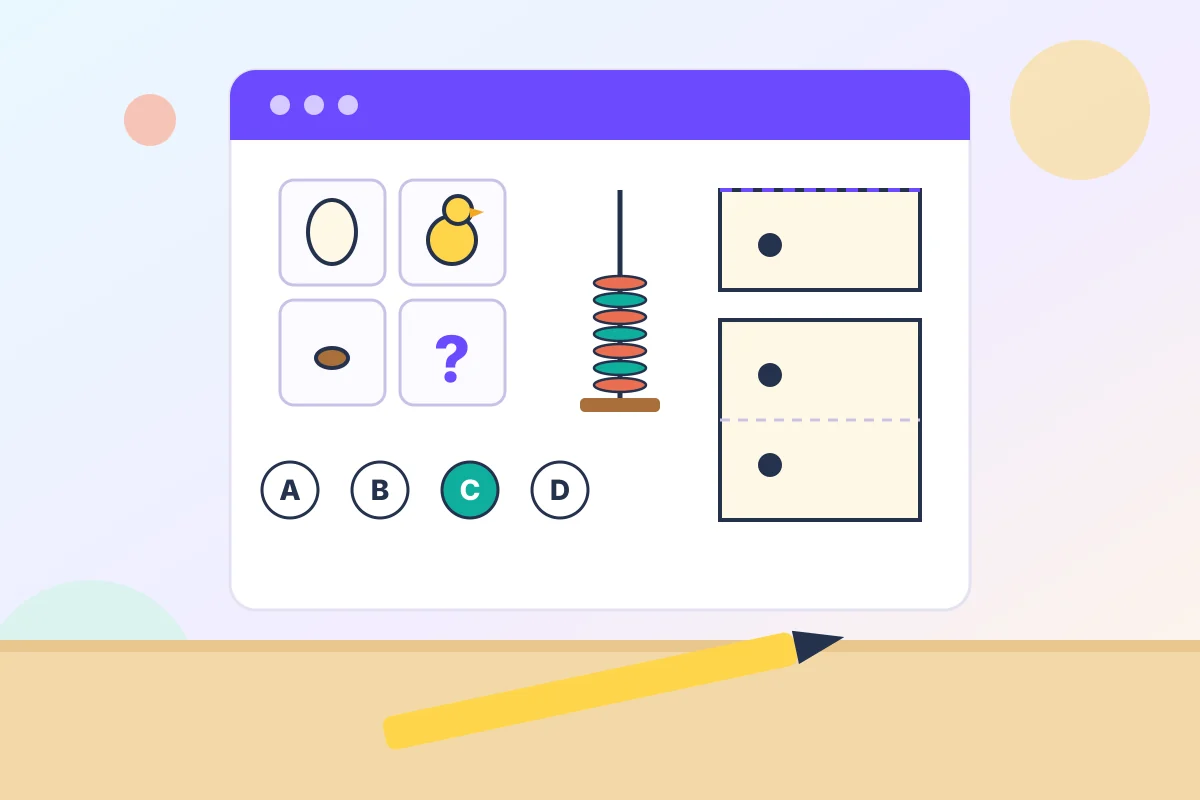
1. Picture Analogies
Read aloud: “The two pictures on top go together. Which picture goes with the seed in the same way?”
Text description: Top row: egg → chick. Bottom row: seed → ?. Choices: A rock, B nest, C sprout, D spoon.
Show answer
Answer: C — sprout. A chick hatches from an egg, and a sprout grows from a seed. The nest goes with birds, but it is not what a seed becomes.
2. Sentence Completion
Read aloud: Listen: “Leo found a tiny ladybug and wanted to see its spots up close. Which one should he use?”
(On the real test the choices are pictures. Here, read the four words aloud.)
- A. magnifying glass
- B. pillow
- C. spoon
- D. ladder
Show answer
Answer: A — magnifying glass. A magnifying glass makes small things look bigger, so Leo could see the spots. The other things cannot help him see up close.
3. Picture Classification
Read aloud: “These three pictures are alike in some way. Which picture below belongs with them?”
Text description: Pictures that go together: sun, candle, flashlight. Choices: A sock, B cup, C chair, D light bulb.
Show answer
Answer: D — light bulb. The sun, a candle, and a flashlight all give light. A light bulb does too. The other objects do not.
4. Number Analogies
Read aloud: “Look at how the top pictures change. Which picture changes the bottom one in the same way?”
Text description: Top row: 3 dots → 2 dots. Bottom row: 7 dots → ?. Choices: A 8, B 6, C 7, D 5 dots.
Show answer
Answer: B — 6 dots. In the top row, one dot is taken away (3 → 2). Taking one away from 7 dots leaves 6 dots.
5. Number Analogies
Read aloud: “The top pictures show a change. Make the same change to the bottom picture.”
Text description: Top row: 6 stars → 3 stars. Bottom row: 8 stars → ?. Choices: A 6, B 7, C 2, D 4 stars.
Show answer
Answer: D — 4 stars. Six stars become three: the group is cut in half. Half of 8 is 4. (If a child says “take away 3,” that would give 5, which is not a choice—a good moment to look for another rule.)
6. Number Puzzles
Read aloud: “One number is missing. Which number makes this true?”
9 − ? = 5
- A. 4
- B. 14
- C. 5
- D. 3
Show answer
Answer: A — 4. 9 take away 4 leaves 5. A child who adds 9 + 5 gets 14, which is a common slip.
7. Number Puzzles
Read aloud: “Both sides have to be the same amount. Which number goes in the box?”
6 + ? = 2 + 9
- A. 8
- B. 4
- C. 5
- D. 11
Show answer
Answer: C — 5. The right side is 2 + 9 = 11. Six plus 5 also makes 11. Choosing 11 is a common mistake—it is the total, not the missing part.
8. Number Series
Read aloud: “Look at the beads on each rod. Which rod comes next?”
Text description: Bead rods: 1, 3, 5, 7, ?. Choices: A 8, B 9, C 10, D 11 beads.
Show answer
Answer: B — 9 beads. Each rod has two more beads than the one before: 1, 3, 5, 7, so the next rod has 9.
9. Number Series
Read aloud: “What comes next on the bead rods?”
Text description: Bead rods: 2, 4, 2, 4, 2, ?. Choices: A 2, B 6, C 3, D 4 beads.
Show answer
Answer: D — 4 beads. The rods take turns: 2, then 4, then 2, then 4. After a 2 comes a 4.
10. Figure Matrices
Read aloud: “The top two boxes go together. Which picture goes with the circle in the same way?”
Text description: Top row: plain square → square with an X inside. Bottom row: plain circle → ?. Choices: A circle with an X, B square with an X, C plain circle, D triangle with an X.
Show answer
Answer: A — circle with an X. The shape stays the same and gets an X drawn inside. So the circle becomes a circle with an X.
11. Paper Folding
Read aloud: “A square paper is folded in half from top to bottom. Then one hole is punched. What does the paper look like when it is opened?”
Text description: The top half is folded down onto the bottom half. One hole is punched near the left side of the folded paper. Choices: A one hole lower left; B two holes lower left and lower right; C two holes on the left side, one above and one below the fold; D two holes upper left and upper right.
Show answer
Answer: C — two holes on the left, upper and lower. The punch goes through both layers. When the paper opens, the second hole appears straight above the first, the same distance from the fold line.
12. Figure Classification
Read aloud: “These three shapes are alike in some way. Which shape below belongs with them?”
Text description: Shapes that go together: triangle, square, and circle, each with a dot in the middle. Choices: A star with no dot, B pentagon with a dot inside, C hexagon with no dot, D square with a dot outside it.
Show answer
Answer: B — pentagon with a dot inside. Each shape in the group has a dot inside it. Only the pentagon has a dot inside. In choice D the dot is outside the square.
Beyond practice questions
Riverside recommends that everyone in a testing group gets the same practice activities, or nobody does, and notes that excessive coaching has reduced impact. That matches what parents usually find: once a child understands each format, more drilling adds little. Everyday play builds the same reasoning:
- Verbal: play “goes together” games at dinner (“A puppy is to a dog as a kitten is to…?”) and sort toys by what they do. Our vocabulary games article has more ideas.
- Quantitative: count, add, and take away with real objects, and build bead or block patterns for each other to continue. See number sense activities at home.
- Nonverbal: fold and cut paper snowflakes, then predict the holes before opening them. Our spatial reasoning activities collect more.
- FocusPlay’s learning games and free worksheets include grade 2 pattern, logic, and visual-reasoning practice in short sessions.
Test scores are one piece of information. Gifted programs usually combine them with other evidence, and a single morning of testing does not define what a child can do. Our parent’s guide to gifted testing explains the wider process, and our NNAT3 guide covers a nonverbal test some districts use instead.
Frequently asked questions
What CogAT level do 2nd graders take?
Most second graders take Level 8, the highest of the primary levels (5/6–8). Schools can choose a different level for a group, so check the notice from your district.
Do 2nd graders need to read on the CogAT?
No. At Level 8 the questions are built from pictures, beads, numbers, and shapes, and the teacher reads the directions aloud. Text-based Verbal and Quantitative items start at Level 9, usually in third grade.
How long is the CogAT for 2nd grade?
Riverside estimates about 10 to 15 minutes for each of the nine subtests at the primary levels. Schools often spread testing across more than one session.
What subtests are on CogAT Level 8?
Picture Analogies, Sentence Completion, and Picture Classification (Verbal); Number Analogies, Number Puzzles, and Number Series (Quantitative); and Figure Matrices, Paper Folding, and Figure Classification (Nonverbal).
How much should my child practice for the CogAT?
A few short sessions are enough to make the formats familiar. Riverside notes that excessive coaching has reduced impact, so relaxed practice and reasoning games work better than drilling.
Are these real CogAT questions?
No. They are original FocusPlay questions written in a similar style. They are not test items and cannot predict a score.
Sources
- Riverside Insights: CogAT test descriptions (DataManager)
- Riverside Insights: CogAT overview brochure (2023)
- Riverside Insights: Structure of the CogAT assessment
- Riverside Insights: Introducing CogAT Form 8
Last updated: November 7, 2026. This article is for information only and is not affiliated with or endorsed by the test publishers. Testing rules change; confirm current details with your school or district.
Explore Focusplay learning games