What Is the NNAT3? A Parent’s Guide to the Naglieri Nonverbal Ability Test
Some districts screen for gifted programs with a test that uses no words at all. Here is how the NNAT3 is built, what the scores mean, where its limits are, and what its puzzles look like.
- Full name
- Naglieri Nonverbal Ability Test, Third Edition
- Publisher
- Pearson
- Grades
- Kindergarten–Grade 12, in seven levels (A–G)
- Length
- 48 multiple-choice items, about 30 minutes
- Format
- Group test, online or paper-and-pencil
- Language
- Pictorial directions; no reading, writing, or speaking needed to answer
- Main scores
- Naglieri Ability Index (mean 100, SD 16), percentile ranks, stanines, NCEs
- Who gives it
- Schools and districts, often once or twice a school year
What the NNAT3 measures
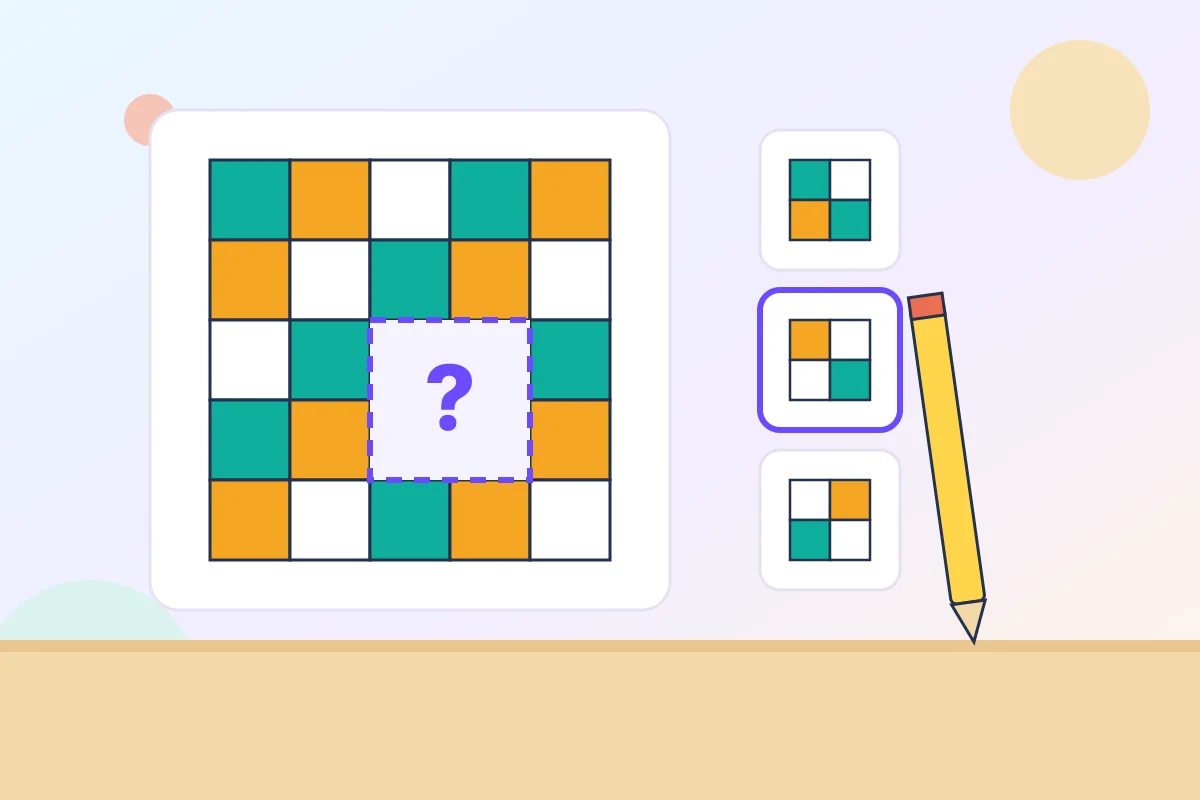
The NNAT3 is a test of general reasoning ability that uses progressive matrices: designs made of shapes and colors with a part missing. The child studies how the design is organized and chooses the piece that completes it. Pearson describes the test as “a nonverbal measure of general ability” for kindergarten through grade 12.
Because nothing has to be read or said, the test is meant to reduce the role of vocabulary and schooling. Pearson’s FAQ says the test “requires no spoken or written language” and presents it as useful for students who are learning English. That design is the main reason districts choose it—and also the source of the most important questions about it, covered below.
It helps to know what the test is not. It is not an achievement test, so it does not check reading or math skills. It is also not a full individual IQ evaluation: it is one 30-minute group measure of one kind of reasoning.
NNAT3 levels by grade
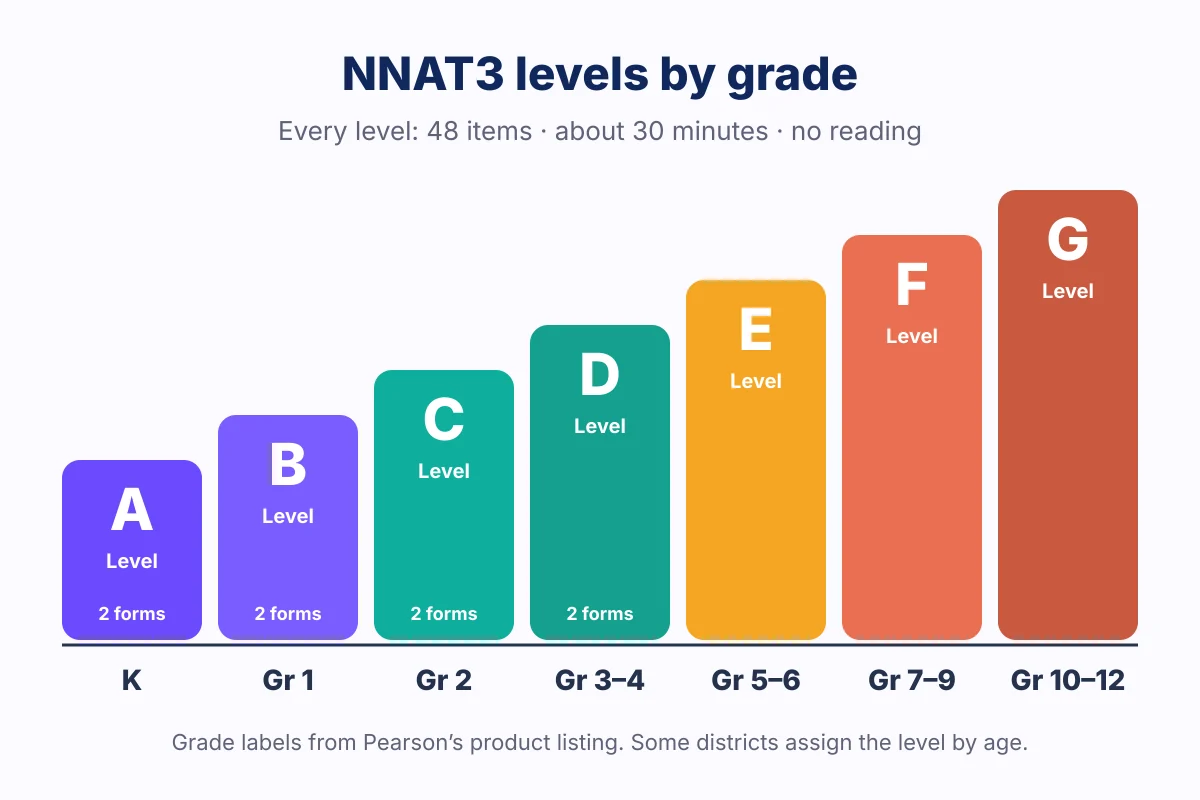
Pearson sells the test in seven grade-based levels. The table follows the grade labels on Pearson’s product page. Some districts assign the level by a student’s age instead; Northshore School District in Washington, for example, says the level is determined by birth date.
| Level | Grade | Forms |
|---|---|---|
| A | Kindergarten | Two |
| B | Grade 1 | Two |
| C | Grade 2 | Two |
| D | Grades 3–4 | Two |
| E | Grades 5–6 | One |
| F | Grades 7–9 | One |
| G | Grades 10–12 | One |
Every level has 48 multiple-choice items. Pearson lists the format as “30 minutes, Online or Paper-Pencil, Group-Administered,” and notes it can be given once or twice in a school year. Its FAQ says testing commonly happens in the fall and early spring. The third edition launched in spring 2016.
What NNAT3 questions look like
Every item is a matrix puzzle, but the puzzles are not all the same kind. Pearson’s current pages do not split the NNAT3 into named sections. Jack Naglieri’s earlier Matrix Analogies Test, a forerunner of the NNAT, was described as assessing pattern completion, reasoning by analogy, serial reasoning, and spatial visualization, and those four labels are a handy way to talk about matrix items:
- Pattern completion: one large design with a piece cut out. The child finds the piece that continues the design.
- Reasoning by analogy: a small grid where a figure changes across a row (it turns, grows, or gains a part). The child applies the same change to a new figure.
- Serial reasoning: a grid where shapes change step by step across rows and down columns.
- Spatial visualization: figures that combine, overlap, or move, so the child has to picture the result.
Younger levels lean on simpler designs; higher levels add more rules at once. The practice section below has one or two puzzles of each style.
How NNAT3 scores work
Raw scores are converted to scaled scores and then compared with students of the same age. Pearson’s product page lists the Naglieri Ability Index (NAI), percentile ranks, stanines, scaled scores, and normal curve equivalents.
- Naglieri Ability Index (NAI): the main score. Pearson’s norms report describes it with “a mean of 100, a standard deviation of 16,” and a range of 40 to 160.
- Percentile rank: the share of same-age students in the norm group who scored lower. A percentile of 50 is average; it is not the percentage of questions answered correctly.
- Stanine: a broad 1–9 band. Stanines 4–6 are the middle range.
Northshore School District gives parents a helpful rule of thumb: about 95% of students score between 68 and 132 on the NAI, and a national percentile between 25 and 75 is in the average range.
The 2018 norms update
In 2018 Pearson updated the norms for the lower levels (A–D) using a larger sample of 85,959 students. The items and scoring did not change, but the new age tables shifted scores: Pearson reports that average NAI scores at each level came out “about four and a half points lower” than under the 2015 norms. If you compare an older report with a newer one, ask which norms were used before reading much into a change.
For a wider explanation of percentiles, local norms, and how one score fits into placement decisions, see our guide to gifted testing for parents.
How schools use the NNAT3
The NNAT3 is most often used as a screener: a quick group test given to a whole grade so that no student depends on a teacher referral to be noticed. Students who score above a district’s chosen point may then take a longer test or have more information reviewed. Northshore puts it plainly: “The NNAT3 alone will not qualify nor disqualify” a student.
Cut scores, grades tested, and the next steps vary from district to district, and they change. Some districts pair the NNAT3 with the CogAT, an achievement measure, or a teacher rating scale.
| NNAT3 | CogAT (full test) | |
|---|---|---|
| Publisher | Pearson | Riverside Insights |
| What it uses | Shape and color matrices only | Words, numbers, and shapes in three batteries |
| Length | 48 items, about 30 minutes | Nine subtests; much longer |
| Main score | Naglieri Ability Index (mean 100) | Standard Age Score (mean 100) |
| Typical use | Quick universal screening | Screening or fuller ability profile |
Is the NNAT3 fair to English learners?
The case for a nonverbal test is simple: a child who is still learning English can show reasoning without a language barrier. Pearson’s FAQ calls the test particularly useful for students who might be English language learners. Naglieri’s newer Naglieri General Ability Tests—verbal, nonverbal, and quantitative—are presented as designed to identify gifted students fairly.
Research has also raised cautions. A 2008 study by Lohman, Korb, and Lakin compared the Raven, an earlier edition of the NNAT, and the CogAT with about 1,200 elementary students, roughly 40% of them English learners. As summarized by the U.S. Department of Education’s Regional Educational Laboratory Southwest, it found norming problems that overstated how many children scored high, and that none of the nonverbal tests predicted English learners’ achievement very well. That study predates the NNAT3 and its 2018 norms, so it does not settle the question for the current edition. The practical lesson still holds: a nonverbal score is useful evidence, not a complete picture, and the strongest identification systems use several measures.
Practice questions in a similar style
These questions were written by FocusPlay as original practice in a similar style. They are not real test items, they are not taken from any test publisher or prep book, and they should not be used to predict a score. Use them for short, playful familiarity with the format.
There are five puzzles, from easiest to hardest, covering four common styles of matrix item. Children can point to an answer; an adult can read the short direction aloud.
1. Pattern Completion (missing piece)
Read aloud: “Look at the big picture. A piece is missing. Which piece fits in the empty space?”
Text description: A board of tiles with colors in diagonal stripes: each diagonal going down to the left is one color, repeating teal, gold, white. A 2×2 piece is missing. Choices: A top row teal, white; bottom row gold, teal; B top row white, teal; bottom row teal, gold; C top row gold, white; bottom row white, teal; D top row white, gold; bottom row teal, white.
Show answer
Answer: C — top row gold, white; bottom row white, teal. The colors run in diagonal stripes that repeat teal, gold, white. Following each stripe into the gap gives gold, white on top and white, teal below. Choice D has the right colors in mirrored order, so the stripes would break.
2. Reasoning by Analogy (shape matrix)
Read aloud: “The top two pictures go together. Find the picture that goes with the bottom one in the same way.”
Text description: On a 3×3 grid, the top-left figure has shaded squares at top-left, middle-left, bottom-left, bottom-center; the top-right figure is the same shape turned a quarter turn clockwise. The bottom-left figure is shaded at top-center, top-right, middle-center, bottom-center. Choices: A middle-left, middle-center, middle-right, bottom-right; B top-left, top-center, middle-center, bottom-center; C top-left, middle-left, middle-center, middle-right; D top-center, middle-center, bottom-left, bottom-center.
Show answer
Answer: A — middle-left, middle-center, middle-right, bottom-right. The top shape is turned a quarter turn clockwise, like a clock hand moving from 12 to 3. Turning the hook shape the same way gives choice A. B is a mirror image, C is turned the other way, and D is turned halfway around.
3. Serial Reasoning (sequence matrix)
Read aloud: “Look across each row and down each column. What belongs in the empty box?”
Text description: Rows: circles, squares, triangles. Columns: one, two, three of each shape. The bottom-right box is empty. Choices: A 2 triangles, B 3 squares, C 4 triangles, D 3 triangles.
Show answer
Answer: D — 3 triangles. Each row keeps one shape, and each column adds one more. The last box needs triangles (the bottom row) and three of them (the right column).
4. Spatial Visualization (combine the parts)
Read aloud: “Look at the first row. What happens when the first two pictures are put together? Do the same for the second row.”
Text description: Row one: vertical line + horizontal line = plus sign. Row two: line slanting down to the right + line slanting up to the right = ?. Choices: A plus sign, B X, C one slanted line, D X with a vertical line.
Show answer
Answer: B — an X. The third picture in each row is the first two drawn on top of each other. Two slanted lines that cross make an X.
5. Pattern Completion (3×3 matrix)
Read aloud: “Every row and every column follows the same rule. Which picture completes the grid?”
Text description: Grid: row 1: white circle, gold square, teal triangle; row 2: teal square, white triangle, gold circle; row 3: gold triangle, teal circle, question mark. Choices: A teal square, B white triangle, C white square, D white circle.
Show answer
Answer: C — white square. Each row and each column has one circle, one square, and one triangle, and one white, one gold, and one teal shape. The bottom row still needs a square, and the right column still needs a white shape.
How to help your child prepare
The NNAT3 is short and its directions are pictorial, so a little familiarity goes a long way. A calm, light approach fits best:
- Try a handful of puzzles. A few examples like the ones above help a child understand “find the missing piece” so the format is not a surprise on test day. Two or three short sessions are plenty.
- Talk about rules. Ask “What changes across this row? What stays the same?” Describing a rule out loud builds the habit the test rewards.
- Play with patterns and space. Tangrams, block building, and tile patterns are natural practice. Our articles on pattern recognition activities and spatial reasoning activities have ideas, and FocusPlay’s learning games and free worksheets include visual-logic practice that fits into ten minutes.
- Check every choice. Many wrong answers are “almost right,” like a mirror image. Encourage looking at all the options before choosing.
- Keep it low-stakes. Tell your child it is a puzzle activity that helps teachers plan, and avoid drilling or labels.
If you get a report, ask which level and norms were used, what the district’s next step is, and what other information is considered. Our CogAT practice questions for 2nd grade show how a multi-battery test differs.
Frequently asked questions
What does the NNAT3 test measure?
The NNAT3 measures general reasoning ability with nonverbal matrix puzzles made of shapes and colors. Children find the piece that completes a design, so the test does not depend on reading or vocabulary.
How long is the NNAT3?
Each level has 48 multiple-choice items, and Pearson lists the testing time as about 30 minutes. It is usually given to a group of students at once, online or on paper.
What is a good NNAT3 score?
The Naglieri Ability Index has an average of 100, and a percentile rank of 50 is average for the child’s age. Gifted programs set their own cut scores, so what counts as qualifying depends on the district.
What NNAT3 level is my child taking?
Pearson labels Level A for kindergarten, B for grade 1, C for grade 2, D for grades 3–4, E for grades 5–6, F for grades 7–9, and G for grades 10–12. Some districts assign the level by age, so check with your school.
Is the NNAT3 an IQ test?
Not exactly. It is a short group screener of nonverbal reasoning. Its index uses a scale centered on 100, but it is not the same as an individual intelligence test given by a psychologist.
Can a child qualify for a gifted program on the NNAT3 alone?
That depends on the district, but many use it only as a first step. Northshore School District, for example, states that the NNAT3 alone will not qualify or disqualify a student.
Sources
- Pearson: Naglieri Nonverbal Ability Test, Third Edition (product page)
- Pearson: NNAT3 flyer
- Pearson: NNAT3 frequently asked questions
- Pearson: NNAT3 special report, 2018 lower levels updated norms
- Northshore School District: NNAT3 overview
- Jack A. Naglieri: Tests
- REL Southwest (IES): Identifying English learners for gifted programs, reference list
Last updated: November 7, 2026. This article is for information only and is not affiliated with or endorsed by the test publishers. Testing rules change; confirm current details with your school or district.
Explore Focusplay learning games