Pattern Recognition Activities for Kids: A K–8 Guide
Patterns are more than colored blocks in a row. Finding a rule, testing it, and explaining why it works gives children a practical way to organize information across mathematics, reading, science, music, and everyday routines.
Key takeaways
- Ask for the rule before accepting “what comes next.”
- Use shapes, sounds, movements, words, and numbers so the skill transfers.
- Include both repeating patterns and growing patterns.
- Invite children to create, break, repair, and compare patterns.
- Adjust the complexity of the rule rather than turning practice into a speed test.
What is pattern recognition?
Pattern recognition is noticing a rule, relationship, or structure that organizes information. A learner might see that colors repeat, that a design gains two tiles each step, that a spelling family shares an ending, or that a calculation can be decomposed in a familiar way. The goal is to describe the structure well enough to make and check a prediction.
This attention to structure appears in the Common Core Standards for Mathematical Practice. CAST’s UDL Guidelines 3.0 also recommend highlighting patterns, critical features, big ideas, and relationships so learners can focus on what matters.
A five-step pattern routine
1. Notice
Give the child time to look or listen. Ask: “What changes? What repeats? What stays the same?” For a complex display, cover part of it or reduce the number of items.
2. Name
Ask the learner to put the rule into words, gestures, symbols, or a drawing. “Red, blue, blue” is more useful than “It repeats” because it identifies the repeating unit.
3. Predict
Hide one item or ask for the next stage. Encourage a reason: “I think a triangle goes here because every third shape is a triangle.”
4. Build
Have the learner continue the pattern or create a new example with the same rule. Changing materials—from tiles to claps, for example—checks understanding beyond the surface.
5. Explain
Ask how the result proves or challenges the rule. If two rules seem possible, build more steps and compare them.
Seven pattern recognition activities for kids
1. Cover one piece
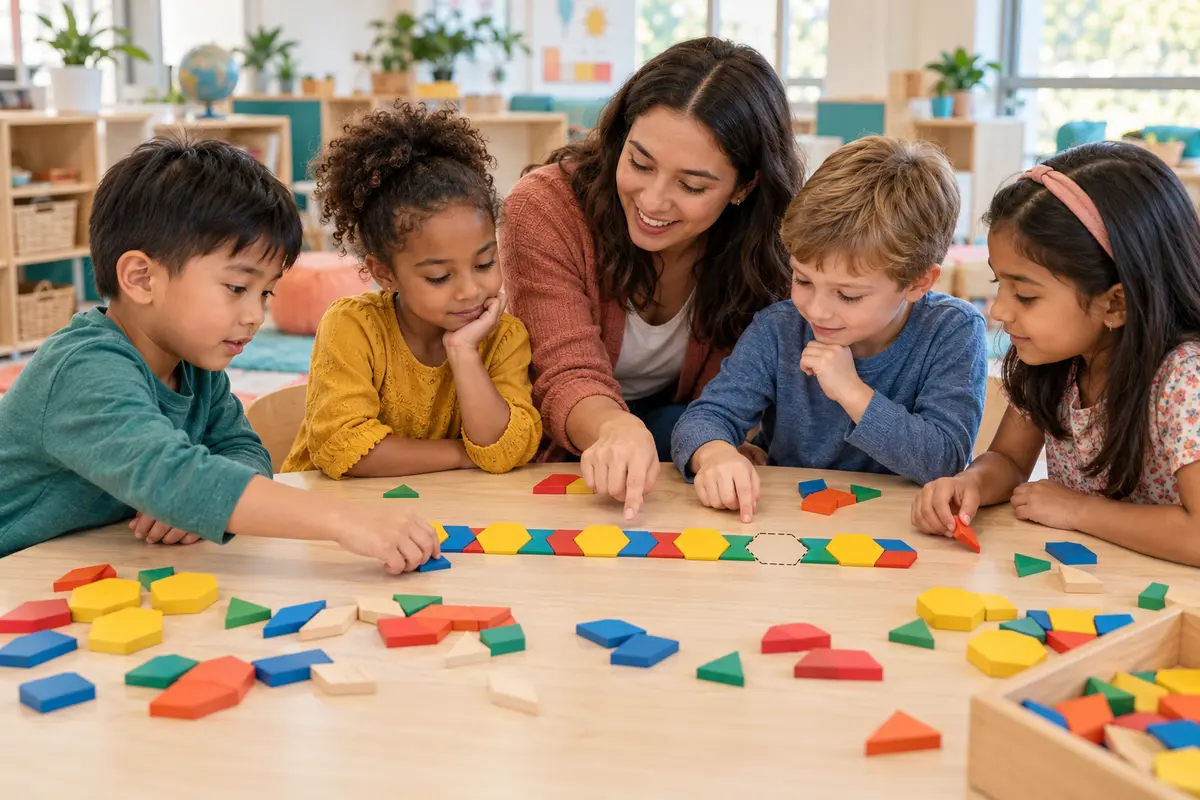
Build a short pattern and hide an item in the middle. Middle gaps require children to use information on both sides instead of only continuing from the end.
2. Keep the rule, change the materials
Make “circle, square, square” with tiles. Reproduce the same structure with sounds, movements, or household objects. Ask what stayed the same.
3. Grow a pattern journal
Draw stages that add a fixed amount: one square, three squares, five squares. Record the stage and total in a table. Older learners can predict a later stage without drawing every step.
4. Make a sound-and-movement sequence
Try clap, tap, turn, clap, tap, turn. Let the child perform, extend, and alter one part. This nonvisual option also works as a two-minute classroom transition.
5. Hunt for structure in language
Sort words by endings, notice repeated phrases in a story, or compare sentence frames. Add a non-example that clarifies the boundary of the rule.
6. Become a number-structure detective
Ask what happens to the ones digit when counting by five, or how 6 × 7 and 5 × 7 are related. Find more ideas in our number sense activities.
7. Play “same or different rule?”
Show two similar-looking patterns with different rules, or different materials with the same rule. Children choose and justify. This pairs naturally with our logic games guide.
How to adjust pattern activities by grade
| Grade band | Good starting tasks | Questions to ask |
|---|---|---|
| K–2 | Copy and extend AB, AAB, and ABC patterns with objects, sounds, or movements. | “What is the part that repeats?” “How do you know?” |
| 3–5 | Compare repeating and growing patterns; use tables; repair an incorrect term. | “What changes each step?” “Can the same rule look different?” |
| 6–8 | Connect visual growth to tables, expressions, ratios, or coordinate graphs. | “Will your rule always work?” “What evidence would disprove it?” |
The IES What Works Clearinghouse guide for teaching math to young children includes pattern activities among its practical examples. Across ages, model one example, use clear contrasts, and allow children to show a rule with words, objects, actions, or symbols.
Common mistakes to avoid
- Accepting a guess without a rule: Ask, “What makes that answer fit?”
- Using only AB patterns: Add longer repeating units and growing patterns.
- Making every task visual: Include sound, movement, language, and number relationships.
- Increasing speed instead of reasoning: Add complexity through the rule and explanation, not a timer.
- Correcting too quickly: Let the child test the idea by extending the pattern.
Use pattern thinking during play
Board games, block designs, rhythms, and digital learning games all create chances to notice structure. Pause occasionally to ask what the learner noticed and why a move makes sense. FocusPlay’s learning games can support this brief, purposeful practice alongside hands-on play and classroom discussion.
Frequently asked questions
What is pattern recognition for children?
Pattern recognition is noticing a rule, relationship, or structure that organizes information, then using it to describe, predict, build, or check something.
Are pattern activities only for mathematics?
No. Children can find patterns in sounds, movements, spelling, sentence structures, stories, routines, science observations, and visual designs as well as numbers and shapes.
What should I do if a child guesses the next item?
Ask the child to name the repeating unit or growth rule and show how the prediction follows from it. A correct guess becomes reasoning when the child can explain and test the rule.
How can I adjust a pattern task for different ages?
Change the rule, not just the materials. Younger learners can copy and extend simple repeating patterns; older learners can compare rules, represent growth in a table, and justify whether a rule always works.