Logic Games for Kids: 7 Reasoning Skills to Practice from K–8
A useful logic game does more than produce a right answer. It gives a child a rule to notice, a decision to make, evidence to test, and a reason to explain.
Key takeaways
- Choose a game by the reasoning it requires, not by a broad “brain training” label.
- Ask for one piece of evidence before asking for speed.
- Increase difficulty one feature at a time: more choices, more rules, longer plans, or less visual support.
- Repeated guessing is a signal to pause, reveal the rule, or simplify the next decision.
- A game result shows performance on that activity; it is not a diagnosis or a measure of intelligence.
What counts as a logic game?
A logic game presents a small system: objects, clues, positions, paths, conditions, or moves. The learner must use that system consistently. Matching identical pictures may require attention, but it becomes a logic task when the player must infer a category, follow a constraint, eliminate alternatives, or plan several moves.
Examples include sorting games, repeating patterns, “which one does not belong?” tasks, mazes with restrictions, grid puzzles, deduction games, spatial puzzles, and strategy games. A digital game can qualify, but so can arranging household objects or solving a paper puzzle.
The reasoning matters more than the format. The Common Core Standards for Mathematical Practice describe habits such as making sense of problems, constructing arguments, attending to precision, using structure, and noticing repeated reasoning. Those habits appear across kindergarten through Grade 8, even though the content and language become more complex.
This does not mean every logic game teaches grade-level mathematics or meets a particular standard. It means that a well-chosen puzzle can create a concrete opportunity to practice a named reasoning action.
Seven reasoning skills children can practice
1. Sorting and classification
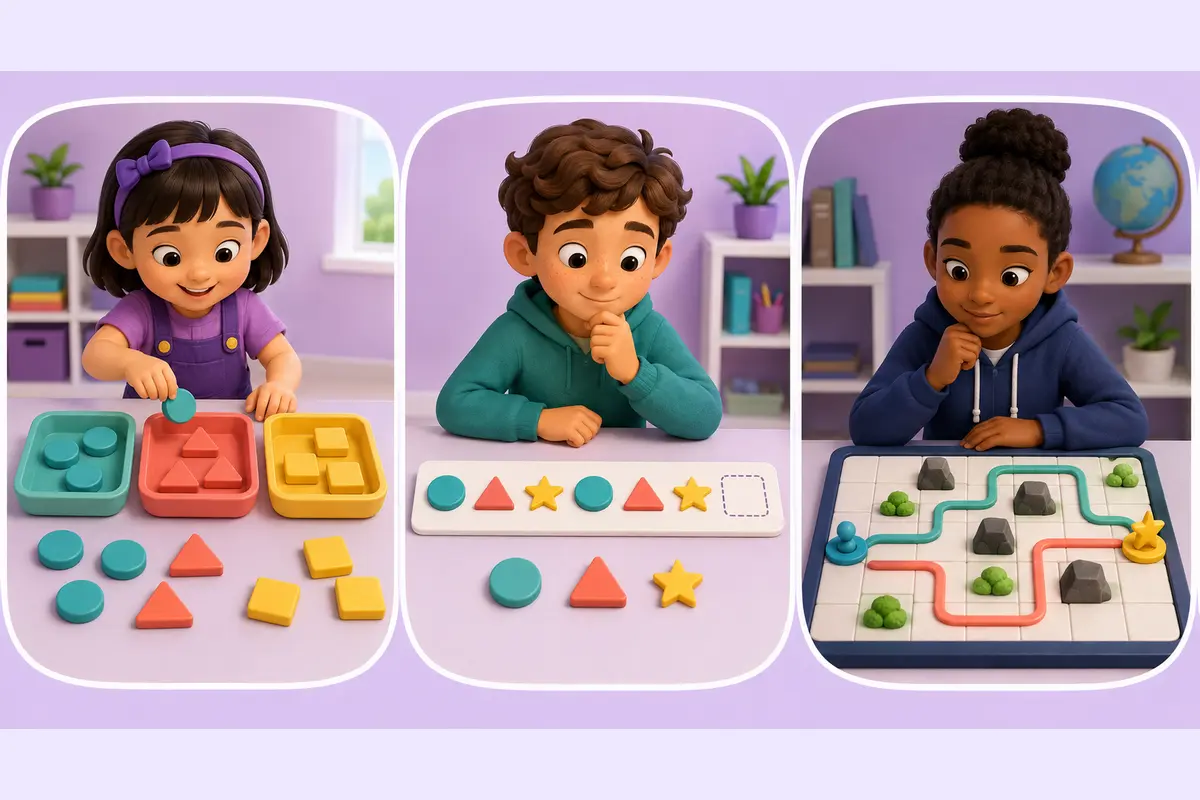
The learner decides which features matter and groups items by a rule. A young child might sort shapes by color, then sort the same shapes by form. An older learner might classify numbers as prime, composite, both impossible, or neither.
Ask: “What rule did you use?” and “Could the same object belong to a different group if the rule changed?” These questions separate a deliberate classification from placing items by appearance alone.
2. Patterns and sequences
A pattern task asks the child to identify what repeats or changes. Early examples may alternate colors or shapes. Later examples may use growing figures, function-like rules, or several changing attributes.
Do not accept only the next item. Ask the learner to describe the unit that repeats or the feature that changes: “I see circle, triangle, star repeating,” or “Each figure adds two tiles.” A prediction is stronger when it is tied to a rule.
3. Elimination
Elimination means ruling out choices that cannot satisfy the clues. In a picture puzzle, a child might remove every option with the wrong color. In a number puzzle, the learner might rule out odd numbers when the result must be even.
Elimination is especially useful when a learner does not yet see the final answer. Ask: “Which option cannot work, and what clue proves it?” One justified rejection is meaningful progress.
4. Conditional reasoning
Conditional reasoning follows rules such as “if this happens, then that must happen” or “the red piece cannot be beside the square.” Young learners can use one visible condition. Older learners can coordinate several conditions and notice when two clues interact.
Keep the conditions visible while the skill is new. The memory demand of holding several sentences should not hide whether the learner understands the logic.
5. Spatial reasoning
Spatial logic involves positions, rotations, routes, symmetry, fit, and relationships between parts and wholes. A child might complete a shape, predict how a piece turns, or find a route that avoids blocked spaces.
Allow physical rotation or drawing when mental rotation is not the target. Then ask, “What stayed the same when the piece turned?” or “Which landmark helped you choose the route?”
6. Planning ahead
A planning game requires the learner to consider how one move changes later options. For a beginner, that may mean thinking one move ahead. For an older learner, it may mean comparing several routes, ordering operations, or protecting a future choice.
Planning should not be confused with guessing many moves quickly. Invite the child to pause and state a small plan: “First I will open this path; then I can reach the target.”
7. Debugging and error analysis
In an error-analysis task, the learner finds the first place a rule was broken. This can be a misplaced tile, an invalid route, a number pattern with one incorrect term, or a solution that ignores a condition.
Ask, “What is the last part that still follows the rule?” This keeps the focus on evidence instead of treating the entire attempt as wrong.
Match the game to the grade band
| Grade band | Accessible starting points | Signs of a useful challenge | Adult prompt |
|---|---|---|---|
| Kindergarten–Grade 2 | Sort by one attribute, copy or extend a short pattern, match shapes, follow one route rule | The learner can state or show one rule and correct a move after feedback | “What do you notice?” |
| Grades 3–5 | Use two clues, eliminate choices, compare strategies, plan two or three moves, analyze an error | The learner explains why an option works and why another does not | “Which clue helped most?” |
| Grades 6–8 | Coordinate constraints, reason with tables or diagrams, compare efficient plans, test counterexamples | The learner revises a plan when new evidence conflicts with it | “What would prove your idea wrong?” |
These are starting points, not fixed limits. A Grade 2 learner may enjoy a complex spatial puzzle, while a Grade 7 learner may benefit from returning to a visually simple task that makes one unfamiliar rule easier to see.
For Grades 4–8, the U.S. Department of Education’s problem-solving practice guide recommends visual representations, multiple strategies, mathematical notation, and reflection on the solving process. Those recommendations are useful selection questions: does the game let the learner see the relationships, try a strategy, and review what happened?
A four-step routine: Notice, Choose, Test, Explain
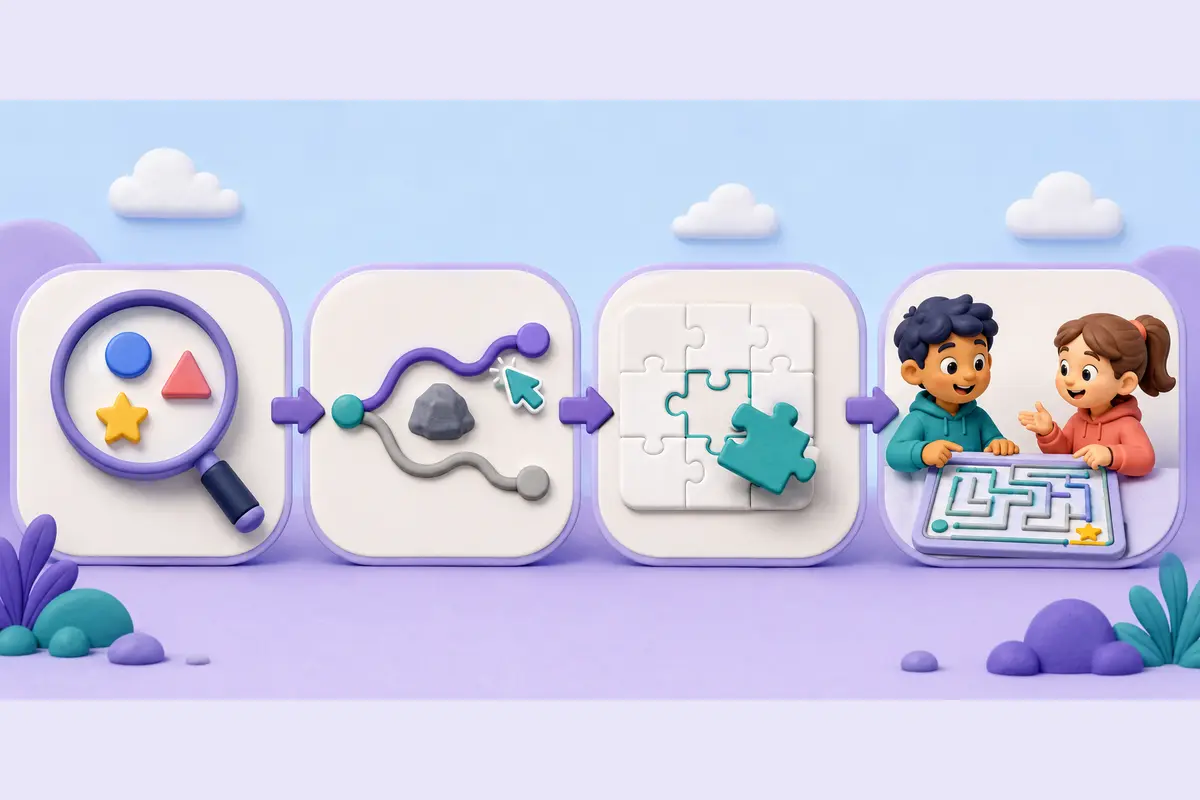
Notice the rule or clue
Before making a move, the learner identifies one relevant feature: a repeated shape, a blocked route, a required position, or a condition that must remain true.
Choose a strategy
The child decides what to try: sort the options, draw a route, work backward, test a smaller case, or eliminate an impossible choice.
Test one move
The learner acts and compares the result with the rule. Immediate feedback can help, but the child still needs to decide what the feedback means.
Explain the evidence
The learner names why the move worked, failed, or should be revised. A brief explanation such as “That path crosses the blocked square” is enough.
How to tell reasoning from guessing
A correct answer does not automatically reveal the method. A learner may have reasoned, recognized a familiar layout, copied a pattern of taps, or guessed.
Look for evidence that the child can:
- name or point to a rule
- reject at least one option for a reason
- predict what a move will change
- use feedback to revise the next attempt
- solve a similar problem when the surface details change
- explain part of the strategy in age-appropriate language
Repeated rapid tapping, using the same action regardless of the clues, or ignoring feedback suggests the task is no longer functioning as reasoning practice. Pause before adding more rounds.
What to do when the game is too hard
Change one source of difficulty at a time. You might reduce the number of choices, show the rule beside the puzzle, remove a secondary condition, allow pieces to be moved physically, turn off time pressure, or complete one example together.
If the learner still cannot begin, ask whether the obstacle is the reasoning, the reading, the controls, or the memory load. A child who understands the rule when it is spoken may need help reading the instruction. A learner who explains the correct move but cannot drag the piece may need interface practice rather than an easier puzzle.
What to do when the game is too easy
Add depth before adding speed. Ask for another valid solution, require a reason for each eliminated choice, hide one unnecessary clue, introduce a second condition, ask the learner to create a puzzle, or compare two strategies for efficiency.
A fast timer can change the task from reasoning to response speed. Use it only when speed is part of the intended skill and the learner already has an accurate strategy.
Using Focusplay for logic practice
Focusplay organizes learning games by grade level and learning area, including logic, math, memory, attention, language, creativity, and other available categories. Learners use short game rounds with clear goals and immediate feedback; authorized adults can review completed activity results and available progress information.
A parent or educator can use Focusplay within the same four-step routine:
- Before the round: open a grade-appropriate activity and name one reasoning action to watch for.
- During the round: let the learner make the decision, then ask for evidence if tapping becomes random.
- After the round: ask which clue, rule, or strategy helped most.
Explore the K–8 learning areas available in Focusplay, see how Focusplay works for families and schools, or use the Journal’s guide to solving math word problems with a visible routine.
Focusplay is a practice environment. A result from one game should not be treated as a diagnosis, a complete measure of reasoning, or proof of transfer to unrelated skills.
Five questions to ask after any logic game
- What was the rule or goal?
- Which clue changed your decision?
- What did you rule out first?
- What happened when your first plan did not work?
- Where else could the same strategy help?
Choose one or two questions, not all five after every round. The goal is to reveal thinking without turning play into an interview.
Frequently asked questions
What age can children start using logic games?
Children can begin with simple sorting, matching, and one-rule puzzles in kindergarten. The important question is not whether a game is labeled “logic,” but whether its rules, language, controls, and number of choices are accessible to that learner.
Should logic games be timed?
Usually not when a child is learning a new rule or strategy. Time can be added only when speed is genuinely part of the skill and the learner can already explain an accurate approach. Untimed play makes reasoning easier to observe.
What should I do when a child guesses repeatedly?
Pause the round and ask the child to name one rule, eliminate one impossible choice, or point to the clue that supports the next move. If the learner cannot do that, simplify one feature or demonstrate a smaller example before returning control.
Do logic games improve intelligence?
A logic game directly practices the reasoning required by that activity. Broader benefits should not be assumed from one game or score. Look for evidence that the learner can explain and reuse a strategy in a different problem.
How often should children play logic games?
A few short, focused sessions across the week can be a practical starting point. End while the learner is still reasoning, and revisit the activity later instead of extending a session after it has turned into random guessing.
The best logic game makes thinking visible
A useful logic game gives the learner enough information to make a decision and enough feedback to reconsider it. The adult’s role is not to announce every answer. It is to help the child notice the rule, choose a strategy, test one move, and explain the evidence.
Start with a challenge the learner can enter. Add one layer of complexity when the reasoning becomes secure. Stop when play turns into repeated guessing, and return another day.
The most informative moment is often not the correct finish. It is the sentence that begins, “I chose this because…”