How to Solve Math Word Problems: A K–8 Routine That Makes Thinking Visible
Use Read–Draw–Plan–Check to help children understand a math story, represent its relationships, choose a strategy, and test the answer—without relying on keyword tricks.

A child can calculate accurately and still feel lost when the same mathematics appears inside a story. Word problems ask the learner to coordinate reading, quantities, relationships, operations, units, and a final answer. When one part is unclear, guessing an operation may feel easier than making sense of the situation.
The goal is not to teach a rigid script that works automatically. It is to give the learner a dependable place to begin—and a way to notice when the answer does not fit the story.
Key takeaways
- Understand before calculating. The learner should name the question, known information, and unknown quantity.
- Represent the relationship. Objects, quick drawings, bar models, number lines, tables, and equations can reduce unnecessary mental load.
- Choose operations from meaning. Words such as “more,” “left,” or “each” are clues, not automatic commands.
- Keep units visible. A number without its meaning can hide a wrong answer.
- Check against the story. The learner should decide whether the answer is reasonable and actually answers the question.
Why keyword tricks break down
Lists that say “more means add” or “left means subtract” may produce a correct answer on a narrow set of examples, but they do not describe the relationship.
Consider: “Maya has 8 stickers. She has 3 more stickers than Leo. How many stickers does Leo have?” The word more appears, but finding Leo's amount requires thinking about which quantity is larger. A learner who automatically adds may answer 11.
Instead of asking, “Which keyword do you see?” ask:
- What is happening in the story?
- Which quantity is the whole, total, difference, group size, rate, or unknown?
- What would the answer tell us?
In the Common Core mathematics standards, early word problems include joining, separating, comparing, putting together, and taking apart—with the unknown in different positions. The standards also use objects, drawings, equations, number lines, tables, and visual fraction models across the grades. That variety is one reason meaning matters more than a single trigger word.
The Read–Draw–Plan–Check routine

1. Read: What is the problem asking?
Read the problem once for the situation and again for the mathematics. The child should say the question in their own words before touching a calculator or writing an operation.
Ask:
- What do you know?
- What are you trying to find?
- Which information has a number or measurable amount?
- What unit should the answer use?
If reading is the barrier, an adult can read the problem aloud without explaining how to solve it. This keeps the math task intact while separating it from decoding difficulty.
2. Draw: How are the quantities connected?
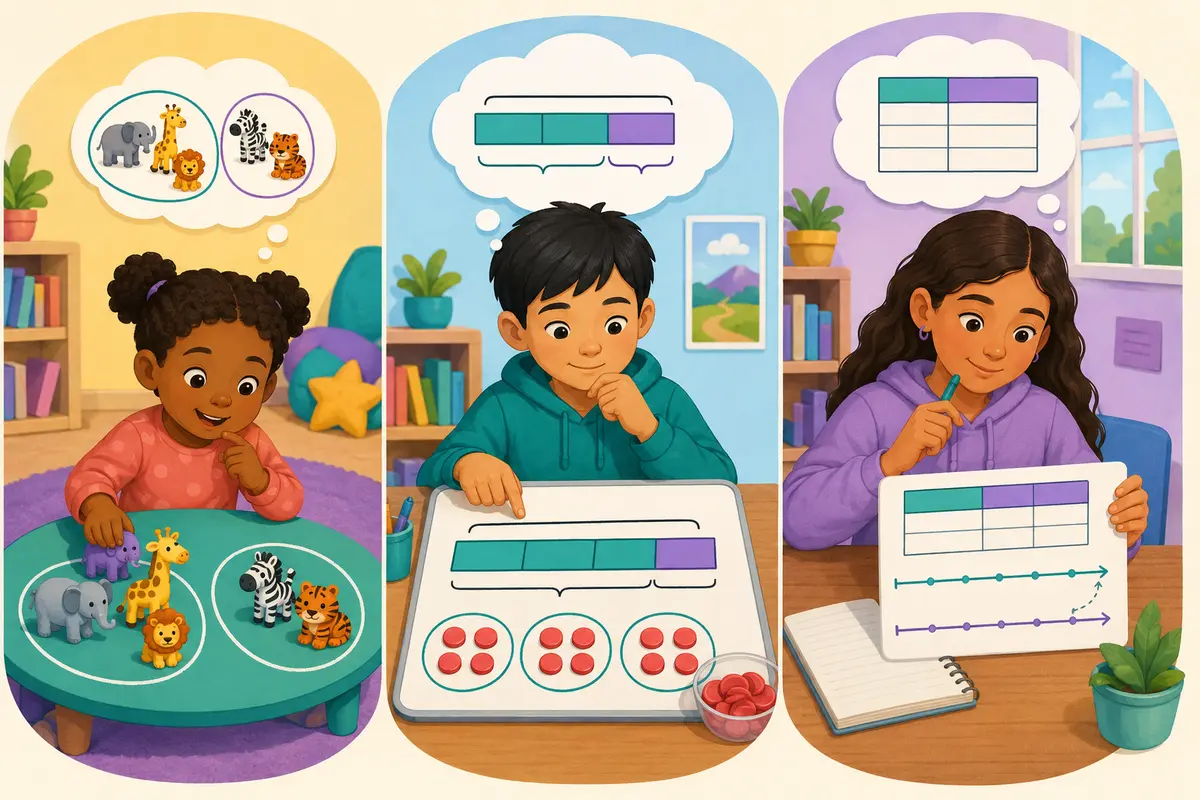
A useful drawing shows the mathematics, not every detail in the story. Five quick circles can represent five objects; equal boxes can represent groups; a bar can show a whole and its parts; a number line can show position or distance; and a table can organize two changing quantities.
The Institute of Education Sciences gives strong-evidence recommendations for teaching visual representations in Grades 4–8 problem solving. Its elementary mathematics guidance also recommends well-chosen concrete and visual representations. The model should make the relationship visible without adding decoration or irrelevant information.
3. Plan and solve: Which strategy fits the relationship?
After the model is visible, ask the learner to choose the operation, equation, or strategy. The important question is not only “What will you do?” but “Why does that fit?”
Possible strategies include:
- counting, joining, separating, or comparing
- using a related fact or decomposing a number
- multiplying equal groups or finding an unknown group size
- using a fraction model or number line
- building a ratio table or double number line
- writing an equation with a symbol or letter for the unknown
For Grades 4–8, IES also recommends exposing learners to multiple problem-solving strategies. That does not mean requiring several methods for every question. It means helping learners build options and choose among them.
4. Check: Does the answer fit the story?
Checking is more than repeating the same calculation. Return to the original question.
- Did you answer what was asked?
- Does the unit match?
- Should the result be larger or smaller than the starting quantity?
- Could an estimate rule out the answer?
- Can you substitute the answer into the relationship?
- If there is a remainder, what does it mean in this situation?
IES recommends helping students in Grades 4–8 monitor and reflect on their problem-solving process. A short explanation such as “I know it is reasonable because…” makes that monitoring visible.
What the routine looks like by grade band
| Grade band | Useful representations | Adult prompt |
|---|---|---|
| Kindergarten–Grade 2 | Objects, fingers, acting out, quick drawings, ten-frames, part–whole mats | “Can you show what is happening?” |
| Grades 3–5 | Arrays, bar models, equations with an unknown, number lines, fraction models | “Which quantity does each part of your model represent?” |
| Grades 6–8 | Ratio tables, double number lines, graphs, labeled diagrams, algebraic equations | “What stays constant, and what changes?” |
Kindergarten through Grade 2: act it out
Suppose: “There are 6 birds on a fence. Two fly away. How many remain?” The learner can place six counters, move two aside, and count the remaining group. Then connect the action to a drawing and finally to an equation.
Change the unknown to deepen the reasoning: “There were some birds. Two flew away, and four remained. How many were there at first?” The action is related, but the missing quantity is different. Avoid changing to a new keyword rule; let the objects reveal the relationship.
Grades 3 through 5: label the model
Suppose: “Four boxes hold 6 markers each. The class uses 5 markers. How many remain?” A learner can draw four equal groups, find the total, then remove five. Labeling each step helps preserve the meaning of the intermediate answer.
For fraction problems, identify the whole before drawing parts. Two fractions can be compared or combined only when their units and wholes are understood.
Grades 6 through 8: organize relationships
Suppose a recipe uses 3 cups of flour for 8 servings and the learner needs 20 servings. A ratio table or double number line can organize equivalent pairs. The learner can scale from 8 to 20, find a unit rate, or use an equation—then check whether the result is reasonable for more servings.
Older students should label units through each step. A correct calculation can still answer the wrong question or combine incompatible quantities.
How to help when a child is stuck
Start with the smallest useful prompt and stop once the learner can continue.
- “What is the question asking?”
- “Which quantity do you already know?”
- “Can you show the relationship with objects, a picture, a bar, a line, or a table?”
- “What does this part of your model mean?”
- “Which operation matches what is happening?”
- “Does the answer make sense in the story?”
If every step requires adult direction, the problem may be testing an unfamiliar concept, language structure, or representation. Teach a similar, simpler example and then return to the original problem.
Common errors and what to try next
| What you notice | Possible next step |
|---|---|
| The child selects every number and immediately calculates. | Ask for the unknown and a one-sentence summary before choosing an operation. |
| The drawing repeats the story but does not show the relationship. | Replace detailed artwork with circles, bars, groups, a number line, or a table. |
| The learner solves the first step and forgets why it matters. | Label the intermediate result with its unit and role. |
| The calculation is correct but the final answer is wrong. | Reread the last question and complete the sentence: “The answer means…” |
| The child guesses after one unsuccessful attempt. | Reduce the number size or model one similar problem, then return control. |
Using Focusplay alongside word-problem practice
Focusplay organizes short learning-game rounds by grade level and learning area. Depending on the activity, learners can practice number relationships, operations, logic, memory, attention, and other available skills with clear goals and immediate feedback.
A game round can support the component skills used in problem solving, but it does not automatically teach every learner to interpret written situations. Pair digital practice with conversation, drawings, objects, and written problems when word-problem understanding is the goal.
Before a round, choose one focus such as representing quantities or checking reasonableness. Afterward, ask the learner to explain one decision. Authorized adults can review completed results and available progress patterns, but one score should not be treated as a complete measure of problem-solving ability.
Explore Focusplay's K–8 learning areas, see how Focusplay works for families and schools, or use the help ladder for supporting a child without giving the answer. For reasonable-answer checks, try these number sense activities for K–8 learners.
Frequently asked questions
Should children circle key words in math word problems?
They may mark important information, but operation keywords should not replace understanding the situation. The same word can appear in different mathematical relationships, so the learner should explain what is happening before choosing an operation.
What should a child do first when solving a word problem?
First, state what the problem is asking in the child's own words. Then identify the known quantities and the unknown before calculating.
When should a child draw a model?
A drawing is useful when it clarifies the quantities and their relationship. Use quick circles, groups, bars, number lines, tables, or diagrams rather than detailed artwork.
How can an adult help without solving the problem?
Ask one focused question at a time, such as “What do you know?” or “What are you trying to find?” Provide the smallest prompt that lets the learner make the next decision.
Make the relationship visible
Word problems become more manageable when the learner can separate the story from the mathematical relationship. Read for meaning. Draw what matters. Choose a plan that fits. Check the result against the story.
The routine should become flexible, not mechanical. Over time, learners may combine steps or choose a representation mentally. What matters is that the operation comes from understanding—and that the final answer still means something in the situation.