How to Help a Child With Math Without Giving the Answer
When a child says, “I don’t know,” the kindest response is not always the fastest answer. Often, it is one small prompt that helps the thinking start again.
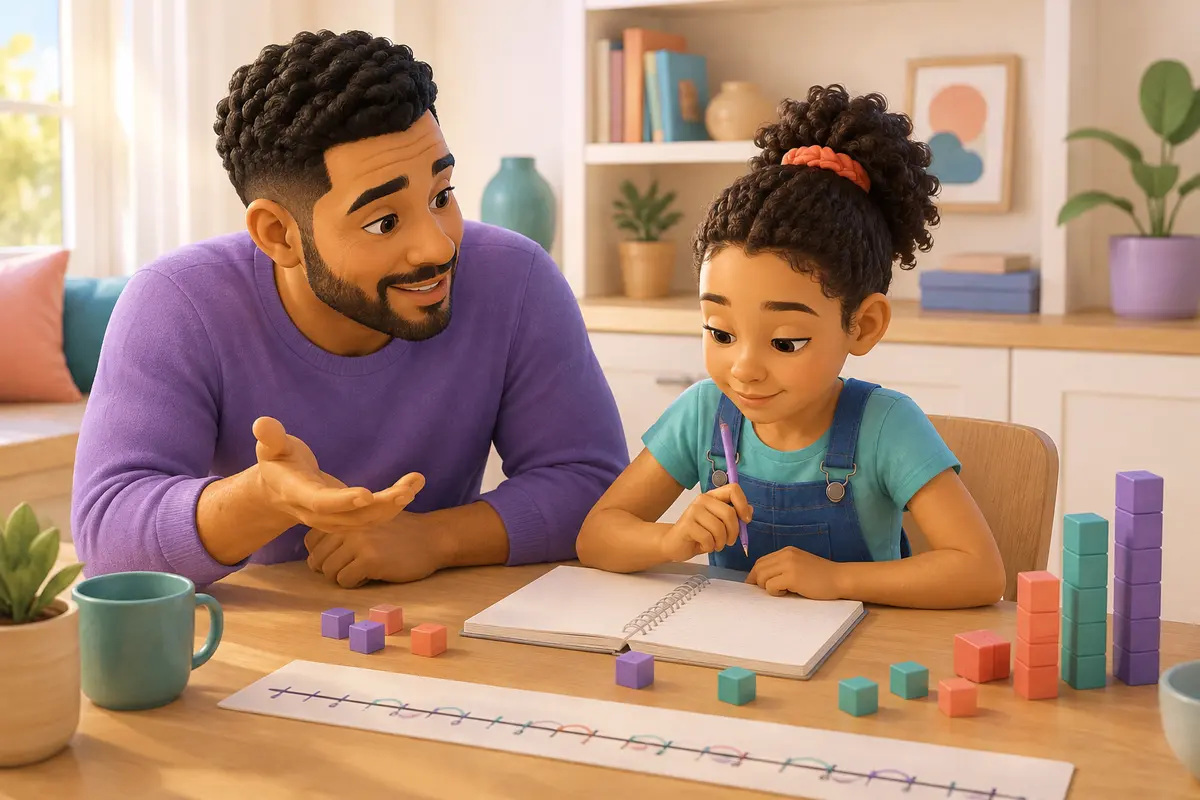
Picture the familiar moment: a worksheet, a game round, or a homework problem has stopped moving. You can see the answer almost immediately. Your child looks at you and waits.
Giving the answer would end the discomfort. But it can also turn the learner into a passenger. On the other hand, saying “try harder” and walking away can leave a child alone with a problem they do not yet know how to enter.
Why the kind of help matters
Useful support reveals what the learner is thinking. It does not simply produce a correct screen or a finished page. The U.S. Department of Education’s What Works Clearinghouse recommends clear mathematical language, visual and concrete representations, supportive feedback, and opportunities for students to explain their reasoning. Its grades 4–8 guidance also emphasizes helping learners monitor and reflect on how they solve problems.
That does not mean turning every ten-minute game into a formal lesson. In real life, one calm question is often enough.
Try: “What is the question asking you to find?”
The six-step help ladder
Begin at step one. Move up only if the learner still cannot continue.
Give thinking a little room
A pause is not always confusion. The child may be recalling a fact, comparing choices, or deciding what to try. Wait five or ten quiet seconds before filling the silence.
“Take your time. Tell me when you want one clue.”
Bring back the goal
Sometimes the math is manageable, but the learner has lost track of the task. Ask them to put the goal in their own words.
“What are you trying to find?” “Which part already makes sense?”
If the goal is unclear, restate it without solving it: “Find two numbers that make 12” keeps the decision with the child. “Choose 7 and 5” removes it.
Point to one important detail
Use a noticing question, not a stream of hints. Too many questions can create a second problem for the child to manage.
“What changed?” “Which information matters?” “Can you rule out one choice?”
Make the idea visible
When symbols are not enough, reach for counters, a quick sketch, a number line, an array, or a small table. The representation should reveal the relationship—not decorate the page.
“Would a picture, number line, or table help you see it?”
Make the doorway smaller
Cover information that is not needed yet, use a similar problem with smaller numbers, reduce the choices, or separate a multi-step problem into two questions.
For 8 × 7, you might ask: “What is 8 × 5? How could two more groups of 8 help?” The important reasoning still belongs to the learner.
Model one step, then hand it back
If the child does not have a strategy to begin, demonstrate one move aloud. Then return the next decision immediately.
“I’ll draw equal-size rectangles so the fractions are easier to compare. You decide how many parts each rectangle needs.”
What helpful feedback sounds like
“Wrong” tells a child almost nothing. Specific feedback gives them something to work with.
- “You chose the right operation. Let’s check the calculation.”
- “That strategy worked for the first step. What comes next?”
- “You changed your answer after checking the pattern.”
- “Show me where it stopped making sense.”
- “The game marked that choice incorrect. What can we use from that feedback?”
An incorrect response may come from the math, the reading, the controls, a rushed tap, or working-memory load. One mistake does not tell you which one.
Adjust the language by age
Kindergarten through Grade 2
Keep prompts short and concrete: “Touch each object as you count.” “Which group has more?” “Can you show it with your fingers?” First check that the learner knows how to select, drag, match, or submit—the interface can look like a math problem.
Grades 3 through 5
Connect models, facts, and operations: “Could an array help?” “What related fact do you know?” “Can you estimate first?” Ask for an explanation after some correct answers too, so questions do not feel like a sign of failure.
Grades 6 through 8
Use collaborative planning questions: “What is known?” “Which strategy is most efficient?” “Does that answer seem reasonable?” Older learners may reject support that feels childish, so offer choices and protect their ownership.
When to step in—and when to wait
Step in when the learner is repeatedly guessing, cannot explain the goal, makes the same error several times, is blocked by the controls, or becomes too frustrated to use a strategy. Wait when they are quietly examining the problem, testing a reasonable idea, correcting themselves, or asking to try again alone.
Using the ladder with Focusplay
Before a round, choose an activity from the learner’s grade-appropriate catalog and name one goal. During the round, let the game give immediate feedback; if help is needed, start at the lowest rung. Afterward, ask one question: “What strategy helped?” or “Where did you begin guessing?”
If you are unsure about difficulty, read How to Choose Math Games by Grade Level. Focusplay’s authorized adult view can help families and educators notice patterns across completed activities, but a score should be treated as information—not a label.
The rule to remember: help, then release
Give room to begin. Ask one focused question. Make the idea visible if needed. Model only enough to reopen the path. Then return the next choice to the child.
The goal is not perfect independence today. It is helping the learner need a little less support when a similar challenge appears tomorrow.
Explore grade-appropriate learning games