12 Number Sense Activities at Home for K–8 Learners
Help children understand what numbers mean—not only how to follow a calculation—with practical activities for quantities, fractions, integers, ratios, and percentages.
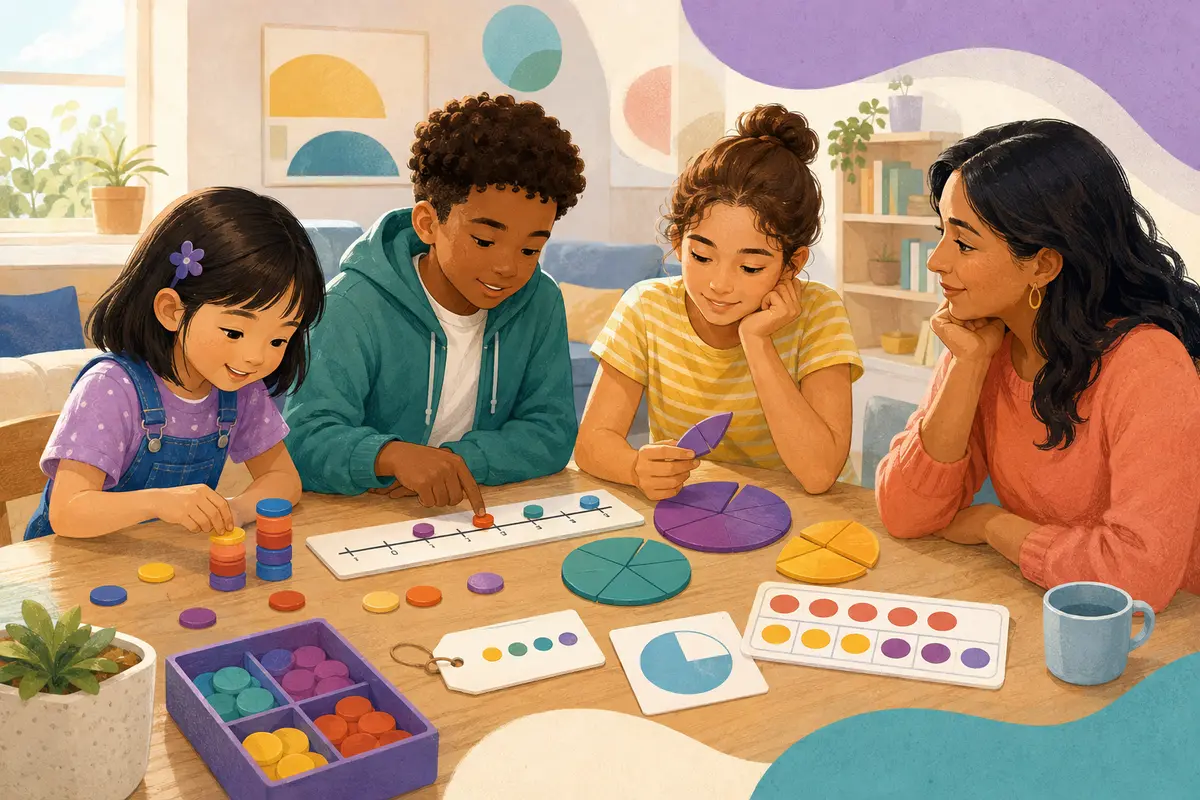
A child calculates 48 + 27 and writes 615. Another follows a fraction procedure but cannot tell whether the answer should be greater or less than one. A middle school learner finds a sale price with a calculator but does not notice that the “discounted” price is higher than the original.
These errors do not always mean the child needs more calculation practice. Sometimes the missing piece is a stronger sense of what numbers represent and how they relate to one another.
It helps a learner notice that 48 plus 27 should be near 75—not 615; one-half is greater than one-third; -8 is farther below zero than -3; 25% is one-fourth; and a unit price of $3 is better than $4 for the same item.
What number sense looks like across the grades
| Grade band | Useful number relationships |
|---|---|
| Kindergarten–Grade 2 | Counting accurately, comparing quantities, composing and decomposing numbers, making ten, and understanding place value |
| Grades 3–5 | Estimating, connecting operations, recognizing factors and multiples, comparing fractions and decimals, and checking answers |
| Grades 6–8 | Reasoning with signed and rational numbers, ratios, rates, percentages, exponents, and proportional relationships |
The Common Core State Standards reflect this progression. Kindergarten begins with counting, cardinality, comparison, and representing addition and subtraction. Elementary grades extend these ideas into place value, operations, fractions, and decimals. Grades 6–8 apply number relationships to rational numbers, ratios, rates, percentages, and algebraic reasoning.
Why flashcards are not enough
Quick recall of useful facts can support mathematical fluency. However, remembering that 6 × 7 = 42 is different from understanding when multiplication is appropriate, how 42 relates to nearby numbers, or whether an answer of 420 makes sense.
The Institute of Education Sciences recommends systematic instruction that uses clear mathematical language, visual and concrete representations, number lines, word problems, and supportive feedback. Its guidance for Grades 4–8 also recommends visual representations, multiple problem-solving strategies, and reflection on the solving process.
That does not require turning every home activity into a formal lesson. A five-minute conversation can be useful when the child is making the decisions.
Kindergarten through Grade 2
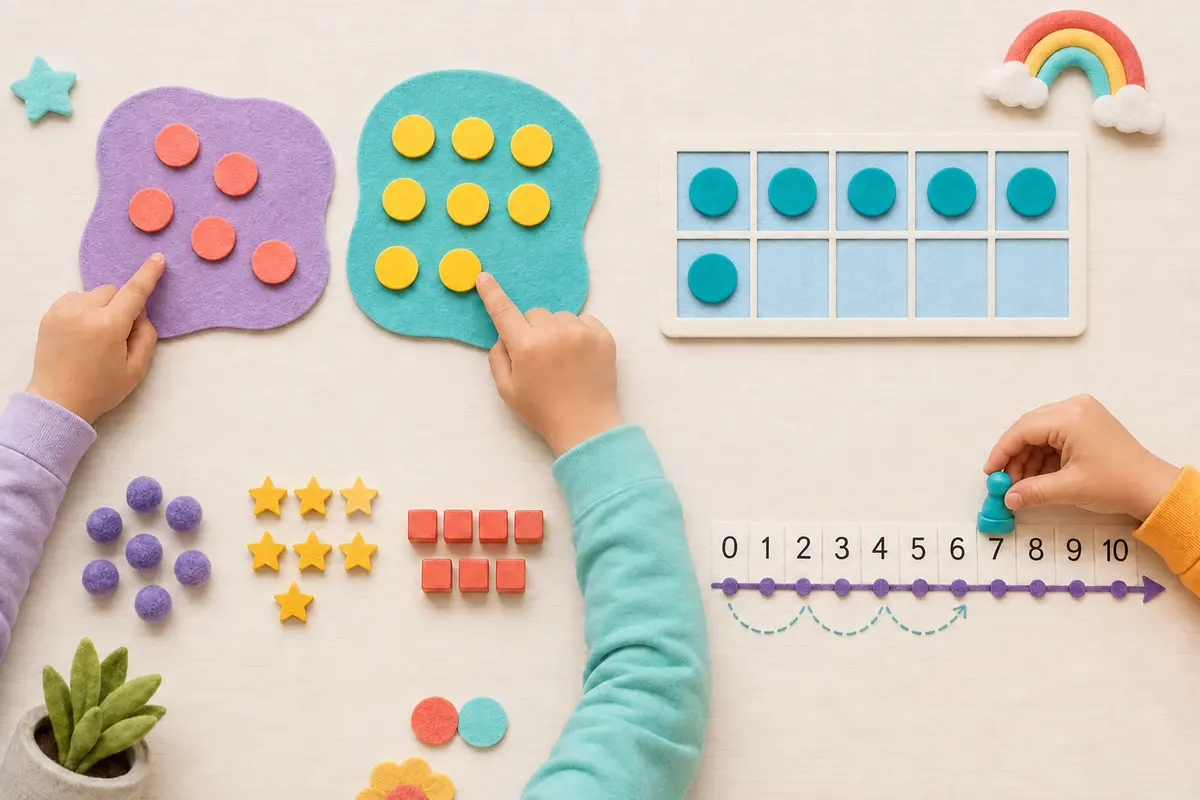
1. Which group has more?
You need: Two small groups of safe household objects such as blocks, buttons, spoons, or toy animals.
Before counting, ask: “Which group do you think has more? What makes you think that?” Then let the learner count or match objects one-to-one.
Spread one group into a long line and keep the other close together. Ask whether the number changed when the objects moved, how the learner could prove which group has more, and how to make the groups equal. The purpose is to connect visual impressions with counting and comparison.
2. Build the same number three ways
Choose a number such as 7. Ask the child to show it using counters, fingers, a drawing, 5 + 2, and 8 - 1. Then ask: “What stayed the same even though the picture changed?”
For Grade 1 or 2, show 34 as three tens and four ones, two tens and fourteen ones, 30 + 4, and 40 - 6.
3. Make-ten search
Choose a number from 1 through 9 and ask what must be added to make 10. Place six counters on a ten-frame, ask how many spaces remain, and record 6 + 4 = 10.
Later ask: “If 6 needs 4 to make 10, how could that help with 6 + 5?” For Grade 2, extend the relationship to making 20, 50, or 100.
4. Walk a number line
Create a floor number line with paper cards or removable tape. Ask the child to stand on 4, move two spaces forward, move one backward, find the number between 6 and 8, and show which number is closer to 10.
Subtraction does not always mean “going backward”; it can also describe comparison or a missing part. Use the line as one representation among several.
Grades 3 through 5
5. Estimate before calculating
Use an ordinary situation: the cost of three items, pages read during a week, or the total in several groups. Before calculating, ask: “What would be a reasonable answer?”
A learner might round 48 + 27 to 50 + 30 and predict a result near 80. Afterward ask whether the exact answer is close, what to check if it is not, and whether the estimate was high or low.
6. Place-value switch
Write 4,306. Ask for the value of the 4, what happens if the 4 and 3 switch places, which number is larger, and how to represent the original as 4,000 + 300 + 6.
For decimals, compare 3.5, 3.05, and 3.50. Discuss why adding a zero at the end of 3.5 does not change its value, while placing the zero between the decimal point and 5 does.
7. Array detective
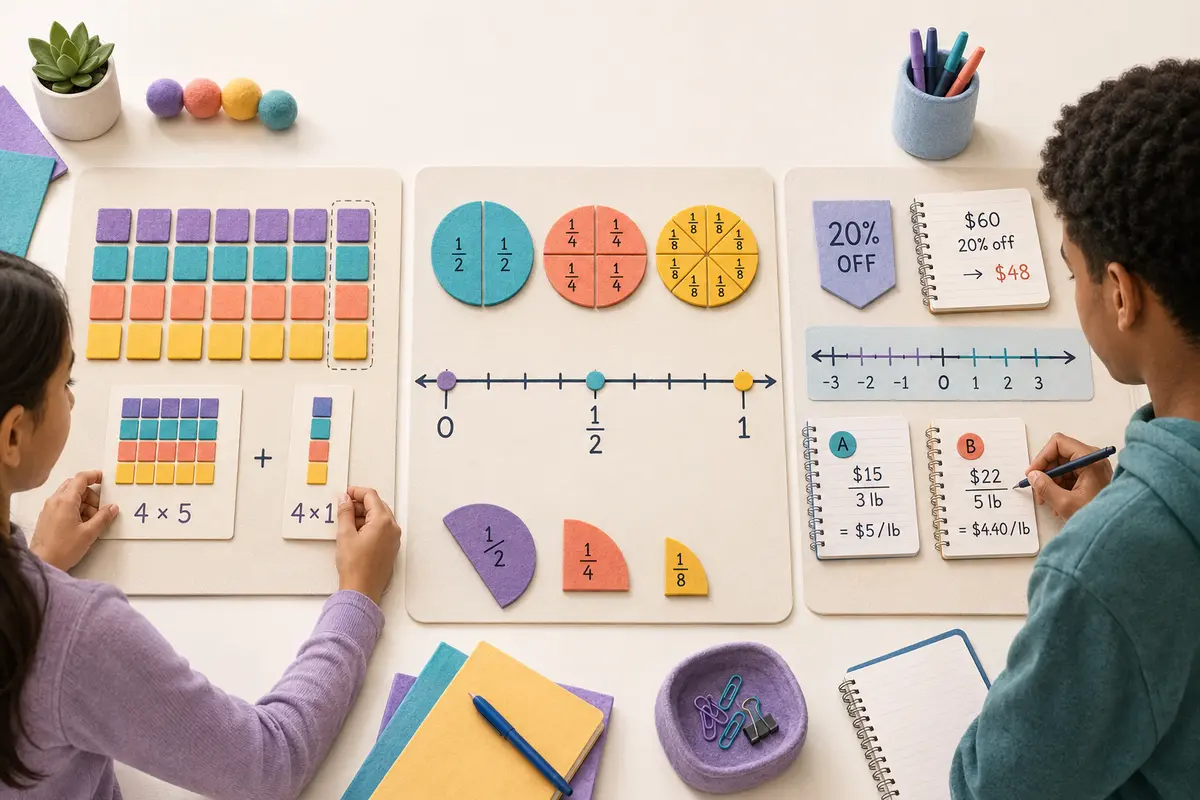
Arrange objects in four rows of six. Ask which multiplication and division equations describe it and how it could be broken into easier parts. A learner might see 4 × 6 = (4 × 5) + (4 × 1).
Turn the array to show that 4 × 6 and 6 × 4 have the same product while describing differently oriented groups.
8. Fraction benchmark challenge
Compare fractions with 0, one-half, and 1. Is 3/8 less than one-half? Is 7/8 closer to one-half or 1? Which is greater: 4/5 or 5/8? Could 9/10 + 8/10 be less than 1?
Use fraction strips, drawings, or a number line before introducing a common-denominator procedure. Ask whether the learner can decide without calculating the exact decimal.
Grades 6 through 8
9. Percent benchmark challenge
Use familiar relationships: 50% is one-half, 25% is one-fourth, 10% is one-tenth, and 1% is one-hundredth.
Estimate 25% of 80, 10% of 340, 15% of 60, or a 20% discount on $45. For 15% of 60, combine 10% (6) and 5% (3) to get 9. Then compare the estimate with the exact calculation or calculator result.
10. Integer distance
Draw a number line with positive and negative numbers. Ask which is greater, -3 or -8; how far each is from zero; and the distance between -4 and 2.
Be precise: as negative numbers move left, their absolute values become larger but their numerical values become smaller.
11. Unit-rate comparison
Compare six notebooks for $12 with eight notebooks for $20. Ask what each option costs for one notebook, which is the better price, and how the relationship could be shown in a table.
Other contexts include miles per hour, price per ounce, points per game, or ingredients per serving. Grade 6 standards specifically include ratio reasoning, unit rates, equivalent-ratio tables, double number lines, unit pricing, and percentages.
12. Error detective
Give the learner an incorrect solution such as 3/4 + 1/2 = 4/6, 20% of 50 = 100, or -4 + 7 = -11.
Ask what looks reasonable, where the first incorrect decision occurs, whether an estimate could reveal it, and how to represent the relationship another way. Error analysis shifts the task from producing an answer to evaluating reasoning.
How to adjust the difficulty
Change one feature at a time. To make an activity more accessible, use smaller numbers, restore objects or a number line, reduce the steps, keep information visible, remove time pressure, or ask one clear question.
To increase challenge, use fractions or negative values, request two strategies, ask for an estimate before an exact answer, invite the learner to create an example, or introduce a misleading answer that must be evaluated.
What number-sense practice should not become
Avoid turning every activity into a speed test. A slow response may contain strong mathematical thinking. A quick answer may come from understanding, memorization, guessing, or an interface pattern; speed alone does not reveal which.
Avoid correcting before hearing the strategy, insisting on mental calculation when written work would help, teaching tricks without meaning, praising only correct answers, or continuing after the learner shifts into repeated guessing.
Using Focusplay to support number relationships
Focusplay organizes learning games by grade level and learning area. Depending on the activity, learners encounter short rounds, clear goals, immediate feedback, familiar controls, visual supports, and grade-matched difficulty.
Before a round, name one relationship to notice. During the round, let the game provide feedback and pause repeated guessing with an estimate, representation, or explanation. After the round, ask which relationship helped or how the learner knew an answer was reasonable.
Authorized adults can review completed game results, time spent, and available skill progress to notice patterns over time. One score should not be treated as a diagnosis or a complete measure of number sense.
Explore the K–8 learning areas, learn how Focusplay works, or read How to Help a Child With Math Without Giving the Answer.
A realistic five-minute routine
- Monday: Compare two quantities or numbers.
- Tuesday: Represent one number in several ways.
- Wednesday: Estimate before calculating.
- Thursday: Place a fraction, decimal, percentage, or integer on a number line.
- Friday: Find and explain an incorrect answer.
Choose examples that match the learner’s grade and current instruction. Five attentive minutes can be more informative than a long session filled with guessing or conflict.
When to talk with the teacher
Speak with the learner’s teacher when the child persistently cannot connect written numbers with quantities, struggles to compare numbers despite visual support, confuses place value, cannot estimate an approximate answer, or applies procedures without recognizing clearly unreasonable results.
The teacher can compare home observations with classroom instruction, grade-level expectations, and performance across different tasks.
Build relationships, not just answers
Number sense develops when children repeatedly ask: How much? Which is greater? How close? What changed? What stayed the same? Is this result reasonable? Can I represent it another way?
The goal is not to replace accurate calculation. It is to help the learner understand what the calculation means—and notice when an answer cannot possibly be right.