GATE Program Identification in California: How Students Are Selected
GATE program identification in California is decided district by district, so the grade, test, and deadline that matter for your child depend on where you live. This guide explains the three building blocks most districts use—universal screening, referrals, and multiple criteria—with real 2026–27 examples and the questions to ask your own district.

- Who sets the rules
- Each district (“local control,” per the California Department of Education)
- State funding
- No separate GATE funding since the 2013–14 Local Control Funding Formula
- Common entry points
- Universal screening of a whole grade; referrals by teachers, parents, or staff
- Grades screened (examples)
- Grade 2 (San Diego), grades 2 and/or 4 (Long Beach), grades 1 and 3 (Sacramento City), grade 3 (Tustin)
- Common tests
- CogAT, Naglieri tests, OLSAT—chosen by each district
- Final decision
- Usually a committee review of multiple measures, not one score
How are students identified for GATE in California?
Students are identified for GATE in California through a process each district designs for itself, usually combining a screening or referral step with a review of several kinds of evidence. There is no statewide test, grade, or cutoff. The California Department of Education (CDE) says GATE is under “local control,” so “each district can set its own guidelines and policies regarding identification and enrollment procedures.” (CDE page last reviewed December 5, 2025; checked November 8, 2026.)
That has been true since 2013, when the Local Control Funding Formula folded GATE money into general district funding; in 2014, SB 971 repealed the old GATE sections of the Education Code, according to CDE. Our parent guide to what a GATE program is covers that history and the service models in more detail.
Even without state rules, most district processes follow the same three-part pattern:
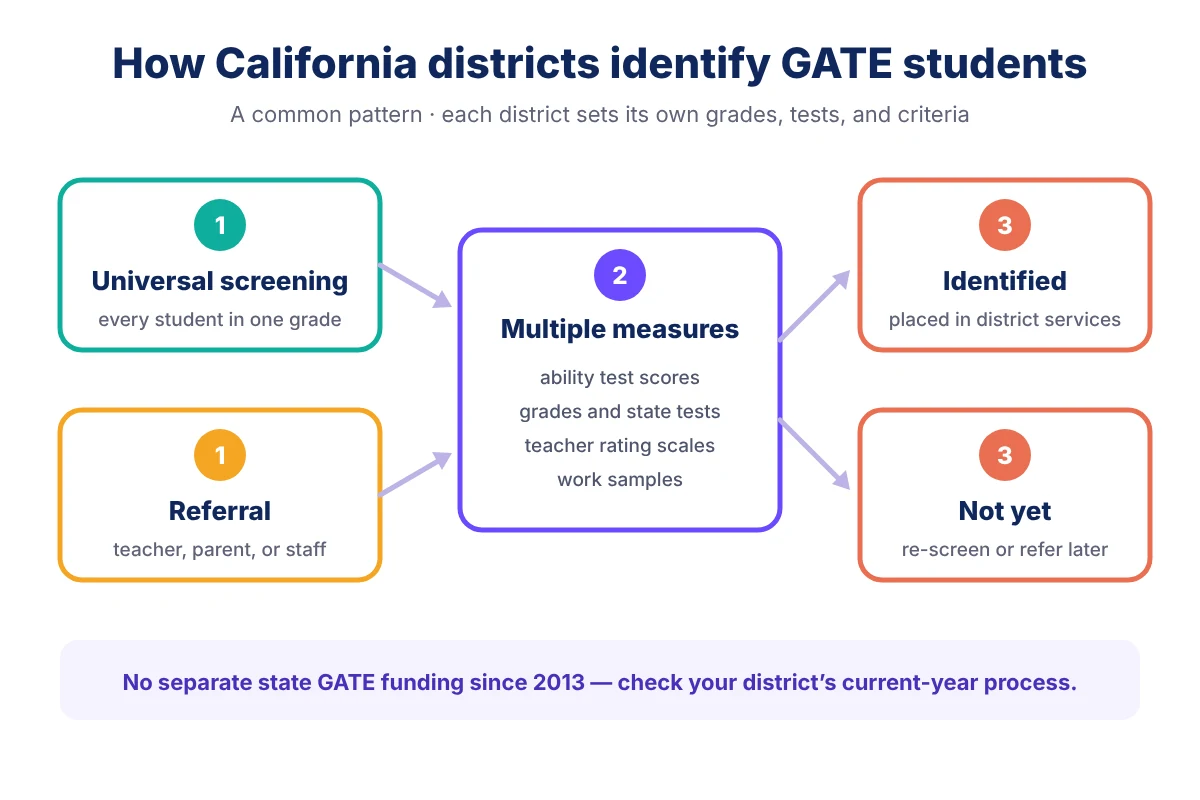
- An entry point—every child in one grade is screened, or a child is referred.
- A multiple-measures review—test scores are combined with other evidence.
- A decision—the child is identified for services, or can be screened or referred again later.
Universal screening: who gets tested and when
Universal screening means a district gives a short ability test to every student in a chosen grade, not only to children someone has referred. It is the most common starting point in larger California districts, but the grade and the test differ widely. These examples come from each district’s own GATE page:
| District | Universal screening | Test named | Year verified |
|---|---|---|---|
| San Diego Unified | All 2nd graders, testing window typically late January–February | CogAT Screener | Page checked Nov 7, 2026 |
| Long Beach Unified | Once in grade 2 and/or grade 4 | CogAT, plus other measures | 2026–27 (page notes “revisions pending”) |
| Sacramento City Unified | All 1st and 3rd graders, in January | CogAT Form 7 | 2025–26 (latest posted) |
| Tustin Unified | All 3rd graders, September 28–October 13, 2026 | Naglieri General Ability Tests (NGAT) | 2026–27 |
| Conejo Valley Unified | Spring of 2nd grade (late April–early June 2027) | Computer-based screening; district links to CogAT score guides | 2026–27 |
For what each of these tests measures and how they compare, see our GATE test guide. Two practical points stand out. First, timing ranges from early fall to late spring, so a family that waits for “testing season” can miss a window. Second, some districts screen twice: Sacramento City screens both grade 1 and grade 3, and Long Beach screens in grade 2, grade 4, or both. If you are new to the screener itself, our explainer on what a gifted screener is walks through how short screening tests differ from full evaluations.
Referrals: how teachers and parents nominate students
A referral is a request—from a teacher, parent, counselor, or administrator—that the district screen a particular child, usually in a grade that is not universally screened or for a student who is new to the district. Referral rules are where districts differ most (our GATE referral guide covers forms and what to write), and deadlines are firm:
- Tustin Unified says students in 4th and 6th grades “may be referred for GATE screening by a teacher, parent, counselor, or administrator,” and those grades take the OLSAT 8. Consent forms for the fall 2026 cycle were due September 21, 2026, and the district says late forms will not be accepted.
- Conejo Valley Unified accepts referrals for grades 4–12 and for new 3rd graders who missed universal screening. Parent referrals for 2026–27 were due November 3, 2026, with screening from December 1, 2026, to January 15, 2027.
- Sacramento City Unified accepted 2025–26 screening request forms for new students and for students in grades 1–6 who live in the district but do not attend its schools, with deadlines of January 31 and March 31.
Two rules catch many families off guard. Several districts do not accept private testing in place of their own screening: Sacramento City says privately obtained screening results are not accepted, and Tustin says “private IQ test results are not accepted for the GATE screening process.” And CDE notes that public districts are not required to test or serve students who attend private schools, although some do—Tustin, for example, offers a private-school testing date for residents in grades 3, 4, and 6.
If you plan to refer your child, ask for the form early, note the deadline, and include concrete examples of how your child learns: the books they choose, the problems they invent, or the projects they pursue on their own.
Multiple criteria: what evidence counts besides the test
Multiple criteria means the district looks at more than one kind of evidence before deciding, so a single test score is rarely the whole story. CDE says “best practices support using more than one factor to identify GATE students” and lists achievement and test scores, motivation, recommendations, classroom observations, and portfolios as examples.
Here is how that looks in practice in 2026:
- Long Beach Unified lists the CogAT alongside achievement reports, grade-level district assessments, state test results, and teacher observation using a Traits, Aptitudes, and Behaviors (TABs) rating.
- Tustin Unified uses two stages: students who do well on the ability test move to a second stage where “academic data, performance on critical thinking work samples and teacher feedback” are reviewed by site and district committees.
- Sacramento City Unified does not use a combined score: “Composite scores are not considered. Each domain (Verbal, Quantitative, and Non-Verbal) is considered independently,” and the district uses local norms.
- San Diego Unified starts from the CogAT Screener score and can add matrix points for strong report card or state test results and for factors such as English learner or low-income status.
Two terms in that list deserve a closer look. A matrix is a points chart that turns several measures into one total, so a child slightly below a test threshold can still qualify with strong classwork. Local norms compare a child with students in the same district or school instead of a national sample. In a ten-state analysis published in AERA Open, Peters and colleagues (2019) found that moving from national to school-level norms roughly quadrupled the representation of Black students and nearly tripled that of Hispanic students in gifted identification, though both groups remained underrepresented. Scores, percentiles, and cutoffs get their own article later in this series; for the basics of percentile ranks, see our gifted testing guide.
A typical GATE identification year, step by step
A typical California GATE cycle runs most of a school year, from consent forms to placement letters. Using the 2026–27 calendars published by Tustin, Conejo Valley, and Sacramento City as a guide, the steps usually look like this:
- Notice and consent (fall or early spring). Schools send screening notices; some districts require signed consent, others use an opt-out form.
- Referral window. Parents and teachers submit referral forms for grades not universally screened.
- Screening. Students take a group ability test at school, often on a computer or tablet, in about 30–60 minutes.
- Review. The district scores the test and gathers other evidence; a committee reviews each student’s profile.
- Letters. Families are notified—Tustin in mid-January 2027; Conejo Valley after the last week of school; Sacramento City in late May to June.
- Placement. Identified students are placed in the district’s GATE services, sometimes with a separate application for special programs.
Retesting, transfers, and other rules to know
Retesting and transfer rules are set locally too, and they decide what happens after a first screening. A few current examples:
- Waiting periods: Conejo Valley says its computer-based platform “requires a minimum of 12 months between screening sessions.”
- Limits: Tustin says students “may screen a maximum of 3 times in TUSD for GATE.”
- Illness: Sacramento City reschedules tests for illness but says reassessment requests based on illness are not valid after a student tests.
- Transfers: CDE says a new district does not have to recognize identification from another district. Long Beach reviews the previous district’s procedures to see whether they match its own; Sacramento City asks for documentation such as a district letter or results.
Where a district does not publish a rule—Long Beach does not list a retest policy, for example—ask the GATE office directly rather than relying on forums or older handouts.
What GATE screening questions can look like
Most GATE screeners ask children to spot rules in shapes, numbers, or words rather than recall school facts. These two items show the general style so the format feels familiar; they are not a predictor of any score.
Original FocusPlay practice items—not real test questions. They are not taken or adapted from any test publisher, prep book, or forum.
1. What comes next? (figure series)
Read aloud: “Look at how the shapes change from box to box. Which shape comes next?”
Text description: A triangle, then a square, then a pentagon, then ?. Choices: A circle, B hexagon, C triangle, D square.
Show answer
Answer: B — the hexagon. Each shape has one more side than the one before: 3, 4, 5, so the next shape has 6 sides. A circle has no straight sides, and the triangle and square repeat earlier shapes.
2. What number comes next? (number series)
Read aloud: “Look at how much the numbers grow each time. What number comes next?”
1, 2, 4, 7, 11, ?
- A. 15
- B. 14
- C. 22
- D. 16
Show answer
Answer: D — 16. The jumps grow by one each time: +1, +2, +3, +4, so the next jump is +5, and 11 + 5 = 16. Doubling does not work, because 4 doubled is 8, not 7.
For more original examples by test type, see our CogAT test guide, the NNAT3 guide, and CogAT practice questions for 2nd grade.
Questions to ask your district about GATE identification
The fastest way to understand your own district’s process is to ask a short list of specific questions early in the school year:
- Which grade is universally screened this year, and when is the testing window?
- Which test is used, and are subtests considered separately or as a composite?
- Can parents refer, for which grades, and what is the deadline?
- What other evidence is reviewed—grades, state tests, teacher ratings, work samples?
- Does the district use local norms or a matrix?
- How soon can a student be screened again, and how are transfer students handled?
- What GATE services are offered at our school once a student is identified?
At home, the best preparation is light and playful: puzzles, pattern games, reading together, and talking through how your child solved something. FocusPlay’s learning games, logic games, and pattern recognition activities build those reasoning habits in a few minutes a day. A GATE decision reflects one process on one day in one district—it does not define your child’s abilities or worth, and many children are identified later or thrive with challenge in the regular classroom.
Frequently asked questions
How are students identified for GATE in California?
Each district sets its own process. Most combine universal screening of one grade or referrals by teachers and parents with a review of several measures, such as an ability test, grades, state test results, teacher rating scales, and work samples. Check your district’s GATE page for the current year.
What grade is GATE testing in California?
There is no statewide grade. As of the 2026–27 school year, San Diego Unified screens all second graders, Long Beach Unified screens in grade 2 and/or grade 4, Sacramento City Unified screens grades 1 and 3, and Tustin Unified screens all third graders. Many districts also test other grades by referral.
Can a parent refer a child for GATE testing?
In many districts, yes. Districts such as Conejo Valley and Tustin accept parent referrals for certain grades during a set window, and late forms may not be accepted. Ask your school or the district GATE office for the form and the deadline.
Is there a statewide GATE cutoff score in California?
No. California ended separate state GATE funding in 2013 and repealed the old GATE statutes in 2014, so each district chooses its own tests, criteria, and cutoffs. A cutoff published by one district does not apply anywhere else.
Do California districts accept private IQ test results for GATE?
Often not. Sacramento City Unified says privately obtained screening results are not accepted, and Tustin Unified says private IQ test results are not accepted for its GATE screening. Ask your district before paying for private testing.
Can my child be tested for GATE again?
Usually, but rules vary. Conejo Valley requires at least 12 months between screenings on its computer-based platform, and Tustin allows up to three GATE screenings. Ask your district when the next screening or referral window opens.
Does GATE identification carry over to a new California district?
Not automatically. The California Department of Education says each district sets its own identification rules, so a new district may accept prior identification, review your documents, or ask your child to be screened again.
Sources
- California Department of Education: Gifted and Talented Education (last reviewed December 5, 2025)
- California Department of Education: GATE program and funding FAQ (historical)
- San Diego Unified School District: GATE assessment
- Long Beach Unified School District: GATE identification and testing
- Sacramento City Unified School District: Gifted and Talented Education
- Tustin Unified School District: GATE
- Conejo Valley Unified School District: Gifted and Talented Education (GATE)
- Card, D., & Giuliano, L. (2016). Universal screening increases the representation of low-income and minority students in gifted education. PNAS, 113(48).
- Duke University: summary of Peters, S. J., Rambo-Hernandez, K., Makel, M. C., Matthews, M. S., & Plucker, J. A. (2019). Effect of local norms on racial and ethnic representation in gifted education. AERA Open, 5(2).
Last updated: November 8, 2026, by the Focusplay Editorial Team. District details verified on November 7–8, 2026, from each district’s GATE page for the 2026–27 school year where published (Sacramento City’s latest posted calendar is 2025–26). This article is for information only and is not affiliated with or endorsed by any school district, state agency, or test publisher. GATE rules change every year; confirm current details with your district.
Explore Focusplay learning games