What Is a Gifted Screener? How Schools Decide Who Gets a Closer Look
Many districts start gifted identification with a short test for a whole grade. Here is what that screener does, which tests are common, how cut scores work, and what to ask if your child is just below the line.
- Purpose
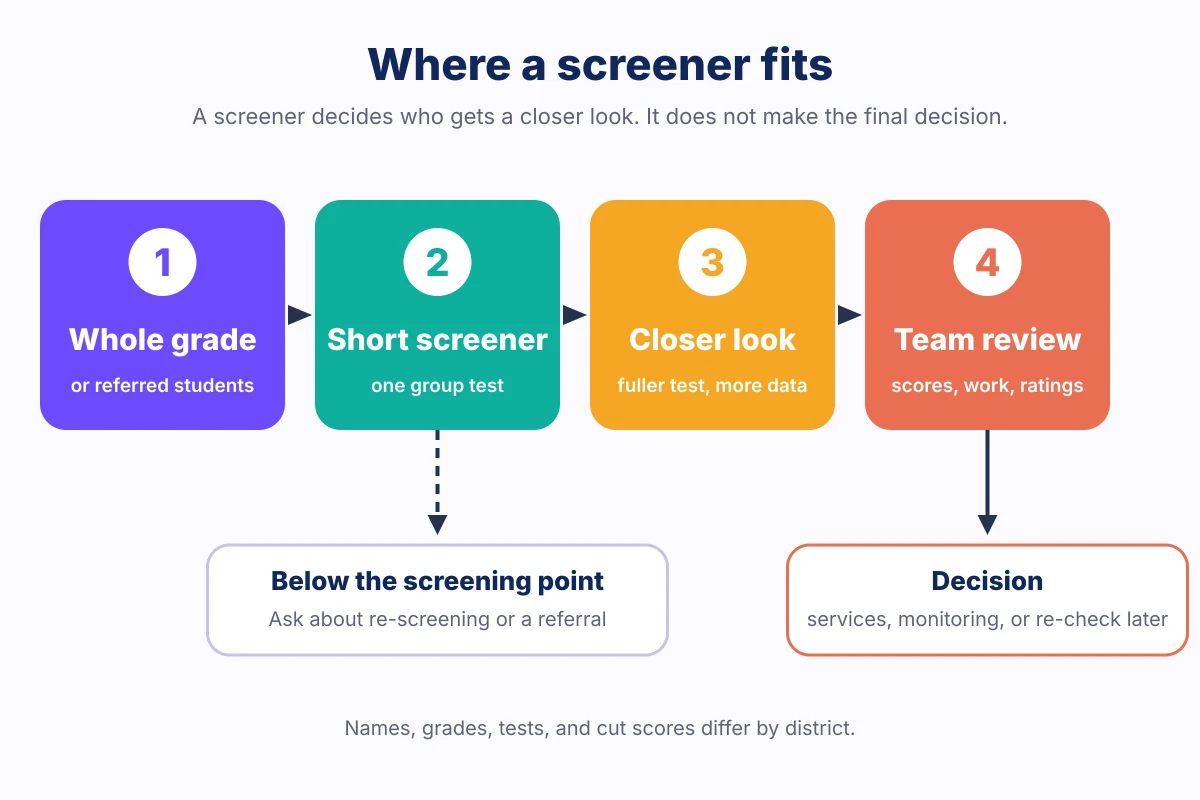
- Decide who gets a closer look; not to make the final placement
- Who takes it
- A whole grade (universal screening) or referred students
- Grades
- Set by each district; often an early elementary grade, such as grade 2
- Format
- Group test, online or paper, usually in one sitting
- Examples
- CogAT Screener (three subtests), NNAT3 (48 items, about 30 minutes)
- Result
- One overall score, compared with a screening point set by the district
- Next step
- Fuller ability test, achievement data, rating scales, and a team review
What a gifted screener is—and what it is not
Gifted identification usually happens in stages. A screener is the first gate: a quick, inexpensive way to look at many students so that a smaller group can be studied in more depth. Think of it like a hearing check at school. It is designed to flag children who need a closer look, not to give a full diagnosis.
That has two practical consequences for families. First, a high screener score rarely means a child is “in.” It usually means the child moves to the next step. Second, a lower score does not have to be the end of the road. State guidance often says so directly. New Jersey tells districts they “must use multiple measures” and that no single result should disqualify a student, and North Carolina’s program standards say that “No one criterion should exclude a child.”
For the full identification process, from screening to decision, see our guide to gifted testing for parents.
Universal screening vs. referral
There are two common ways a child reaches the screening step.
- Referral: a teacher or parent nominates a child, and only nominated children are tested.
- Universal screening: every student in a chosen grade takes the screener, whether or not anyone nominated them.
The difference matters. A widely cited study of a large Florida school district found that when the district began screening all second graders with a nonverbal ability test, identification rose sharply among students from low-income families, English learners, and Black and Hispanic students. The authors concluded these groups had been “underreferred” when the district relied on parent and teacher referrals (Card and Giuliano, PNAS, 2016). A study of rural districts that screened every second grader and used local norms also identified more minority students than the districts’ usual process, as summarized by the Thomas B. Fordham Institute.
Many districts now combine both routes: they screen a whole grade and still accept referrals for older students, new students, or children who were missed. North Carolina’s standards also recommend several screening windows during the year, so one missed day or one off morning does not decide everything.
Common gifted screening tests
Districts choose their own tools. These are the kinds you are most likely to see in a school notice.
| Screener | What it uses | Format | What happens next |
|---|---|---|---|
| CogAT Screener (Riverside Insights) | Three subtests: Picture or Verbal Analogies, Number Analogies, Figure Matrices | Group test; one combined score | Often the rest of the CogAT, or a review |
| NNAT3 (Pearson) | Shape-and-color matrix puzzles; no reading | 48 items, about 30 minutes, online or paper | Often a fuller test or more evidence |
| Naglieri General Ability Tests | Separate verbal, nonverbal, and quantitative versions | Varies by district | Varies by district |
| Achievement or growth data | Reading and math tests the school already gives | Existing scores, sometimes with local norms | Used alongside an ability measure |
| Teacher rating scales | Behaviors teachers observe, such as reasoning and curiosity | Checklist or scale | Often a safety net for students tests miss |
The CogAT Screener
The full CogAT has nine subtests in three batteries. The Screener uses one subtest from each battery—Picture or Verbal Analogies, Number Analogies, and Figure Matrices—and reports a single score instead of separate battery scores. Riverside advises that a Screener cut score “should always be more generous” than the cut score used with the full test, so possible candidates are let through rather than screened out. Schools testing online can give the remaining six subtests later as a Post-Screener. Our CogAT test guide explains the full test and its scores.
The NNAT3
The NNAT3 is a nonverbal test made entirely of matrix puzzles. Pearson lists it as “30 minutes, Online or Paper-Pencil, Group-Administered,” which makes it practical for screening a whole grade. Northshore School District in Washington, which uses it for screening, tells families that “The NNAT3 alone will not qualify nor disqualify” a student. Our NNAT3 guide covers its levels, scores, and fairness questions.
Other measures used at the screening stage
Some districts use Jack Naglieri’s newer Naglieri General Ability Tests, which come in verbal, nonverbal, and quantitative versions. Others start from data they already have, such as state test results or adaptive reading and math tests, and pair them with teacher ratings. New Jersey’s guidance describes teacher rating scales as a safety net for catching students that other measures miss.
How screening scores and cut points work
Most screeners report a percentile rank or a standard score. A percentile rank compares your child with a norm group; Riverside’s CogAT guide notes that “A PR of 50 is considered average.” A percentile of 90 means your child scored as well as or better than about 90 percent of the comparison group—not that they answered 90 percent of the questions correctly.
The screening point (or cut score) is the score a district uses to decide who moves on. Setting it is a trade-off:
- A generous screening point sends more students to the next step. A few will not end up qualifying, but fewer capable students are missed.
- A strict screening point saves testing time but misses more students—especially children who were tired, anxious, or still learning English on screening day.
That is why the publisher of the CogAT recommends a more generous cut for its Screener than for the full test. Some districts also compare scores with local norms—students in the same district or school—instead of only national norms. In one study using MAP Growth data from more than 3 million students, local norms made identified groups noticeably more representative (Peters et al., AERA Open, 2019).
Questions to ask your school
- Which grade is screened, and which test is used?
- Is screening universal, or does my child need a referral?
- Is the screener score compared with national norms, local norms, or both?
- What happens if my child is just below the screening point?
- When is the next screening window, and can I request testing?
- What other evidence—classwork, rating scales, portfolios—goes into the final decision?
Helping your child on screening day
A screener measures reasoning in a short window, so the most useful preparation is ordinary: sleep, breakfast, and a calm explanation. Practice that makes the format familiar can help a child understand the directions, but Riverside notes that excessive coaching has reduced impact on CogAT results. A few relaxed sessions are plenty.
- Describe it simply. “Your class is doing some puzzles so teachers can plan fun challenges.” Avoid calling it “the gifted test.”
- Practice reading every choice. Many wrong answers are close: the right shape with the wrong number, or a rule that fits only one pair.
- Play with patterns. Pattern recognition activities, logic games, and spatial reasoning play build the same thinking in a low-pressure way. FocusPlay’s learning games and free worksheets include short pattern and visual-reasoning practice.
- Keep the result in perspective. Whatever the score, it is one morning’s snapshot. Your child’s curiosity and effort do not change with it.
Practice questions in a similar style
These questions were written by FocusPlay as original practice in a similar style. They are not real test items, they are not taken from any test publisher or prep book, and they should not be used to predict a score. Use them for short, playful familiarity with the format.
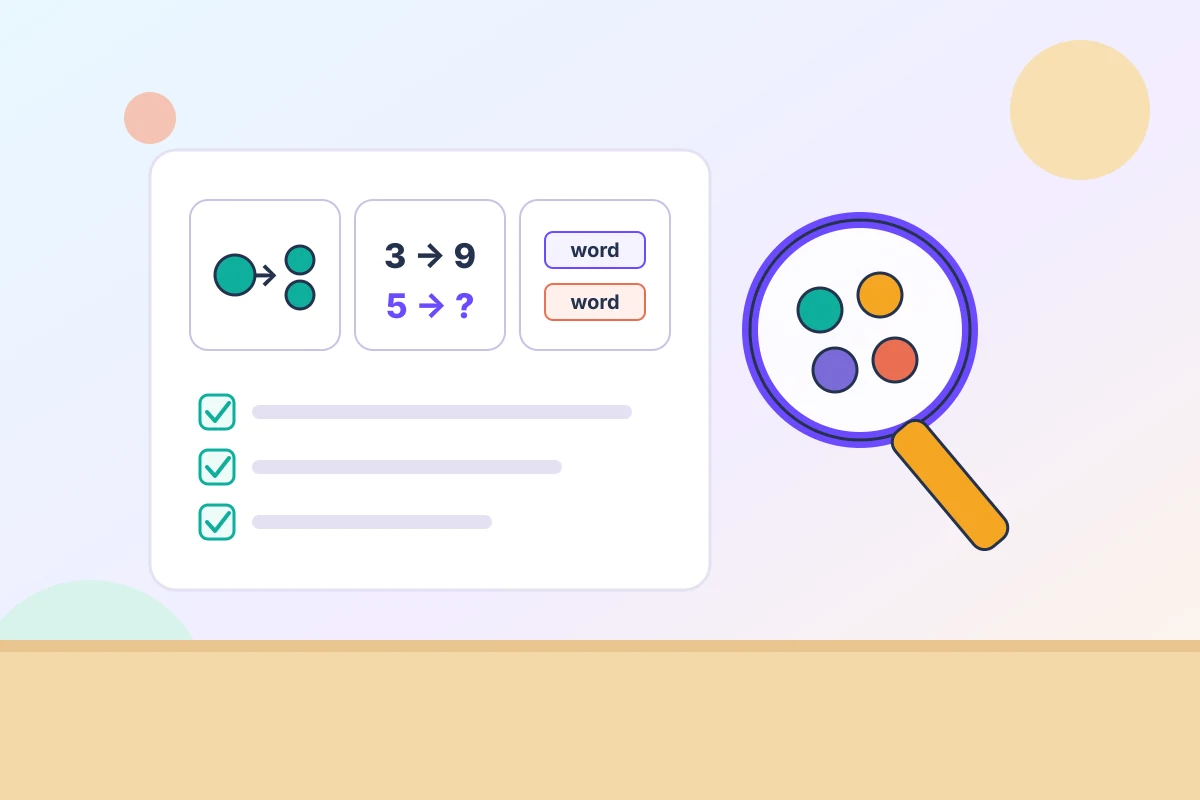
Screeners often mix a number rule and a shape rule, like the two examples below. For a complete set by subtest, see our CogAT practice questions for 2nd grade; for word-based items, see the CogAT Verbal Battery guide.
1. Number Analogies
Read aloud: “Find the rule that changes each first number into the second number. Use the same rule on the last number.”
[2 → 6] [4 → 12] [5 → ?]
- A. 9
- B. 10
- C. 15
- D. 20
Show answer
Answer: C — 15. Each number is multiplied by 3: 2 × 3 = 6 and 4 × 3 = 12, so 5 × 3 = 15. Adding 4 works for the first pair only, and doubling gives 10, which does not fit either pair.
2. Figure Matrices
Read aloud: “The top row shows a change. Find the picture that makes the bottom row change the same way.”
Text description: Top row: one circle → two circles. Bottom row: one star → ?. Choices: A one star, B two circles, C three stars, D two stars.
Show answer
Answer: D — two stars. In the top row, one circle becomes two circles of the same kind. One star should become two stars. Choice B has the right number but the wrong shape, and C has too many stars.
Frequently asked questions
What is a gifted screener?
A gifted screener is a short group test that helps a school decide which students should get a closer look for gifted or advanced services. Students who reach the district’s screening point usually take a fuller test or have more evidence reviewed before any decision is made.
Does passing a gifted screener mean my child is gifted?
No. Passing usually means your child moves to the next step, such as a fuller ability test or a team review. The final decision normally combines several kinds of evidence.
What happens if my child does not pass the screener?
Ask the school about re-screening windows, referrals, and appeals. Many states and districts say no single score should exclude a child, and some screen more than once during the year or in later grades.
Which tests are used as gifted screeners?
Common examples are the CogAT Screener, which uses three of the CogAT’s nine subtests, and the NNAT3, a 30-minute nonverbal test. Some districts also use the Naglieri General Ability Tests, existing achievement data, or teacher rating scales.
What is universal screening for gifted programs?
Universal screening means every student in a chosen grade takes the screener, not only students who were referred. Research from a large Florida district found it identified many more students from low-income families, English learners, and Black and Hispanic students.
Should my child practice for a gifted screener?
A little familiarity with the question formats helps children understand the directions. Heavy drilling is not recommended; rest, a calm explanation, and a few short practice puzzles are enough.
Sources
- New Jersey Department of Education: Gifted and Talented best practices for identification
- North Carolina DPI: Unpacking the NC AIG Program Standards (2021)
- Riverside Insights: Introducing CogAT Form 8 (includes the CogAT Screener)
- Riverside Insights: CogAT types of scores
- Pearson: Naglieri Nonverbal Ability Test, Third Edition (product page)
- Northshore School District: NNAT3 overview
- Jack A. Naglieri: Tests
- Card & Giuliano (2016), Universal screening increases the representation of low-income and minority students in gifted education, PNAS
- Thomas B. Fordham Institute: The benefits of multiple screenings for student giftedness
- Peters et al. (2019), Effect of local norms on racial and ethnic representation in gifted education, AERA Open
Last updated: November 8, 2026. This article is for information only and is not affiliated with or endorsed by the test publishers. Testing rules change; confirm current details with your school or district.
Explore Focusplay learning games