CogAT Verbal Battery: What It Measures, Subtests by Level, and Practice Questions
The Verbal Battery is the CogAT’s word-and-meaning section. Here is what each subtest asks at each level, how the verbal score is reported, and what its questions look like.
- Part of
- The CogAT (Riverside Insights), alongside the Quantitative and Nonverbal batteries
- Subtests
- Three: an analogies subtest, Sentence Completion, and a classification subtest
- Levels 5/6–8 (K–2)
- Picture-based; no reading needed; Sentence Completion is optional and read aloud
- Levels 9–17/18 (Grades 3–12)
- Text-based items; ten minutes per subtest
- Language support
- Directions in English and Spanish; an Alternate-Verbal option for K–2
- In the Screener
- Picture or Verbal Analogies is one of the three Screener subtests
- Scores
- Verbal Standard Age Score, percentile ranks, stanines; part of the Ability Profile
What the Verbal Battery measures
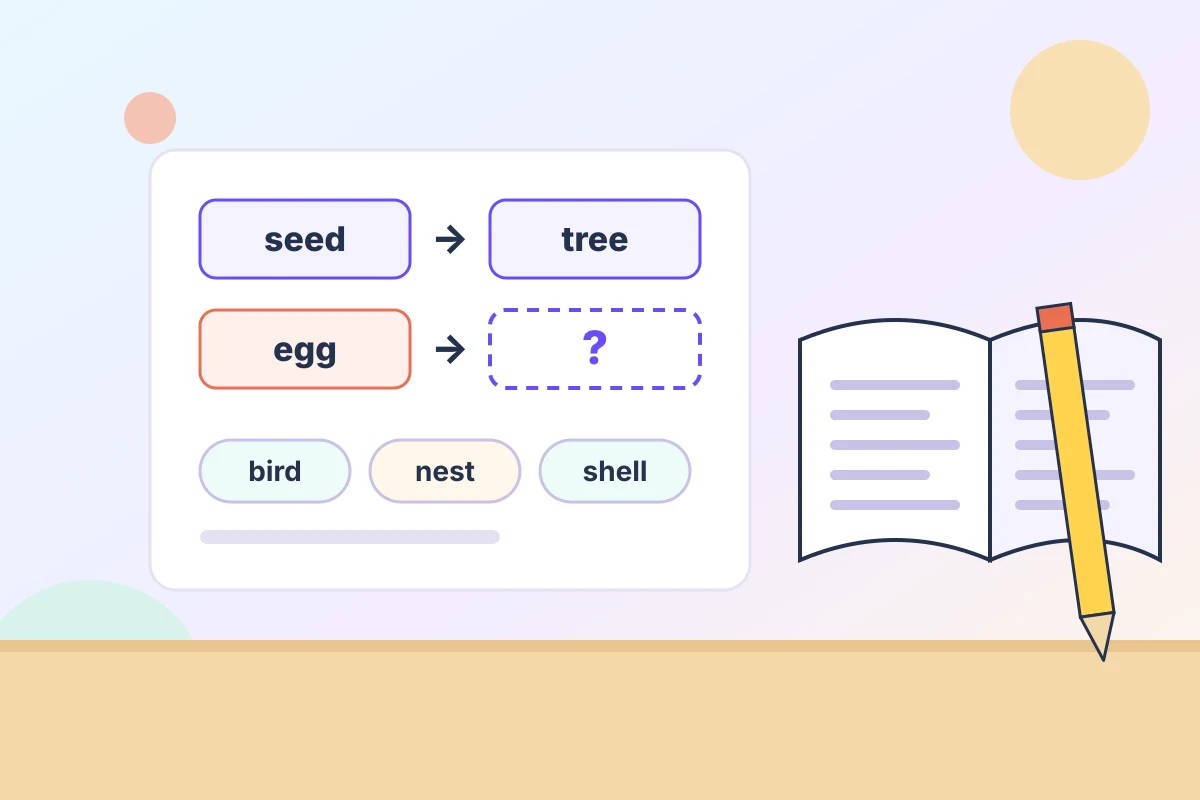
Every CogAT battery asks children to find a relationship or rule and apply it to something new. The Verbal Battery does this with language: words, sentences, and—at the youngest levels—pictures of familiar things. A child who sees that “a glove goes on a hand” is noticing a relationship; applying it to a sock and a foot is the reasoning step.
That makes it different from a vocabulary quiz or a reading test. Knowing words certainly helps, but most items use everyday words; the challenge is the thinking. Riverside describes the CogAT as capturing information “not represented in report card grades”, which is why schools use it alongside classwork rather than instead of it. For an overview of all three batteries, see our CogAT test guide.
Verbal subtests by level
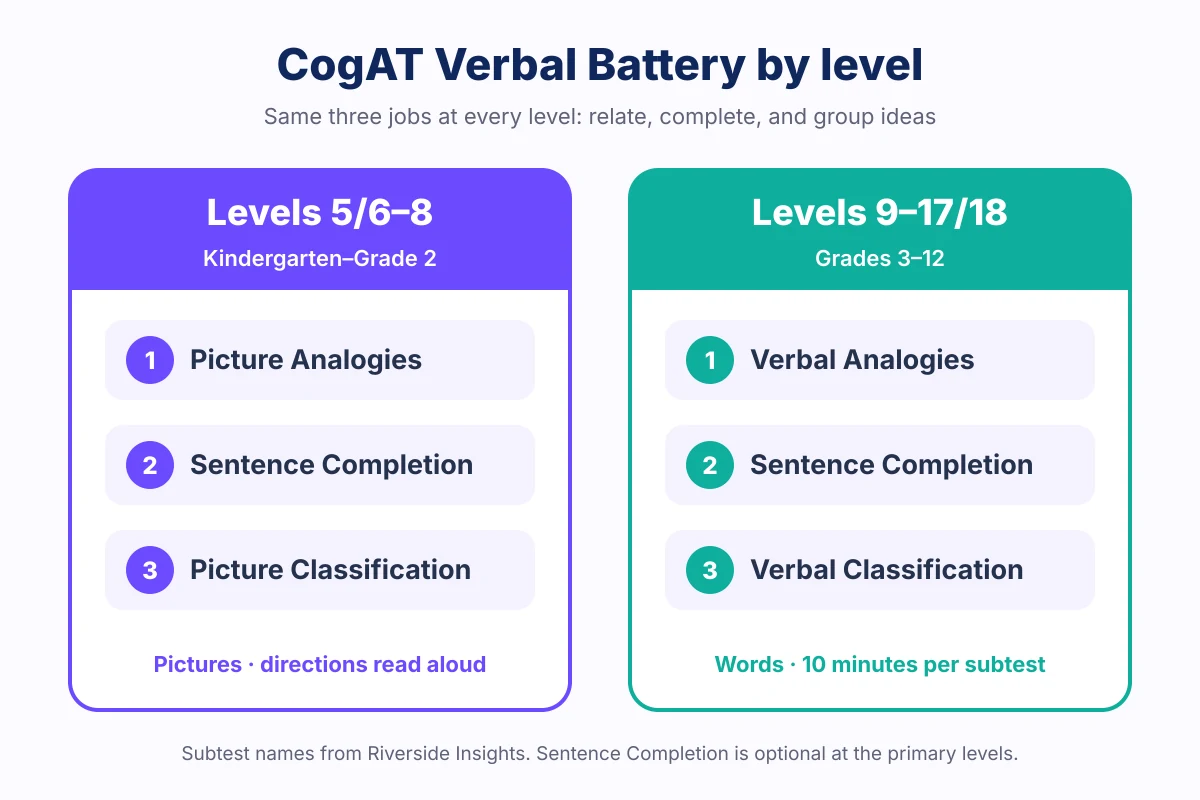
The CogAT has ten levels spanning kindergarten through grade 12. Levels 5/6–8 are the primary levels, usually given in kindergarten through grade 2, and Levels 9–17/18 cover grades 3–12. Schools can choose a different level for a group, so check your district’s notice.
Primary levels (5/6–8): pictures and listening
At the primary levels, Riverside says the questions are “entirely pictorial”, so children do not need to read. Sentence Completion is the optional subtest; the teacher reads each question aloud, in English or Spanish. The table uses Riverside’s test descriptions and the approximate times in its 2023 overview brochure.
| Subtest | What the child does | About |
|---|---|---|
| Picture Analogies | Looks at a 2×2 grid with three pictures and picks the picture that completes the second pair | 13–15 min |
| Sentence Completion | Listens to a sentence or question read aloud and picks the picture that answers it | 13–14 min |
| Picture Classification | Sees three pictures that are alike and picks the one that belongs with them | 13–14 min |
Riverside also offers an Alternate-Verbal administration for kindergarten through grade 2, and online testing can play the directions as audio. If your child is in second grade, our CogAT practice questions for 2nd grade show every Level 8 subtest.
Levels 9–17/18: printed words
From Level 9, Riverside’s brochure notes, the Verbal and Quantitative items become text-based. The three subtests keep the same jobs:
| Subtest | Format | The thinking |
|---|---|---|
| Verbal Analogies | A word pair, then a third word and four choices | Name the relationship (part of, opposite, used for, makes) and apply it |
| Sentence Completion | A sentence with a missing word | Use the meaning of the whole sentence, not one nearby word |
| Verbal Classification | Three words that belong together and four choices | Find the most specific shared category |
At these levels each subtest is timed at ten minutes. Higher levels use the same three formats at greater difficulty.
How Verbal Battery scores are reported
The Verbal Battery gets its own scores, using the same scales as the other batteries. Riverside’s guide to score types explains them:
- Verbal Standard Age Score (SAS): compares your child with others of the same age, with a mean of 100 and a standard deviation of 16.
- Percentile ranks: by age and by grade. A percentile rank of 50 is average; it is not the percentage of questions answered correctly.
- Stanine: a broad band from 1 to 9.
- Ability Profile: a short code such as “7C (V+ Q–).” A V+ marks verbal reasoning as a relative strength compared with your child’s other batteries, and V– as a relative weakness. In Riverside’s sample report, an “A” profile goes with battery scores that “do not differ significantly.”
A V+ or V– describes your child’s own pattern, not a comparison with classmates. A child with a V– can still score well above average on the Verbal Battery. If the school uses only the composite or only one battery for placement, ask which—districts differ.
The Verbal Battery and language background
Verbal reasoning is expressed through a language, so a child’s experience with English shows up in this battery more than in the others. A child who is still learning English, or who speaks another language at home, may reason very well but not yet know the English words a question depends on. That is one reason Riverside offers Spanish directions and the Alternate-Verbal option for younger children, and why many districts look at all three battery scores rather than the verbal score alone.
Nonverbal tests are not a complete fix either. A 2008 study summarized by the U.S. Department of Education’s Regional Educational Laboratory Southwest found that several nonverbal tests did not predict English learners’ achievement very well. The practical takeaway is to treat any single battery as one piece of evidence. If your child is an English learner, it is reasonable to ask how the district interprets verbal scores and whether local comparisons are used. Our guide to gifted testing explains local norms in more detail.
Building verbal reasoning at home
Riverside notes that excessive coaching has reduced impact on CogAT scores, and drilling word lists is not the goal. Verbal reasoning grows through conversation, reading, and play:
- Talk in relationships. “A puppy is a baby dog. What is a baby cat?” Then flip roles and let your child invent one for you.
- Play category games. Name three things and ask what they share, then argue for the most exact category (“tools for cutting,” not just “tools”). Our vocabulary games include quick versions.
- Read aloud and pause. Stop before a word and ask what would make sense. That is sentence completion in its most natural form. Sentence expansion activities build the same awareness.
- Explore word parts. Knowing that “pre-” means before helps with unfamiliar words; see word parts for kids.
- Keep it short and playful. FocusPlay’s learning games and free worksheets offer quick reasoning practice that fits between other activities.
Not sure whether your child will take the full CogAT or a shorter test first? See what a gifted screener is and how it fits into identification.
Practice questions in a similar style
These questions were written by FocusPlay as original practice in a similar style. They are not real test items, they are not taken from any test publisher or prep book, and they should not be used to predict a score. Use them for short, playful familiarity with the format.
Questions 1–3 match the picture-based primary levels; read them aloud. Questions 4–8 match the word-based upper levels. After each answer, ask your child to say the rule in one sentence—that is the real skill.
1. Picture Analogies
Read aloud: “Look at the top two pictures. They go together. Find the picture that goes with the bee in the same way.”
Text description: Top row: bird → nest. Bottom row: bee → ?. Choices: A flower, B nest, C beehive, D jar of honey.
Show answer
Answer: C — a beehive. A bird lives in a nest, so a bee lives in a hive. A bee visits flowers and makes honey, but neither is its home—those choices use a different relationship.
2. Sentence Completion
Read aloud: “It is snowing, and the air is very cold. Which one will keep Leo’s hands warm?”
- A. sunglasses
- B. mittens
- C. sandals
- D. a fan
Show answer
Answer: B — mittens. Mittens are worn on the hands to keep them warm. Sunglasses and sandals are for sunny weather, and a fan cools you down.
3. Picture Classification
Read aloud: “These three pictures are alike: a cow, a horse, and a sheep. Which one belongs with them?”
cow · horse · sheep
- A. a shark
- B. an eagle
- C. a tractor
- D. a pig
Show answer
Answer: D — a pig. A cow, a horse, and a sheep are four-legged animals often raised on a farm. A pig is too. A shark and an eagle are animals but not farm animals, and a tractor is found on a farm but is not an animal.
4. Verbal Analogies
Read aloud: “The first two words go together. Pick the word that goes with the third word in the same way.”
author → book :: composer → ?
- A. song
- B. piano
- C. singer
- D. concert
Show answer
Answer: A — song. An author creates a book. A composer creates a song. A piano is something music is played on, a singer performs songs, and a concert is an event—none is what a composer makes.
5. Verbal Analogies
Read aloud: “The first two words go together. Pick the word that goes with the third word in the same way.”
shallow → deep :: narrow → ?
- A. thin
- B. long
- C. wide
- D. tall
Show answer
Answer: C — wide. Deep is the opposite of shallow, so the answer is the opposite of narrow: wide. Thin means almost the same as narrow, and long and tall describe other measurements.
6. Sentence Completion
Read aloud: “Choose the word that best completes the sentence.”
Because the bridge was ____, the trucks had to take a longer road.
- A. painted
- B. closed
- C. famous
- D. beautiful
Show answer
Answer: B — closed. A closed bridge cannot be crossed, which explains why the trucks needed another road. The other words describe the bridge but give no reason to go around it.
7. Verbal Classification
Read aloud: “These three words go together. Which word belongs with them?”
inch · meter · mile
- A. pound
- B. hour
- C. liter
- D. foot
Show answer
Answer: D — foot. Inches, meters, and miles are units for measuring length. A foot is also a unit of length. A pound measures weight, an hour measures time, and a liter measures volume.
8. Verbal Classification
Read aloud: “These three words go together. Which word belongs with them?”
whisper · shout · mumble
- A. murmur
- B. listen
- C. loud
- D. radio
Show answer
Answer: A — murmur. Whisper, shout, and mumble are all ways of speaking. To murmur is another way of speaking. Listen is what you do with sounds, loud describes a sound, and a radio is an object.
Frequently asked questions
What is on the CogAT Verbal Battery?
It has three subtests. At Levels 5/6–8 they are Picture Analogies, Sentence Completion, and Picture Classification; at Levels 9–17/18 they are Verbal Analogies, Sentence Completion, and Verbal Classification.
Does my child need to read for the CogAT Verbal Battery?
Not in kindergarten through grade 2. The primary levels use pictures, and Sentence Completion is read aloud by the teacher. Printed words start at Level 9, usually in third grade.
How long is the CogAT Verbal Battery?
At Levels 9 and above, each of the three subtests is timed at ten minutes. At the primary levels, Riverside estimates roughly 13 to 15 minutes per verbal subtest.
What does V+ or V– mean on a CogAT report?
They appear in the Ability Profile. V+ means verbal reasoning is a relative strength compared with your child’s other batteries, and V– means it is a relative weakness. They describe your child’s own pattern, not a comparison with other students.
Is the CogAT Verbal Battery fair to English learners?
Verbal items depend on language, so a child’s English experience can affect the score. Riverside offers Spanish directions and an Alternate-Verbal option for younger grades, and many districts look at all three batteries and other evidence.
How can I help my child with CogAT verbal questions?
Short, playful practice works best: talk about how words are related, play category games, and read aloud together. Riverside notes that excessive coaching has reduced impact, so drilling is not recommended.
Sources
- Riverside Insights: Structure of the CogAT assessment
- Riverside Insights: CogAT test descriptions (DataManager)
- Riverside Insights: CogAT overview brochure (2023)
- Riverside Insights: CogAT Forms 7 and 8 product planning guide
- Riverside Insights: Introducing CogAT Form 8
- Riverside Insights: CogAT types of scores
- Riverside Insights: Individual Profile Narrative report guide
- REL Southwest (IES): Identifying English learners for gifted programs
Last updated: November 8, 2026. This article is for information only and is not affiliated with or endorsed by the test publishers. Testing rules change; confirm current details with your school or district.
Explore Focusplay learning games