Teach Word Parts to Kids: A K–8 Guide to Prefixes, Roots, and Suffixes
Long words become less intimidating when children learn to look for smaller units that carry meaning.
Key takeaways
- A morpheme is the smallest word part that carries meaning.
- Word-part knowledge supports both reading unfamiliar words and reasoning about meaning.
- Begin with familiar, transparent examples and increase complexity by grade level.
- Always check a proposed meaning against the sentence because word parts are clues, not guarantees.
What are word parts?
A base word can stand alone, as help does. A root carries a central meaning but may not stand alone in English; struct, meaning “build,” appears in construct and structure. A prefix comes before a base or root, while a suffix comes after it.
This attention to meaningful units is called morphological awareness. It complements phonics: children still use letter–sound knowledge, but they also recognize that replayed contains re-, play, and -ed. The U.S. Department of Education's K–3 foundational reading guide recommends teaching students to decode words and analyze common word parts. Its grades 4–9 reading intervention guide likewise emphasizes decoding complex multisyllabic words and building word knowledge.
The Spot–Split–Solve–Rebuild–Use routine
1. Spot the familiar piece
Circle or say the part the child already knows. In unhelpful, begin with help. Starting with a recognizable anchor reduces guessing from the first letter or the word's overall shape.
2. Split the word into possible parts
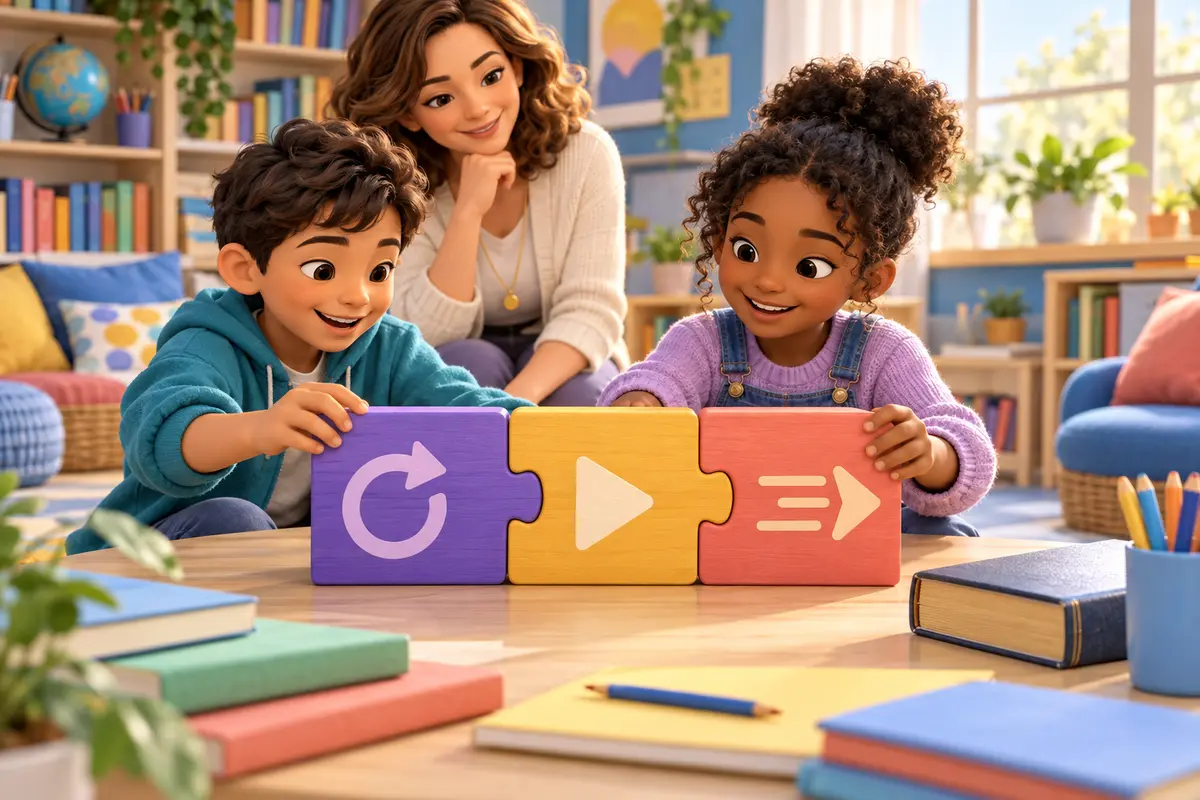
Mark the boundaries: un + help + ful. Moveable cards, colored pencils, or blocks make each unit visible. Read the complete word again after splitting so analysis does not replace fluent reading.
3. Solve what each part contributes
Ask, “What does un- usually signal here? What does -ful add?” Build a tentative meaning: not helpful. Say “usually” because the same letter sequence is not always a meaningful unit in every word.
4. Rebuild and check
Put the pieces back together, pronounce the whole word, and compare the proposed meaning with the sentence. If “not helpful” makes sense in “The broken map was unhelpful,” the analysis has useful support.
5. Use the pattern again
Apply one part to a new example: unfair, helpful, or careful. Then have the child create a sentence or locate the part in current reading. Reuse turns a one-time explanation into a flexible tool.
Match word-part work to the grade band
| Grade band | Useful starting points | Example |
|---|---|---|
| K–2 | Familiar bases, compound words, and common endings such as -s, -ed, and -ing. | jump + ed: the jumping happened in the past. |
| Grades 3–5 | Common prefixes and suffixes such as un-, re-, mis-, -ful, -less, and -ment. | mis + place: to put something in the wrong place. |
| Grades 6–8 | Greek and Latin roots used across science, mathematics, and social studies. | bio + logy: the study of life. |
These are starting points, not rigid age rules. Choose examples a learner can pronounce and connect to known language, then add less familiar parts gradually.
Four playful activities
Build and swap
Write one base on a center card and place possible beginnings and endings around it. Build play, replay, player, and playful. Discuss which combinations are real words and how the meaning changes.
Word-part detective
Choose one paragraph from a class text or library book. Find three words with a shared part, highlight the part, and write a brief meaning hypothesis. Context supplies a reason to verify each guess.
Meaning sort
Sort words by what an affix contributes, not merely by spelling. For example, group words in which re- clearly means “again.” Set aside exceptions or uncertain examples for a dictionary check.
Concept web
For older learners, place a root such as port in the center and connect transport, portable, import, and export. Add a sentence showing how each word relates to carrying or moving.
Avoid the “every piece must mean something” trap
Children may over-split words. The -er in teacher names a person who teaches, but corner is not someone who “corns.” Encourage a three-part check: Does the piece have a familiar meaning? Does the remainder make sense? Does the whole interpretation fit the sentence?
If the answer is uncertain, model curiosity rather than certainty: “That split looks possible, but the meaning does not fit. Let’s verify it.” This keeps word analysis connected to evidence.
Connect word analysis to Focusplay
After a short Focusplay language or reasoning activity, choose one useful word from the directions and run the five-step routine. Extend it with a vocabulary game or use the new word in a sentence-expansion activity. Keep the session brief and end with one question: “Which part helped you most?” Browse Focusplay learning games for another low-pressure context in which children can explain patterns and test ideas.
Frequently asked questions
What age should children learn prefixes and suffixes?
Children can notice simple meaningful parts in familiar spoken and written words during the early grades. Instruction can expand from endings such as -s, -ed, and -ing to common prefixes, suffixes, and Greek or Latin roots as reading demands grow.
Is morphology the same as phonics?
No. Phonics connects written patterns with sounds; morphology examines meaningful parts of words. The two work together when a child reads and interprets a word such as replayed.
What if a word-part clue gives the wrong meaning?
Treat word parts as clues, not guarantees. Test the possible meaning in the sentence, check the spelling and pronunciation, and use a dictionary or teacher explanation when the pieces do not fit.
How many word parts should children practice at once?
Use a small, useful set and revisit it in several real words and sentences. Add new parts when the child can explain and apply the earlier ones rather than following a fixed weekly number.
Sources
- What Works Clearinghouse: Foundational Skills to Support Reading for Understanding in Kindergarten Through 3rd Grade (July 2016; revised December 2019)
- What Works Clearinghouse: Providing Reading Interventions for Students in Grades 4–9 (March 2022)