What Is a GATE Program? A Parent’s Guide to Gifted and Talented Education
If your child’s school mentions GATE, you may wonder what the program is, who qualifies, and how students are chosen. This parent guide explains what a GATE program is, how California districts run GATE today, and what to ask your own district.

- Stands for
- Gifted and Talented Education
- Where the term is used
- Mainly California public school districts; other states use names such as “gifted and talented,” “AIG,” or “highly capable”
- State role (2026–27)
- No separate state GATE funding since the 2013–14 Local Control Funding Formula; programming is a local decision
- Who decides eligibility
- Each district, using its own criteria and timeline
- Common evidence
- Reasoning test scores, achievement scores, grades, teacher or parent input, portfolios
- Common services
- Cluster classrooms, pull-out or seminar groups, self-contained classes or magnets, honors and AP courses
- Best first step
- Read your district’s GATE page or contact its GATE coordinator
What is a GATE program?
A GATE program is the way a school district identifies students with advanced abilities or potential and then gives them learning that is deeper, faster, or more complex than the standard curriculum. GATE is not one test or one class. It is usually a system with two halves:
- Identification—how the district decides which students need gifted services (screening, testing, and a review of several kinds of evidence).
- Services—what changes for identified students, such as being grouped with similar learners, working on extended projects, or joining an advanced class.
The idea behind GATE matches the federal description of gifted students, which the National Association for Gifted Children (NAGC) quotes from the Elementary and Secondary Education Act: students who “give evidence of high achievement capability” in areas such as intellectual, creative, artistic, or leadership capacity, or in specific academic fields, “and who need services and activities not ordinarily provided by the school.” States and districts are not required to use that definition, NAGC notes, and almost all decisions about gifted education are made at the state and local level.
The key phrase is “need services.” A GATE label is meant to describe a learning need at a point in time, not a child’s worth or future.
How GATE works in California today
As of the 2026–27 school year, California has no single statewide GATE program: each district decides whether to run one and sets its own rules. The California Department of Education (CDE) explains how that happened:
- 1980: state law (AB 1040) created the GATE program and let local educational agencies set their own identification criteria.
- 2013: the Local Control Funding Formula (LCFF) eliminated the separate funding stream for GATE along with many other categorical programs. CDE now says GATE “is no longer considered a categorical program.”
- 2014: SB 971 repealed Education Code sections 52200–52212, the old GATE statutes, according to CDE.
The practical result: funding and services for gifted students are decided at the local level. That is why two neighboring districts can test in different grades, use different tests, and offer very different services. CDE’s guidance still says that “best practices support using more than one factor to identify GATE students,” and that identification “can be an ongoing process that continues as students get older.” (CDE page last reviewed December 5, 2025; checked November 7, 2026.)
Two other points from CDE’s FAQ surprise many parents. Public districts are not required to test or serve private school students. And a student identified as GATE in one California district is not automatically identified in another, because GATE is under local control—families who move should ask the new district how it treats prior identification.
Who qualifies for GATE?
Who qualifies for GATE depends entirely on the district, though many California district policies still use categories from the former state law. Before its repeal, Education Code 52202 listed these areas of ability:
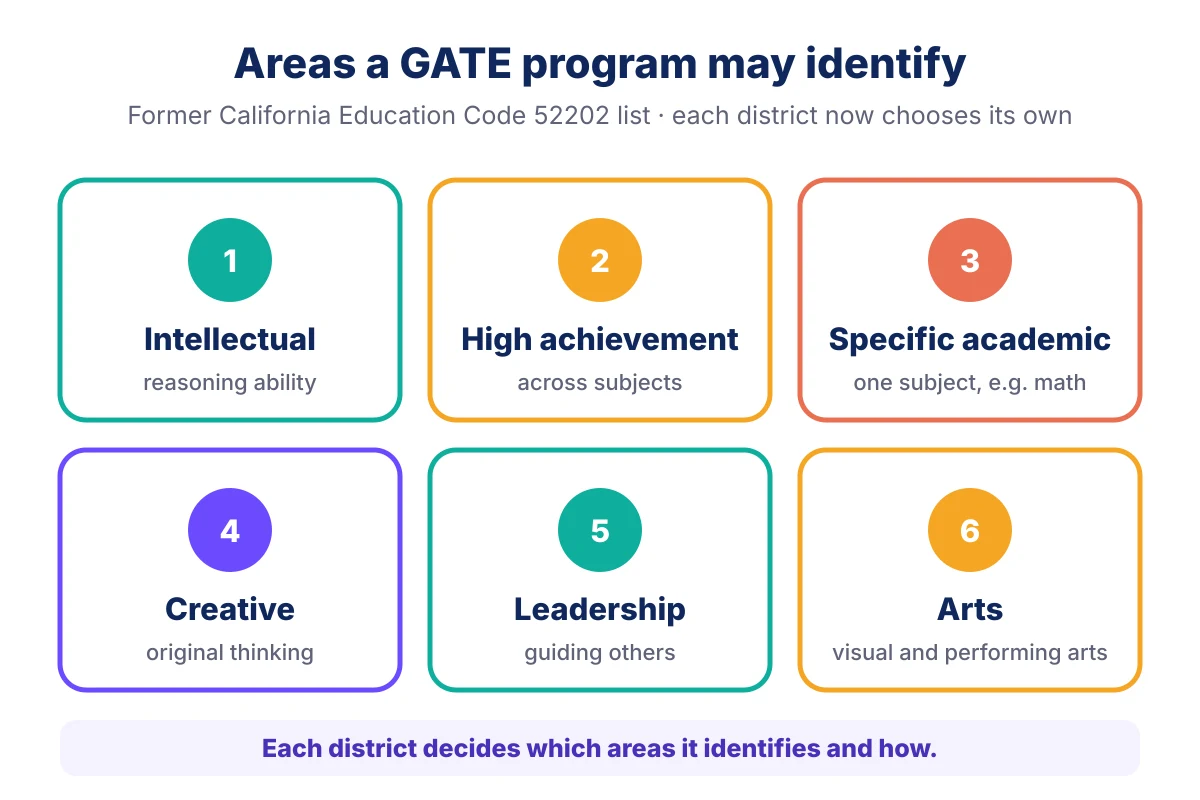
- Intellectual ability—strong general reasoning, often shown on an ability test.
- High achievement—consistently advanced performance across academic subjects.
- Specific academic ability—advanced performance in one area, such as math or English language arts.
- Creative ability—original, flexible thinking and products.
- Leadership ability—organizing, guiding, and motivating others.
- Visual and performing arts talent—art, music, dance, or drama.
Some large districts still identify in several of these categories, each with its own evidence and starting grade. Los Angeles Unified’s GATE 101 overview (June 2023), for example, listed seven categories, including intellectual ability through district psychological testing and creative, leadership, and arts abilities through portfolio, presentation, or audition review. Our LAUSD GATE identification guide walks through all seven with 2026–27 dates. Irvine Unified takes the opposite approach—no referrals, just annual screening of every third through fifth grader—as our IUSD GATE guide explains. Other districts identify in fewer areas. Always check the current year’s rules, because categories and grades change.
Nationally, the U.S. Department of Education’s Office for Civil Rights estimates that about 6 percent of public school students are enrolled in gifted and talented programs.
How students are identified for GATE
Most GATE programs identify students through a sequence of screening, testing, and a review of multiple measures. The details vary, but the usual steps look like this (for real 2026–27 district examples, see our guide to GATE program identification in California):
- Screening or referral. Some districts screen every student in one grade (universal screening). Others rely on referrals from teachers or parents. Many do both. Our GATE referral guide explains who can nominate a child and what to write. Second grade is a common screening year—see our guide to the GATE test in 2nd grade.
- Ability or achievement testing. Students take a group reasoning test such as the CogAT or a nonverbal test such as the NNAT3, and districts may also look at state test results. Our GATE test guide compares the tests districts use.
- Review of multiple measures. A committee combines test scores with grades, work samples, rating scales, or other information—often on a points-based matrix.
- Notification. Families receive a letter with the decision, typically in spring.
- Placement and services. Identified students are placed in the district’s GATE model, which may depend on grade and school.
A current example: San Diego Unified’s GATE assessment page (checked November 7, 2026) says all second graders are universally screened with the CogAT Screener during a testing window that typically runs from late January through February. The score is the base of a multi-factor matrix that can add points for strong report card or state test results and for factors such as English learner or low-income status. The page recommends 121 or higher for its GATE Cluster and 135 or higher for its GATE Seminar. These numbers belong to one district only—they are not California-wide cutoffs. Our guide to the GATE qualifying score compares cutoffs and points matrices across several districts.
For a broader, state-neutral overview of screening, percentiles, and local norms, see our guide to gifted testing for kids.
What GATE services look like
GATE services are the changes a district makes for identified students, and they range from a few hours a month to a full-time separate class. These are the most common models:
| Model | What it means | What to ask |
|---|---|---|
| Cluster grouping | A small group of identified students is placed together in a regular classroom with a teacher who differentiates instruction. | How is work actually different for the cluster group? Is the teacher trained? |
| Pull-out or seminar | Students leave the regular class for a set time each week for enrichment or advanced work. | How often does it meet, and what happens with missed class work? |
| Self-contained class or magnet | A full-time class (sometimes at another school) made up of identified students. | Is there an application, a waitlist, or transportation? |
| Honors, advanced, and AP courses | Middle and high school courses with faster pace or more depth. | Are these open to all students or only to identified students? |
| Acceleration | Moving ahead in one subject or a full grade. | What evidence does the district require? |
Our GATE cluster vs self-contained guide compares these models in depth and explains how to choose. Larger districts often combine models. In LAUSD’s 2023 overview, for instance, every school was expected to cluster identified students and differentiate within the school day, while separate gifted magnets, highly gifted magnets, and honors and AP courses served some students. Research summarized by NAGC says that “almost any form of grouping used will provide an academic or achievement gain to gifted learners,” as long as the content and teaching also change—grouping alone is not enough.
What GATE test questions can look like
GATE screening tests usually ask children to find patterns and rules rather than recall facts. The two questions below show the general style. They are deliberately simple and are meant only to make the format feel familiar.
Original FocusPlay practice items—not real test questions. They are not taken or adapted from any test publisher, prep book, or forum, and they cannot predict a score.
1. What comes next? (figure series)
Read aloud: “Look at how the arrow changes from box to box. Which arrow comes next?”
Text description: The arrow points up, then right, then down, then ?. Choices: A up, B right, C left, D down.
Show answer
Answer: C — the arrow pointing left. Each step turns the arrow a quarter turn clockwise: up, right, down, and then left.
2. Find the rule (number analogy)
Read aloud: “The same rule changes each first number into the second number. Use the rule on the last number.”
[4 → 9] [6 → 11] [10 → ?]
- A. 15
- B. 14
- C. 20
- D. 16
Show answer
Answer: A — 15. The rule is “add 5”: 4 + 5 = 9 and 6 + 5 = 11, so 10 + 5 = 15. Doubling would not work for both pairs.
For many more original examples by test type, see our CogAT practice questions for 2nd grade.
How parents can approach GATE calmly
The most useful thing parents can do is learn their district’s process early and keep the focus on the child’s learning needs, not on a label. Helpful steps:
- Find the district’s GATE page and note the screening grade, test, timeline, and referral deadline for the current school year.
- Ask what evidence counts—test scores only, or also grades, work samples, and teacher input.
- Ask what services exist at your school, since identification and services are not the same thing.
- Keep preparation light. Short, playful practice with patterns, puzzles, and reading builds the same reasoning skills tests look for. FocusPlay’s learning games, logic games, and spatial reasoning activities fit naturally into a normal week.
- If your child is not identified, ask about retesting or referral windows. CDE suggests contacting the district’s GATE coordinator. Our GATE program appeal guide walks through appeals, retesting, and private testing district by district.
Whatever the result, a GATE decision is one snapshot from one process in one district. Children develop at different rates, and many thrive with challenge at home and in the regular classroom.
Frequently asked questions
What does GATE stand for in school?
GATE stands for Gifted and Talented Education. It is the name many California school districts use for their programs that identify and serve students who need more challenge than the regular curriculum provides.
Is GATE the same as a gifted program?
Yes, in practice. GATE is California’s common name for gifted and talented services. Other states use names such as gifted and talented, advanced academics, AIG, or highly capable, and the rules differ from state to state.
What grade are students tested for GATE?
It depends on the district. Many districts screen a whole grade in the early elementary years—San Diego Unified, for example, screens all second graders—and also accept referrals in other grades. Check your district’s GATE page for the current year.
Is GATE required in California?
No. Since the Local Control Funding Formula took effect in 2013–14, GATE has not been a separate state-funded program, and the old GATE statutes were repealed in 2014. Each district decides whether to offer GATE and how.
Can parents request GATE testing?
Many districts accept parent referrals, usually during a set window each year. Ask the school or the district’s GATE coordinator about the referral form, the deadline, and what evidence to include.
Does GATE identification transfer to a new district?
Not automatically. Because GATE is under local control in California, each district decides whether to accept identification from another district or to re-evaluate the student.
What happens if my child is not identified for GATE?
A GATE decision is one snapshot, not a final verdict. Ask whether the district retests in a later grade or accepts referrals, and keep offering challenge at home and in class. CDE suggests contacting the district’s GATE coordinator with questions.
Sources
- California Department of Education: Gifted and Talented Education (last reviewed December 5, 2025)
- California Department of Education: GATE program and funding FAQ (historical)
- California Education Code sections 52200–52212 (2009 text, since repealed)
- National Association for Gifted Children: Frequently asked questions about gifted education
- National Association for Gifted Children: Grouping
- Card, D., & Giuliano, L. (2016). Universal screening increases the representation of low-income and minority students in gifted education. PNAS, 113(48).
- San Diego Unified School District: GATE assessment
- Los Angeles Unified School District: GATE 101 (June 2023)
Last updated: November 7, 2026, by the Focusplay Editorial Team. Rules verified for the 2026–27 school year where published. This article is for information only and is not affiliated with or endorsed by any school district, state agency, or test publisher. GATE rules change; confirm current details with your district.
Explore Focusplay learning games