CogAT Nonverbal Battery: What It Measures, Subtests by Level, and Practice Questions
The Nonverbal Battery is the CogAT’s shapes-and-figures section. Here is what each subtest asks at each level, how the score is reported, and what its puzzles look like.
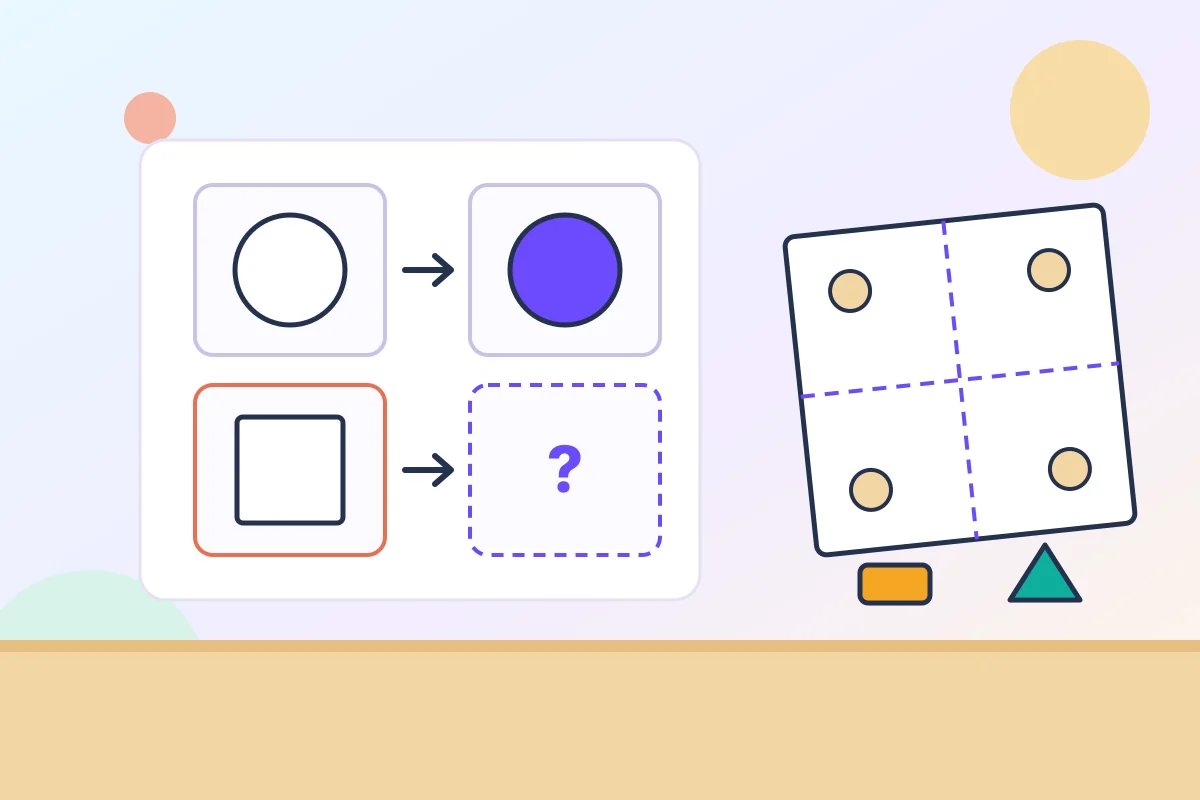
- Part of
- The CogAT (Riverside Insights), alongside the Verbal and Quantitative batteries
- Subtests
- Figure Matrices, Paper Folding, Figure Classification—at every level
- Levels 5/6–8 (K–2)
- Figures; paper is folded and usually cut; about 10–13 minutes per subtest
- Levels 9–17/18 (Grades 3–12)
- Figures; paper is folded and punched; ten minutes per subtest
- Item format
- Figures only; children still need to understand the directions
- In the Screener
- Figure Matrices is the Screener’s nonverbal subtest
- Scores
- Nonverbal Standard Age Score, percentile ranks, stanine; N+/N– in the Ability Profile; part of the QN partial composite on some reports
What the Nonverbal Battery measures
The Nonverbal Battery asks the same kind of question as the rest of the CogAT—find the relationship, then apply it—but with shapes. A child might notice that a figure grows and changes color, or that shading moves from one side to the other. Paper Folding adds a different kind of thinking: holding a picture in mind and mentally unfolding it.
Because the items contain no words or numbers, the battery depends less on language and school content than the other two, though children still bring experience with puzzles and blocks, and must understand the directions. For the full test, see our CogAT test guide; for the other two batteries, see the Verbal Battery and Quantitative Battery guides.
Nonverbal subtests by level
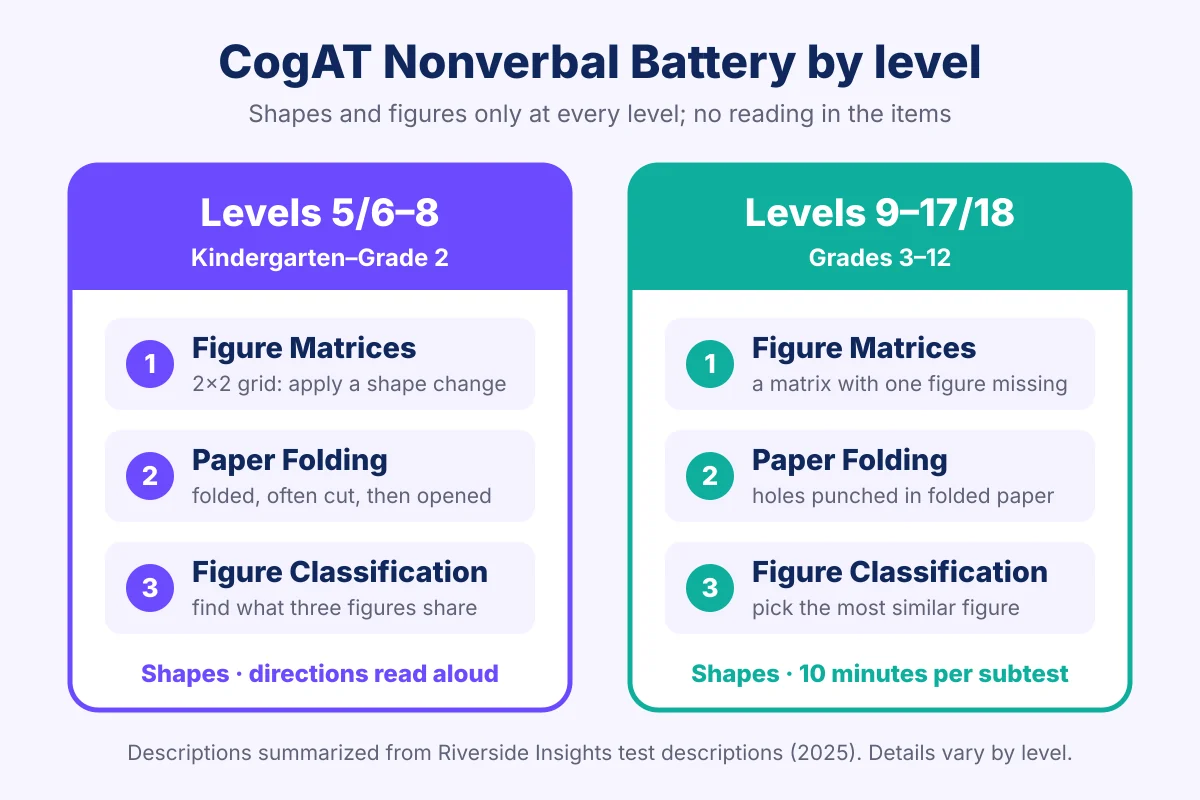
The CogAT’s ten levels span kindergarten through grade 12: Levels 5/6–8 for kindergarten through grade 2, and Levels 9–17/18 for grades 3–12. Unlike the Verbal and Quantitative batteries, the Nonverbal Battery uses figures at every level. The descriptions below follow Riverside’s 2025 test descriptions and its page on Nonverbal Battery subtest items.
Figure Matrices
The shape version of an analogy. Riverside describes a 2×2 matrix that “uses spatial forms”: the child works out how the first figure changes into the second and applies the same change to the third. Level 9 still uses a 2×2 matrix with one empty cell. From Level 10, Riverside describes a matrix in which one figure is missing, so children may need to track changes across rows and down columns.
Paper Folding
The child picks how a folded and changed sheet will look when opened. At the primary levels Riverside says the paper is folded, “usually cut in some way,” and then unfolded. From Level 9 the folded paper has holes punched in it. The key idea is that a cut or hole goes through every layer, so each fold creates a mirror copy on the other side of the fold line.
Figure Classification
The shape version of a category question. The child sees three figures that are alike and chooses the one “most like the first three figures.” The shared rule might be shape, number, shading, or position.
| Subtest | Levels 5/6–8 (K–2) | Levels 9–17/18 (Grades 3–12) | The thinking |
|---|---|---|---|
| Figure Matrices | 2×2 grid of figures; about 11–13 min | 2×2 at Level 9; a matrix with one figure missing from Level 10; 10 min | Name every change, then apply all of them |
| Paper Folding | Paper folded, usually cut, then opened; about 10–11 min | Paper folded and punched, then opened; 10 min | Mirror each cut or hole across each fold |
| Figure Classification | Three alike figures, pick one more; about 10–13 min | Pick the figure most like the three; 10 min | Find the most specific shared rule |
Primary-level times are Riverside’s approximate figures from its 2023 overview brochure; at Levels 9 and above each subtest is timed at ten minutes.
How Nonverbal Battery scores are reported
Like the other batteries, the Nonverbal Battery receives a Standard Age Score (mean 100, standard deviation 16), age and grade percentile ranks, and a stanine, as described in Riverside’s guide to score types. In the Ability Profile, an N+ marks nonverbal reasoning as a relative strength compared with your child’s other batteries, and N– a relative weakness. On some paper-based reports, the Nonverbal and Quantitative batteries are also combined into a QN partial composite, which Riverside says predicts math achievement better than either battery alone.
What a high nonverbal score does—and does not—tell you
Riverside’s talent-identification guidance describes a student with a very high nonverbal score but lower verbal and quantitative scores: such a student may excel in programs built on spatial and figural reasoning, yet is not necessarily the best fit for a typical academic program. Its advice is to match students’ particular strengths with what a program demands.
The Nonverbal Battery and fairness
Because its items contain no words, the Nonverbal Battery is often seen as the fairest part of the CogAT for English learners, and figure-based tests can widen the pool. When a large Florida district began screening every second grader with a nonverbal ability test, identification rose among low-income students, English learners, and Black and Hispanic students, who had been “underreferred” under the old referral system.
Nonverbal tests are not a complete fix, though. A 2008 study summarized by the U.S. Department of Education’s Regional Educational Laboratory Southwest found that several nonverbal tests did not predict English learners’ achievement very well. Treat any single battery—nonverbal included—as one piece of evidence. If your child’s district uses a nonverbal-only test, such as the NNAT3, our NNAT3 guide explains how it differs.
Building nonverbal reasoning at home
Riverside notes that excessive coaching has reduced impact on CogAT scores. Spatial reasoning grows best through hands-on play:
- Fold, cut, and predict. Fold a paper in half, cut a small shape on the fold, and ask your child to draw what they expect before opening it. Then fold twice and punch a hole. Checking the prediction is the learning.
- Build and copy. Blocks, tangrams, and pattern tiles all train the eye. Our spatial reasoning activities include ideas by age.
- Name every change. When two pictures differ, ask your child to list each change—matrices often change two things at once. Visual scanning activities build the same careful looking.
- Keep it short and playful. FocusPlay’s learning games and free worksheets include shape and pattern puzzles that fit into a few minutes.
Practice questions in a similar style
These questions were written by FocusPlay as original practice in a similar style. They are not real test items, they are not taken from any test publisher or prep book, and they should not be used to predict a score. Use them for short, playful familiarity with the format.
Questions 1, 4, and 6 match the primary levels; read them aloud and let your child point. Questions 2, 3, 5, and 7 match the upper levels. For paper folding, it helps to try the real fold with a sheet of paper after answering.
1. Figure Matrices
Read aloud: “The top two boxes go together. Which picture goes with the square in the same way?”
Text description: Top row: circle with left half shaded → circle with right half shaded. Bottom row: square with left half shaded → ?. Choices: A square, left half shaded; B circle, right half shaded; C square, right half shaded; D square, top half shaded.
Show answer
Answer: C — square, right half shaded. The shading moves from the left half to the right half, and the shape stays the same. So the square keeps its shape and the shading moves to the right half. B has the right shading but the wrong shape.
2. Figure Matrices
Read aloud: “The top two boxes go together. Which figure goes with the hexagon in the same way?”
Text description: Top row: small white triangle → large teal triangle. Bottom row: small white hexagon → ?. Choices: A large teal hexagon, B large white hexagon, C small teal hexagon, D large teal triangle.
Show answer
Answer: A — large teal hexagon. Two things change at once: the shape gets bigger and turns teal. Only the large teal hexagon shows both changes while keeping the hexagon shape. B and C each show only one change.
3. Figure Matrices (3×3)
Read aloud: “Look across the rows and down the columns. Which figure belongs in the empty box?”
Text description: Rows: circles, squares, triangles. Columns: a dot inside, a line inside, a plus sign inside. The bottom-right box is empty. Choices: A triangle with a dot, B square with a plus sign, C triangle with a line, D triangle with a plus sign.
Show answer
Answer: D — triangle with a plus sign. Each row keeps one outer shape, and each column keeps one inside mark. The empty box is in the triangle row and the plus-sign column, so it is a triangle with a plus sign.
4. Paper Folding (fold and cut)
Read aloud: “The paper is folded in half. A small triangle is cut from the folded side. What will the paper look like when it is opened?”
Text description: A square sheet is folded in half, left side over right. A small triangle is cut out of the middle of the folded edge. Choices: A a triangle notch in the left edge; B one diamond-shaped hole in the middle; C two separate triangle holes; D one triangle hole in the middle.
Show answer
Answer: B — one diamond-shaped hole in the middle. The cut goes through both layers at the fold, so the triangle is copied as a mirror image on the other side of the fold line. The two triangles share the fold edge and join into one diamond in the middle of the sheet.
5. Paper Folding (punched holes)
Read aloud: “The paper is folded twice, and one hole is punched. Which picture shows the paper when it is unfolded?”
Text description: A square sheet is folded top down onto the bottom, then right over onto the left, and one hole is punched near the outer corner (bottom-left). Choices: A one hole near the bottom-left corner; B two holes near the bottom corners; C four holes, one near each corner; D four holes close together near the center.
Show answer
Answer: C — four holes, one near each corner. The hole goes through four layers. Unfolding the second fold adds a hole near the bottom-right corner; unfolding the first adds mirror holes near the top corners. The punch was near the outer corner, away from the folds, so the holes end up near the corners, not the center.
6. Figure Classification
Read aloud: “The three boxes on top are alike in some way. Which box below goes with them?”
Text description: Boxes that go together: 3 circles, 3 squares, 3 triangles. Choices: A 3 stars, B 2 diamonds, C 4 circles, D 1 triangle.
Show answer
Answer: A — 3 stars. Each box has exactly three of the same shape. Three stars fits. The circles and triangle choices use familiar shapes, but the wrong number.
7. Figure Classification
Read aloud: “The first three figures are alike in some way. Which answer is most like them?”
Text description: Figures that go together: circle inside a circle, square inside a square, triangle inside a triangle. Choices: A square inside a circle, B pentagon with nothing inside, C circle inside a triangle, D pentagon inside a pentagon.
Show answer
Answer: D — a pentagon inside a pentagon. In each figure, a small shape sits inside a larger copy of the same shape. Only the pentagon inside a pentagon follows that rule. A and C have a shape inside, but a different shape.
Frequently asked questions
What is on the CogAT Nonverbal Battery?
Three subtests at every level: Figure Matrices, Paper Folding, and Figure Classification. All three use shapes and figures rather than words or numbers.
Does the CogAT Nonverbal Battery require reading?
No. The items are made of figures, so there are no words to read in the questions. Children still need to understand the directions for each subtest.
How long is the CogAT Nonverbal Battery?
At Levels 9 and above, each of the three subtests is timed at ten minutes. At the primary levels, Riverside estimates roughly 10 to 13 minutes per nonverbal subtest.
Is the CogAT Nonverbal Battery the same as the NNAT?
No. Both use figures, but they are different tests from different publishers. The NNAT3 is a single matrix-only test, while the CogAT Nonverbal Battery has three subtest types and is one part of a three-battery test.
Is a nonverbal score fairer for English learners?
It reduces the role of English, which can help, but it is not a complete fix. Research summarized by REL Southwest found that several nonverbal tests did not predict English learners’ achievement very well, so districts usually look at more than one measure.
How can I help my child with CogAT nonverbal questions?
Short, playful spatial activities work best: folding and cutting paper, building with blocks, and sorting shapes by rules. Riverside notes that excessive coaching has reduced impact, so familiarity matters more than drilling.
Sources
- Riverside Insights: Structure of the CogAT assessment
- Riverside Insights: CogAT test descriptions (DataManager, 2025)
- Riverside Insights: Nonverbal Battery subtest items
- Riverside Insights: CogAT overview brochure (2023)
- Riverside Insights: CogAT types of scores
- Riverside Insights: Using CogAT scores to identify academically talented students
- Card and Giuliano (2016), PNAS: Universal screening and gifted identification
- REL Southwest (IES): Identifying English learners for gifted programs
- Riverside Insights: Introducing CogAT Form 8
Last updated: November 9, 2026. This article is for information only and is not affiliated with or endorsed by the test publishers. Testing rules change; confirm current details with your school or district.
Explore Focusplay learning games