CogAT Quantitative Battery: What It Measures, Subtests by Level, and Practice Questions
The Quantitative Battery is the CogAT’s number-reasoning section. Here is what each subtest asks at each level, how the score is reported, and what its questions look like.
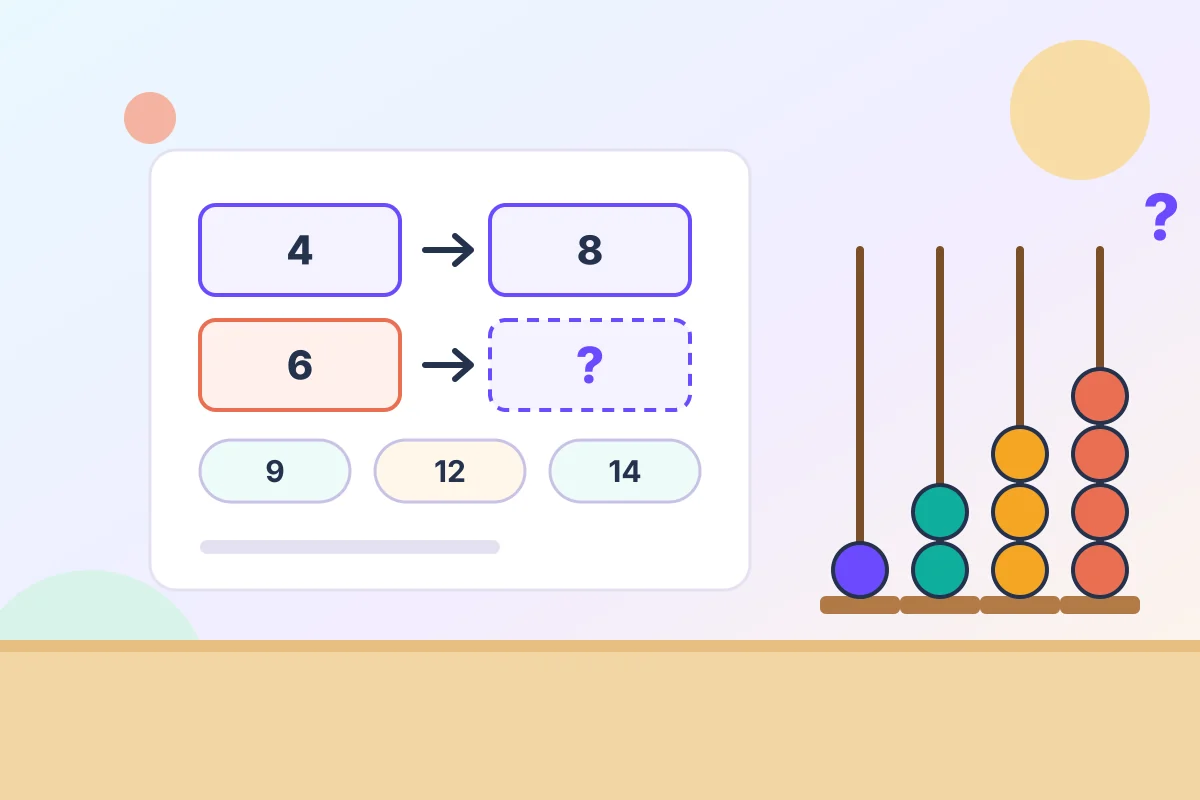
- Part of
- The CogAT (Riverside Insights), alongside the Verbal and Nonverbal batteries
- Subtests
- Number Analogies, Number Puzzles, Number Series—at every level
- Levels 5/6–8 (K–2)
- Pictures, picture “trains,” and bead strings; about 11–15 minutes per subtest
- Levels 9–17/18 (Grades 3–12)
- Numbers and equations; ten minutes per subtest
- Item format
- Pictures, numbers, and symbols rather than words
- In the Screener
- Number Analogies is the Screener’s quantitative subtest
- Scores
- Quantitative Standard Age Score, percentile ranks, stanine; Q+/Q– in the Ability Profile; QN partial composite on some reports
What the Quantitative Battery measures
Every CogAT battery asks children to notice a relationship and carry it over to something new. In the Quantitative Battery, the relationship is about quantity. The step that matters is not the arithmetic itself—it is spotting the rule and checking it against every example.
So the battery is not a math achievement test, although number sense helps. Riverside describes the CogAT as capturing information “not represented in report card grades”, which is why schools use it alongside classwork. For the full test, including the Verbal and Nonverbal batteries, see our CogAT test guide.
Quantitative subtests by level
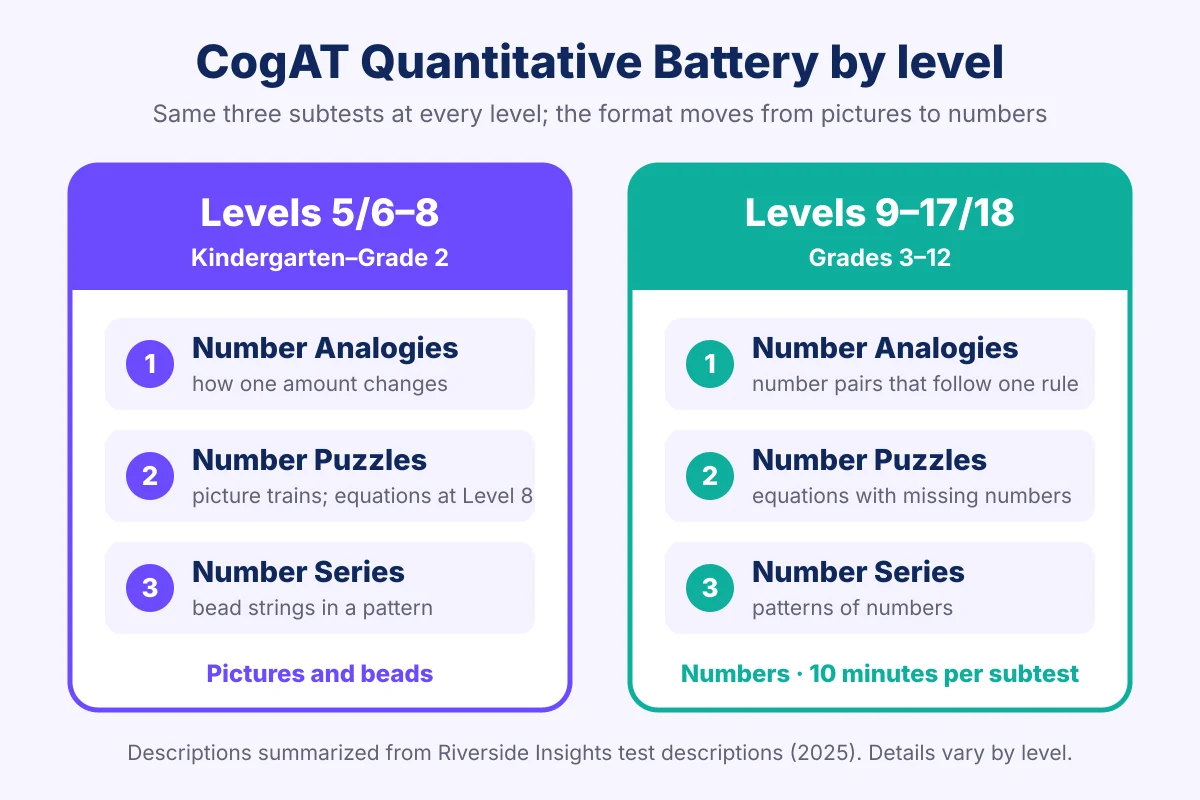
The CogAT has ten levels from kindergarten through grade 12. Levels 5/6–8 are the primary levels, usually given in kindergarten through grade 2, and Levels 9–17/18 cover grades 3–12. A school can choose a different level for a group, so check your district’s notice. The descriptions below follow Riverside’s 2025 test descriptions and its page on Quantitative Battery subtest items.
Number Analogies
The quantitative version of an analogy. Riverside says the subtest uses a 2×2 matrix and “quantitative concepts rather than verbal concepts.” At the primary levels, a picture pair shows an amount changing (for example, some objects are added or taken away), and the child applies the same change to a new amount. At Level 9 some items still use the matrix format; from there, most items show strings of number pairs, and the child works out the rule that both pairs follow, then picks the number that completes the third pair.
Number Puzzles
This is the “make it equal” subtest. At Levels 5/6 and 7, Riverside describes two picture trains: the child picks the car that makes the second train carry the same number of objects as the first. At Level 8, the description changes to an equation with one missing number and four choices. At Level 9, at least one number is missing, and from Level 10 several elements may be missing—children substitute the numbers provided and then solve the equation.
Number Series
The “what comes next?” subtest. At the primary levels the series is shown as strings of beads that make a pattern. Level 9 mixes bead strings shown with numbers and plain number series, and from Level 10 every item is a series of numbers. Patterns can grow, shrink, repeat, or alternate between two steps.
| Subtest | Levels 5/6–8 (K–2) | Levels 9–17/18 (Grades 3–12) | The thinking |
|---|---|---|---|
| Number Analogies | Picture pairs in a 2×2 grid; about 13–15 min | Strings of number pairs (some matrices at Level 9); 10 min | Find one rule that fits every pair, then apply it |
| Number Puzzles | Picture trains; an equation with one missing number at Level 8; about 11–15 min | Equations with missing numbers or symbols to substitute; 10 min | Keep both sides equal |
| Number Series | Bead strings that make a pattern; about 13–15 min | Number series (bead strings still appear at Level 9); 10 min | Describe how each step changes, then continue it |
Primary-level times are Riverside’s approximate figures from its 2023 overview brochure; at Levels 9 and above each subtest is timed at ten minutes. If your child is in second grade, our CogAT practice questions for 2nd grade show every Level 8 subtest, including bead series and simple equations.
How Quantitative Battery scores are reported
The Quantitative Battery has its own scores on the same scales as the other batteries. Riverside’s guide to score types explains them:
- Quantitative Standard Age Score (SAS): compares your child with others of the same age, with a mean of 100 and a standard deviation of 16.
- Percentile ranks: by age and by grade. A percentile rank of 50 is average; it is not the percentage of questions answered correctly.
- Stanine: a broad band from 1 to 9.
- Ability Profile: a short code such as “7C (V+ Q–),” as in Riverside’s sample report. A Q+ marks quantitative reasoning as a relative strength compared with your child’s other batteries; Q– marks a relative weakness.
The QN partial composite
Some reports also show a quantitative-nonverbal (QN) partial composite, which combines the Quantitative and Nonverbal batteries. Riverside calls it an optional score on some paper-based reports and says it predicts achievement in mathematics and some technical areas better than either battery alone. Because the items in those two batteries do not require language, Riverside notes it can also help when interpreting scores for English learners.
Riverside also advises matching students’ particular strengths to what a program demands, so a strong quantitative or QN score is most relevant to math-focused options. Ask which score your district uses—composite, a single battery, or a partial composite—and whether national or local norms apply. Our guide to gifted testing explains local norms, and what a gifted screener is covers the short CogAT Screener, where Number Analogies represents this battery.
Building quantitative reasoning at home
Riverside notes that excessive coaching has reduced impact on CogAT scores, and drilling test-like items is not the goal. Number reasoning grows through everyday talk and play:
- Play “What’s my rule?” Say “2 becomes 5, 4 becomes 7. What does 10 become?” Then let your child invent a rule for you. Our pattern recognition activities include quick variations.
- Balance things. Use a toy scale, two plates of snacks, or two towers of blocks: “How many more do we need to make them equal?” That is the heart of Number Puzzles.
- Build number sense. Counting by twos, noticing doubles, and estimating before counting all help. See number sense activities at home and estimating before solving.
- Keep it short and playful. FocusPlay’s learning games and free worksheets offer quick math and logic practice that fits between other activities.
Practice questions in a similar style
These questions were written by FocusPlay as original practice in a similar style. They are not real test items, they are not taken from any test publisher or prep book, and they should not be used to predict a score. Use them for short, playful familiarity with the format.
Questions 1, 4, and 6 match the picture-based primary levels; read them aloud. Questions 2, 3, 5, 7, and 8 match the number-based upper levels. Ask your child to say the rule in one sentence after each answer—that is the real skill.
1. Number Analogies
Read aloud: “Look at how the top two boxes change. Which box changes the bottom one in the same way?”
Text description: Top row: 2 dots → 5 dots. Bottom row: 4 dots → ?. Choices: A 8 dots, B 7 dots, C 3 dots, D 5 dots.
Show answer
Answer: B — 7 dots. Two dots become five dots, so three dots are added. Four dots plus three more make seven. Eight dots would be doubling, which does not fit the top pair (2 doubled is 4, not 5).
2. Number Analogies
Read aloud: “The first two pairs follow the same rule. Which number fits the rule with the last number?”
[8 → 4] [12 → 8] [20 → ?]
- A. 10
- B. 24
- C. 16
- D. 15
Show answer
Answer: C — 16. Each number goes down by 4: 8 − 4 = 4 and 12 − 4 = 8, so 20 − 4 = 16. Halving works for the first pair but not the second (half of 12 is 6), so 10 is a trap.
3. Number Analogies
Read aloud: “The first two pairs follow the same rule. Which number fits the rule with the last number?”
[2 → 5] [4 → 9] [7 → ?]
- A. 15
- B. 10
- C. 14
- D. 12
Show answer
Answer: A — 15. The rule is “double it, then add 1”: 2 × 2 + 1 = 5 and 4 × 2 + 1 = 9, so 7 × 2 + 1 = 15. Adding 3 works only for the first pair, and adding 5 only for the second, so 10 and 12 are traps.
4. Number Puzzles (trains)
Read aloud: “Both trains must carry the same number of dots. Which car makes the second train carry as many dots as the first train?”
Text description: Train 1 carries 3 dots and 4 dots. Train 2 carries 5 dots and an empty car. Choices: A 4 dots, B 3 dots, C 1 dot, D 2 dots.
Show answer
Answer: D — 2 dots. The first train carries 3 + 4 = 7 dots. The second train already has 5, and 5 + 2 = 7. Choosing 4 copies a car from the first train instead of matching the total.
5. Number Puzzles
Read aloud: “First find the value of the diamond. Then use it to find the missing number.”
◆ × 2 = ? if ◆ = 3 + 4
- A. 9
- B. 14
- C. 10
- D. 24
Show answer
Answer: B — 14. The diamond equals 3 + 4 = 7, and 7 × 2 = 14. Adding 2 instead of multiplying gives 9, a common slip.
6. Number Series (bead strings)
Read aloud: “Look at the beads on each rod. Which rod comes next?”
Text description: Bead rods: 6, 5, 4, 3, ?. Choices: A 2 beads, B 4 beads, C 1 bead, D 7 beads.
Show answer
Answer: A — 2 beads. Each rod has one bead fewer than the one before: 6, 5, 4, 3, so the next rod has 2.
7. Number Series
Read aloud: “Which number comes next in the series?”
3, 6, 12, 24, ?
- A. 36
- B. 30
- C. 27
- D. 48
Show answer
Answer: D — 48. Each number is double the one before: 3, 6, 12, 24, then 48. Adding 12 (to get 36) or 6 (to get 30) only fits one step.
8. Number Series
Read aloud: “Which number comes next in the series?”
5, 9, 7, 11, 9, ?
- A. 7
- B. 15
- C. 13
- D. 11
Show answer
Answer: C — 13. The pattern repeats “add 4, subtract 2”: 5 + 4 = 9, 9 − 2 = 7, 7 + 4 = 11, 11 − 2 = 9, so next is 9 + 4 = 13.
Frequently asked questions
What is on the CogAT Quantitative Battery?
Three subtests at every level: Number Analogies, Number Puzzles, and Number Series. In kindergarten through grade 2 they use pictures, picture trains, and strings of beads; from Level 9 they use numbers and equations.
Is the CogAT Quantitative Battery a math test?
Not exactly. It measures quantitative reasoning: finding and applying rules about amounts and numbers. Basic number sense helps, but the items are built around reasoning rather than taught procedures or grade-level math content.
How long is the CogAT Quantitative Battery?
At Levels 9 and above, each of the three subtests is timed at ten minutes. At the primary levels, Riverside estimates roughly 11 to 15 minutes per quantitative subtest.
What does Q+ or Q– mean on a CogAT report?
They appear in the Ability Profile. Q+ marks quantitative reasoning as a relative strength compared with your child’s other batteries, and Q– as a relative weakness. They describe your child’s own pattern, not a comparison with classmates.
What is the CogAT QN partial composite?
It combines the Quantitative and Nonverbal batteries. Riverside describes it as an optional score on some paper-based reports and says it predicts math achievement better than either battery alone. Because neither battery requires language, it can also help when interpreting scores for English learners.
How can I help my child with CogAT quantitative questions?
Keep it light: notice number patterns in daily life, play “what’s my rule?” games, and talk about how to balance two amounts. Riverside notes that excessive coaching has reduced impact, so short, playful familiarity is enough.
Sources
- Riverside Insights: Structure of the CogAT assessment
- Riverside Insights: CogAT test descriptions (DataManager, 2025)
- Riverside Insights: Quantitative Battery subtest items
- Riverside Insights: CogAT overview brochure (2023)
- Riverside Insights: CogAT Forms 7 and 8 product planning guide
- Riverside Insights: CogAT types of scores
- Riverside Insights: Individual Profile Narrative report guide
- Riverside Insights: Using CogAT scores to identify academically talented students
- Riverside Insights: Introducing CogAT Form 8
Last updated: November 9, 2026. This article is for information only and is not affiliated with or endorsed by the test publishers. Testing rules change; confirm current details with your school or district.
Explore Focusplay learning games