CogAT Practice Questions for Kindergarten: 12 Level 5/6 Examples With Answers
Kindergartners who take the CogAT usually take Level 5/6, the very first level of the test. Every question is a picture, and every direction is read aloud. Here is what each part looks like, followed by 12 original practice questions to try together.
- Test level
- Level 5/6, the first of the primary levels (5/6–8) for kindergarten through grade 2
- Batteries
- Verbal, Quantitative, Nonverbal—three subtests each
- Reading needed
- No; items are pictures and directions are read aloud
- Time per subtest
- Roughly 10–15 minutes at the primary levels, by Riverside’s estimate
- Format
- Paper or online; online testing can play the directions as audio
- Short version
- Some districts give the CogAT Screener (one subtest per battery) first
- Who gives it
- School staff, as a group test
- Publisher
- Riverside Insights
What CogAT Level 5/6 looks like
The CogAT has ten levels spanning kindergarten through grade 12. Levels 5/6, 7, and 8 are the primary levels, and Level 5/6 is the usual match for kindergarten, although a school can choose another level for a group. Riverside’s test descriptions list the same nine subtests for all three primary levels, so a kindergartner sees the same kinds of puzzles as a second grader—just easier versions.
The table summarizes each task, using Riverside’s descriptions and the approximate primary-level times from its 2023 overview brochure.
| Battery | Subtest | What a kindergartner does | About |
|---|---|---|---|
| Verbal | Picture Analogies | Looks at a 2×2 grid with three pictures and picks the picture that completes the second pair | 13–15 min |
| Sentence Completion | Listens to a sentence or question read aloud and picks the picture that answers it | 13–14 min | |
| Picture Classification | Sees three pictures that are alike and picks the one that belongs with them | 13–14 min | |
| Quantitative | Number Analogies | Sees an amount of objects change and applies the same change to a new amount | 13–15 min |
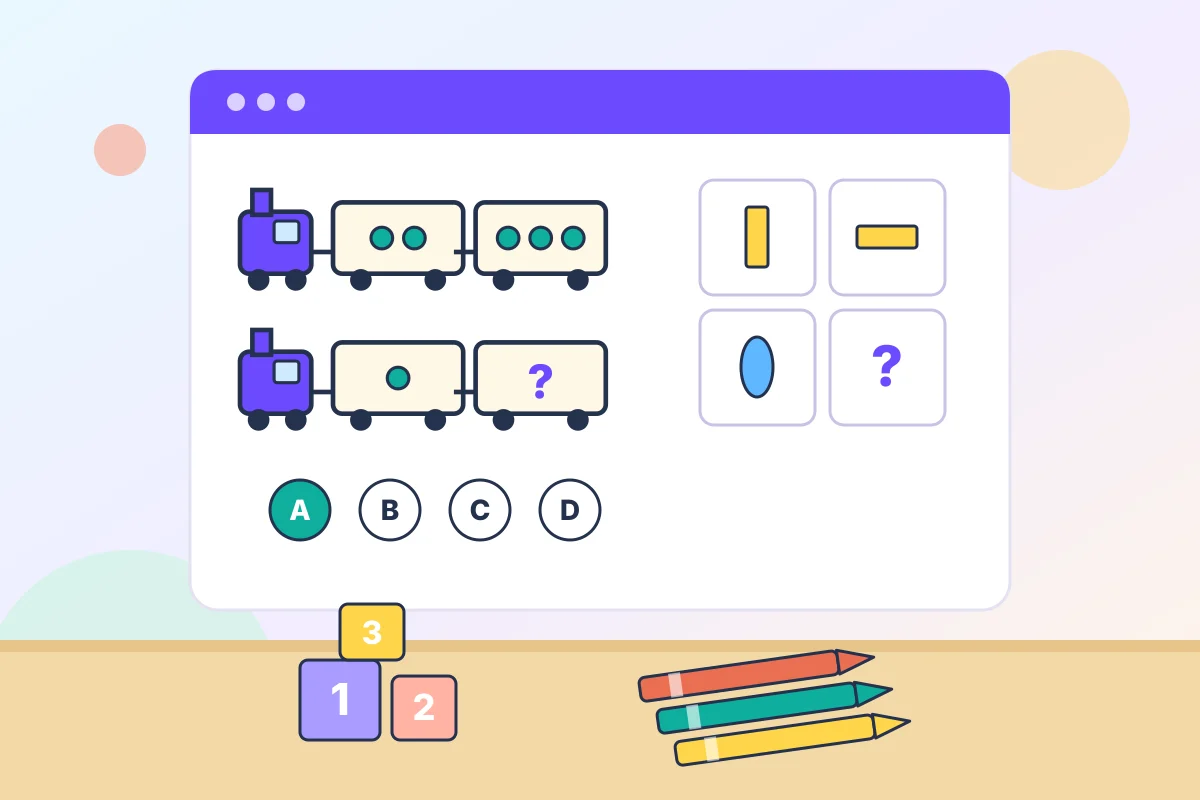
| Number Puzzles | Picks the car that makes two picture trains carry the same number of objects | 11–15 min | |
| Number Series | Studies rods of beads that make a pattern and picks the rod that comes next | 13–15 min | |
| Nonverbal | Figure Matrices | Applies a shape change from one pair of boxes to another | 11–13 min |
| Paper Folding | Imagines paper that is folded, usually cut, and then opened | 10–11 min | |
| Figure Classification | Finds what three figures share and picks the one that matches | 10–13 min |
Two details matter most at this age. First, Number Puzzles at Levels 5/6 and 7 use picture trains rather than written equations—the equation version starts later. Second, Paper Folding at the primary levels usually involves cutting the folded paper; punched holes become the standard format from Level 9. Our guides to the Quantitative Battery and Nonverbal Battery show how these formats change as children move up.
Sentence Completion is the only subtest where a child must listen to language, and Riverside lists it as optional at the primary levels. It can be read in English or Spanish, and Riverside also offers an Alternate-Verbal administration for kindergarten through grade 2. If your child is learning English, ask the school which version it uses. For score types, the Screener, and the upper levels, see our CogAT test guide.
What is different about testing a kindergartner
The puzzles are simple on paper, but the testing situation can be the hardest part for a five- or six-year-old. A few things are worth knowing before test day:
- Listening is part of the task. Children have to wait for the direction, hold it in mind, and then look at every choice. A child who points at the first picture that looks right will miss questions they understand.
- Marking an answer is a skill. Whether the test is on paper or on screen, children have to mark their own choice. That is new for many kindergartners, so a little practice with “point, then choose” helps.
- Attention varies a lot at this age. A tired, hungry, or worried child can score well below what they know. That is one reason schools look at more than one source of information.
- Experience varies a lot too. Some children have done dozens of puzzle books and some have never seen a 2×2 grid. A short introduction to the formats makes the test fairer for the second group, which is why Riverside advises giving everyone in a group the same practice—or nobody.
How to use these practice questions
Think of these as conversation starters, not a test. These habits keep practice useful and light:
- Do two or three at a time. Kindergartners are done long before adults expect. Stop while it is still fun, and come back another day.
- Read the direction exactly. Read the “Read aloud” line, then wait. If your child is stuck, ask “What is the same? What changed?” instead of pointing toward an answer.
- Make looking at every choice a habit. Ask your child to touch each picture before choosing. Many wrong choices are close: the right change on the wrong object, or only one of two changes.
- Ask for the reason. “Why does that one go?” is the most valuable question. A child who says “they’re all black” or “it lies down now” has found the rule.
- Use real objects when needed. Count out real dots or blocks for the train question, or fold and cut a real sheet of paper for Paper Folding. Then let your child check the answer.
- Never time it. The goal is comfort with the formats, not speed.
Practice questions in a similar style
These questions were written by FocusPlay as original practice in a similar style. They are not real test items, they are not taken from any test publisher or prep book, and they should not be used to predict a score. Use them for short, playful familiarity with the format.
There are 12 questions—at least one for each of the nine Level 5/6 subtest types, with a second, slightly harder example for Picture Analogies, Number Analogies, and Figure Matrices. Read the direction aloud, let your child point to an answer, then open the answer box together and talk about the rule.
1. Picture Analogies
Read aloud: “Look at the top two pictures. A bird goes with the sky. Which picture goes with the fish in the same way?”
Text description: Top row: bird → sky. Bottom row: fish → ?. Choices: A cloud, B water, C tree, D boot.
Show answer
Answer: B — water. A bird moves through the sky, and a fish swims in water. The cloud belongs with the sky, so it matches the bird’s side of the puzzle, not the fish’s.
2. Picture Analogies
Read aloud: “The top two pictures go together. Which picture goes with the full bowl in the same way?”
Text description: Top row: full glass → empty glass. Bottom row: full bowl → ?. Choices: A empty bowl, B full bowl, C empty glass, D spoon.
Show answer
Answer: A — empty bowl. The glass was full and became empty, so the full bowl becomes an empty bowl. The empty glass shows the right change but on the wrong object.
3. Sentence Completion
Read aloud: “Listen carefully. Which one is round and is something you can eat?”
Text description: Choices: A ball, B banana, C block, D orange.
Show answer
Answer: D — orange. The orange is the only choice that fits both clues. The ball is round but not food, and the banana is food but not round.
4. Picture Classification
Read aloud: “These three pictures are alike in some way. Which picture below belongs with them?”
Text description: Given: apple, grapes, banana. Choices: A carrot, B cheese, C pear, D basket.
Show answer
Answer: C — pear. Apples, grapes, and bananas are all fruits, and so is a pear. A carrot and cheese are foods too, but they are not fruits; a basket can hold fruit but is not one.
5. Number Analogies
Read aloud: “Look at how the top two boxes change. Which box below shows the same change for the hearts?”
Text description: Top row: 3 dots → 5 dots. Bottom row: 4 hearts → ?. Choices: A 5, B 6, C 4, D 8 hearts.
Show answer
Answer: B — 6 hearts. Three dots became five dots, so two were added. Four hearts plus two more is six hearts. Eight would mean doubling, which does not fit 3 → 5.
6. Number Analogies
Read aloud: “Look at the stars in the top boxes. Something happened to them. Which box shows the same thing happening to the bottom stars?”
Text description: Top row: 6 stars → 4 stars. Bottom row: 5 stars → ?. Choices: A 4, B 6, C 7, D 3 stars.
Show answer
Answer: D — 3 stars. Six stars became four, so two stars were taken away. Five take away two leaves three. Four stars would be taking away only one.
7. Number Puzzles (trains)
Read aloud: “Both trains must carry the same number of dots. The second train has an empty car. Which car should go there?”
Text description: Train 1 carries 2 dots and 3 dots. Train 2 carries 1 dot and an empty car. Choices: A 4, B 3, C 5, D 2 dots.
Show answer
Answer: A — 4 dots. Train 1 carries 2 + 3 = 5 dots. Train 2 already has 1 dot, so it needs 4 more to carry 5. Choosing 5 copies the total instead of finding the missing part.
8. Number Series (bead rods)
Read aloud: “The beads on these rods make a pattern. Which rod comes next?”
Text description: Rods: 2, 3, 4, 5 beads, then ?. Choices: A 4, B 7, C 6, D 5 beads.
Show answer
Answer: C — 6 beads. Each rod has one more bead than the rod before it: 2, 3, 4, 5, so the next rod has 6. Five beads repeats the last rod instead of continuing the pattern.
9. Figure Matrices
Read aloud: “The top two boxes go together. Which box goes with the bottom shape in the same way?”
Text description: Top row: standing rectangle → lying rectangle. Bottom row: standing oval → ?. Choices: A standing oval, B small standing oval, C lying rectangle, D lying oval.
Show answer
Answer: D — oval lying down. The rectangle tips over from standing up to lying down, so the oval should lie down too. Choice C lies down but is the wrong shape.
10. Figure Matrices
Read aloud: “Look at the top boxes. The shape changed in two ways. Which box shows the bottom shape changing the same two ways?”
Text description: Top row: white square on the left → black square on the right. Bottom row: white triangle on the left → ?. Choices: A black triangle right, B white triangle right, C black triangle left, D black square right.
Show answer
Answer: A — black triangle on the right. The square turned black and moved to the right side. The triangle must do both: turn black and move right. B and C each make only one of the two changes.
11. Paper Folding (fold and cut)
Read aloud: “A square paper is folded in half. Then one corner is cut off, like in the picture. What will the paper look like when it is opened?”
Text description: A square is folded in half, left side onto right side. The top-right corner of the folded paper is cut off. Choices: A only top-right corner cut, B both top corners cut, C top-right and bottom-right corners cut, D round hole in the middle.
Show answer
Answer: B — both top corners cut. The cut went through both layers. When the paper opens, the cut shows up twice, mirrored across the fold: once at the top right and once at the top left.
12. Figure Classification
Read aloud: “The three shapes on top are alike in some way. Which shape below goes with them?”
Text description: Given: black circle, black square, black triangle. Choices: A white star, B striped circle, C black heart, D white square.
Show answer
Answer: C — black heart. The shapes are all different, but every one is colored in black. The black heart is the only choice that is black. The circle and square match a shape on top but not the color.
Beyond practice questions
Riverside notes that excessive coaching has reduced impact on CogAT results. That matches what many parents find: once a child understands each format, more drilling adds little, and it can make a young child anxious about “the test.” Everyday play builds the same thinking:
- Verbal: play “what goes together?” at breakfast (“A bird goes in the sky. Where does a fish go?”) and sort toys into groups, then ask your child to name the group. Our vocabulary games article has more ideas.
- Quantitative: share snacks between two plates so each has the same number, and build block towers that grow by one. See number sense activities at home.
- Nonverbal: fold a paper and cut a corner, then guess what it will look like before opening it. Our pattern recognition activities and spatial reasoning activities collect more.
- FocusPlay’s learning games and free worksheets include kindergarten counting, pattern, and shape practice in short sessions.
A test score is one piece of information. Gifted programs usually combine it with other evidence, such as teacher observations, classroom work, or a second test, and one morning of testing does not define what a five-year-old can do. Children also change quickly at this age, so a kindergarten result is a snapshot, not a final word. Our parent’s guide to gifted testing explains the wider process, our gifted screener guide covers the short version some schools give first, and our 2nd grade CogAT practice questions show how the same formats grow at Level 8.
Frequently asked questions
What CogAT level do kindergartners take?
Kindergartners usually take Level 5/6, the first of the CogAT’s ten levels. A school can choose a different level for a group, so check the notice from your district.
Does my kindergartner need to read for the CogAT?
No. At Level 5/6 the questions are pictures, shapes, beads, and dots, and the directions are read aloud by the teacher or played as audio in the online version.
How long is the CogAT for kindergarten?
Riverside estimates roughly 10 to 15 minutes for each of the nine subtests at the primary levels. Schools often spread the subtests across several short sessions, and some give only the three-subtest Screener.
What subtests are on CogAT Level 5/6?
Picture Analogies, Sentence Completion, and Picture Classification (Verbal); Number Analogies, Number Puzzles, and Number Series (Quantitative); and Figure Matrices, Paper Folding, and Figure Classification (Nonverbal).
Should I prepare my kindergartner for the CogAT?
A little familiarity helps a young child feel comfortable with the formats. Riverside notes that excessive coaching has reduced impact, so a few relaxed sessions and everyday reasoning games are enough.
Are these real CogAT questions?
No. They are original FocusPlay questions written in a similar style. They are not test items and cannot predict a score.
Sources
- Riverside Insights: CogAT test descriptions (DataManager)
- Riverside Insights: Structure of the CogAT assessment
- Riverside Insights: CogAT overview brochure (2023)
- Riverside Insights: Introducing CogAT Form 8
Last updated: November 11, 2026. This article is for information only and is not affiliated with or endorsed by the test publishers. Testing rules change; confirm current details with your school or district.
Explore Focusplay learning games