CogAT Levels by Grade: Which Level Will My Child Take?
The testing letter from school says your child will take "CogAT Level 8" or "Level 10," and the number does not match the grade. Here is how the ten CogAT levels line up with grades, how many questions and minutes each level has, why a school might pick a level above or below grade, and what changes when children move from Level 8 to Level 9.
- Publisher
- Riverside Insights
- Number of levels
- Ten: 5/6, 7, 8, 9, 10, 11, 12, 13/14, 15/16, 17/18
- Primary levels
- 5/6 to 8 (usually kindergarten to grade 2); picture-based, not timed
- Upper levels
- 9 to 17/18 (usually grades 3 to 12); printed words and numbers, 10 minutes per subtest
- Subtests
- Nine at every level, three in each battery (Verbal, Quantitative, Nonverbal)
- Items
- 118 at Level 5/6, rising to 176 at Levels 10 to 17/18
- Forms
- Form 7 and Form 8, equivalent versions offered at the same levels
- Who picks the level
- The school or district, using Riverside's planning guidance
CogAT levels and grades at a glance
The level number roughly follows the age of a typical student taking it. A kindergartner is 5 or 6, so the kindergarten level is 5/6. A second grader is usually 7 or 8 and takes Level 8. From Level 13/14 on, each level covers two grades. The item counts and times below come from Riverside's help center page on testing times and item counts.
| Level | Usual grade | Items (all nine subtests) | Testing time | Format |
|---|---|---|---|---|
| 5/6 | Kindergarten | 118 | About 112 min, not timed | Pictures; directions read aloud |
| 7 | Grade 1 | 136 | About 107 min, not timed | Pictures; directions read aloud |
| 8 | Grade 2 | 156 | About 122 min, not timed | Pictures; directions read aloud |
| 9 | Grade 3 | 170 | 90 min (10 per subtest) | Printed words and numbers; shapes for Nonverbal |
| 10 | Grade 4 | 176 | 90 min (10 per subtest) | Printed words and numbers; shapes for Nonverbal |
| 11 | Grade 5 | 176 | 90 min | Same |
| 12 | Grade 6 | 176 | 90 min | Same |
| 13/14 | Grades 7-8 | 176 | 90 min | Same |
| 15/16 | Grades 9-10 | 176 | 90 min | Same |
| 17/18 | Grades 11-12 | 176 | 90 min | Same |
Those times count only the working time. Directions, practice items, and breaks add more, and young children usually take the test across several short sessions. For Levels 5/6 to 8, Riverside notes that the times are estimates for scheduling and that "these tests are not timed."
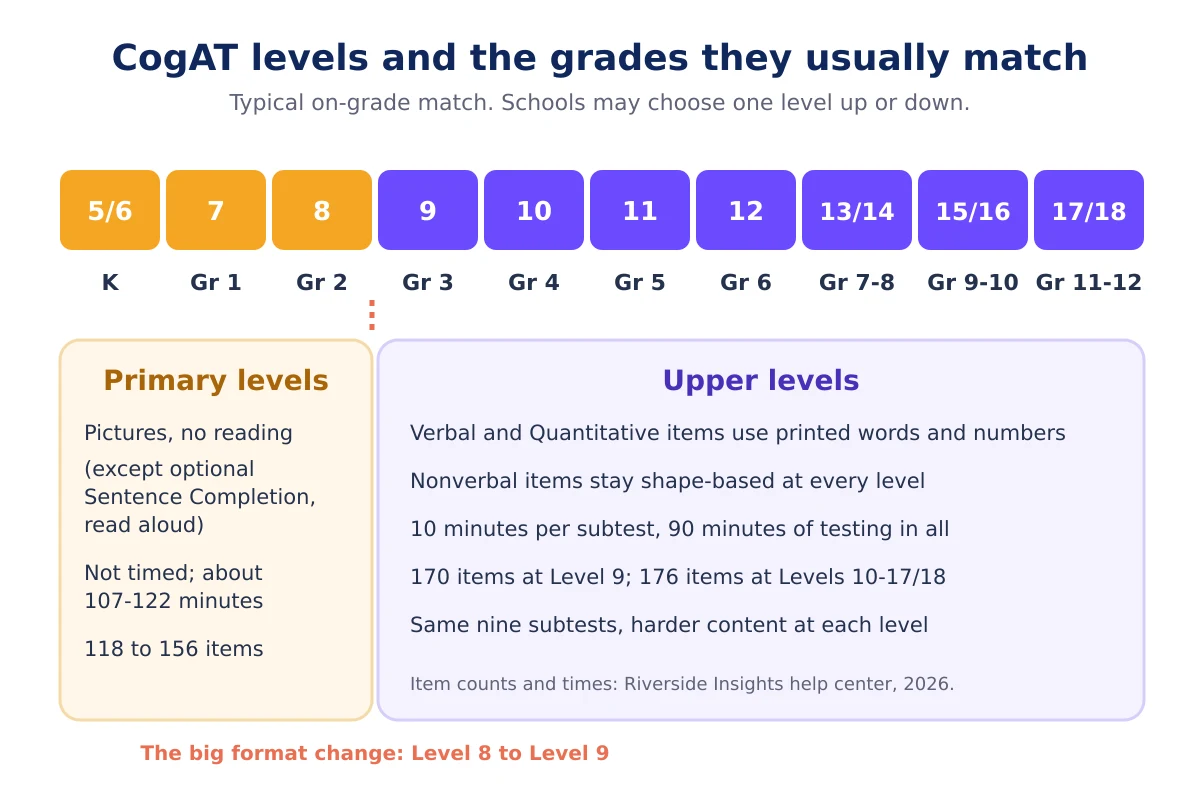
What levels 5/6, 7, and 8 look like
At the primary levels, a teacher or the online audio reads every direction. Riverside's introduction to Form 8 says these subtests "use only pictures with language used only in the directions." A kindergartner does not need to read a single word. The one partial exception is Sentence Completion, an optional Verbal subtest at these levels, where the teacher reads a question aloud and the child picks a picture.
The jump from Level 5/6 to Level 8 is mostly about length and difficulty. Each subtest grows by a few questions: Picture Analogies has 14 items at Level 5/6 and 18 at Level 8, and Paper Folding goes from 10 to 16. A first grader taking Level 7 answers 136 questions in total, spread over several sittings. Our kindergarten CogAT practice questions and 2nd grade CogAT practice questions show every subtest at these levels.
Level 9: the biggest change in the whole test
Level 9 is where the Verbal and Quantitative batteries move from pictures to printed words and numbers. Picture Analogies becomes Verbal Analogies and Picture Classification becomes Verbal Classification, so the child now reads each item instead of looking at pictures. The Nonverbal battery keeps using shapes. Every subtest also gets a fixed 10-minute limit, where the primary levels had none.
So a third grader faces three new things at once: reading the items, working against a clock, and harder content. A child who reads slowly may know the word relationships but run short of time. Riverside's retesting guidance even warns schools to be careful about moving English learners from Level 8 to Level 9, because the Verbal format changes so much. If your third grader is a new or reluctant reader, tell the teacher before testing day; that context matters when the scores come back. The CogAT Verbal Battery guide and Quantitative Battery guide show each subtest before and after the switch.
Levels 10 through 17/18
From Level 10 up, the test has the same shape at every level: nine subtests, 176 items, 10 minutes each. What changes is the difficulty of the words, numbers, and figures. A seventh grader on Level 13/14 sees the same nine question types as a fourth grader on Level 10, in harder versions. The Verbal and Quantitative guides linked above, along with the CogAT Nonverbal Battery guide, walk through each subtest at the upper levels.
How schools choose a level
Most of the time the school gives the on-grade level and never thinks twice. Riverside's planning guide does allow more flexibility. Its level-selection table has separate columns for fall (August 1 to November 30), midyear (December 1 to February 29), and spring (March 1 to July 31), and separate rows for classes that are typical, lower performing, or higher performing. For example, an average first-grade class tested in the fall takes Level 7, while the same grade in the spring might take Level 7 or Level 8. A third-grade class tested in the spring might take Level 9 or Level 10.
Two rules from that guidance matter for gifted testing:
- When the table lists two possible levels, Riverside says to "use the higher level if testing for gifted identification." A harder level leaves more room at the top, so very strong reasoners are less likely to answer everything correctly and hit the ceiling.
- Students who work well above or well below their grade peers can take a higher or lower level than their grade. Riverside's retesting note adds that going one level up or one level down still gives valid scores.
Some programs outside schools test above grade on purpose. Northwestern University's Center for Talent Development, for instance, offers a grade-level CogAT for kindergarten and first grade and an above-grade-level version for grades 2 through 9.
How scores work when the level does not match the grade
Parents often worry that a child given a lower level is being held back, or hope that a higher level will lift the score. Neither is quite right. Riverside's guidance says performance on any level, on grade or off grade, is "evaluated based on the expectations for a student that age and grade." A second grader who takes Level 9 needs fewer correct answers to earn a given Standard Age Score than a third grader taking the same level. A fourth grader who takes Level 9 needs more correct answers than a third grader to earn the same score.
In other words, the Standard Age Score and the age percentile still compare your child with children of the same age nationally. The level changes how hard the questions feel and how much room there is at the top. Our guide to gifted test percentiles explains what those percentile numbers mean, and the main CogAT test guide covers the full score report.
Levels, forms, and retesting
The form and the level are two separate things. Riverside built Form 8 to the same specifications as Form 7, with entirely different questions, and describes the two as equivalent forms. Each form comes in the same set of levels, so "Form 8, Level 9" and "Form 7, Level 9" are the same test design with different items.
This matters if your child needs to retest. Riverside recommends waiting at least three months, and preferably six, before giving the same form at the same level again, to limit practice effects. A school that needs to retest sooner can switch to the other form or keep the form and change the level.
A real example: South Carolina's grade 2 screening
South Carolina shows how a state uses one level for a whole grade. Its Department of Education page for fall 2026 says all second graders take CogAT Level 8, Form 8, along with the Iowa Assessments, during an October 5 to October 27 window. Under State Board Regulation 43-220, a student qualifies by meeting two of three dimensions. The aptitude dimension is a CogAT score at or above the 93rd national age percentile in one or more areas. Other states and districts use different grades, levels, and cutoffs, so read your own district's notice for the numbers that apply to your child.
Practice questions in a similar style
These questions were written by FocusPlay as original practice in the general style of CogAT item types at different levels. They are not real test items and should not be used to estimate a score.
The questions move up through the levels, from a kindergarten listening item to a grade 4 number puzzle, so you can see how the same subtests change. Read the "Read aloud" line to younger children. For kindergarten through grade 2, one or two questions at a sitting is enough.
Question 1: Sentence completion (Verbal, Level 5/6 style)
Read aloud: Listen carefully. It is cold outside. Which one do you wear on your head to keep warm?
- A) boots
- B) a hat
- C) a scarf
- D) mittens
Show answer
B, a hat. All four things help on a cold day, but only a hat goes on your head. Boots go on feet, a scarf goes around the neck, and mittens go on hands.
Question 2: Figure classification (Nonverbal, Level 7 style)
Read aloud: The three shapes in the top row go together in some way. Which shape below goes with them?
Text description: top row, a square, a circle, and a triangle, each with exactly half shaded. Choices: A a fully shaded square, B a circle with one quarter shaded, C an unshaded star, D a hexagon with half shaded.
Show answer
D. In every top figure exactly half of the shape is shaded. Only the hexagon has half shaded. The square is all shaded, the circle has a quarter, and the star has none.
Question 3: Number puzzles (Quantitative, Level 8 style)
Read aloud: Which number goes in the box so that both sides are equal?
□ − 3 = 2 + 4
- A) 3
- B) 6
- C) 9
- D) 10
Show answer
C, 9. The right side is 2 + 4 = 6. The number that leaves 6 after taking away 3 is 9, because 9 - 3 = 6.
Question 4: Paper folding (Nonverbal, Level 8 style)
Read aloud: A square piece of paper is folded in half, top down. Then a half circle is cut from the bottom edge. What does the paper look like when it is opened?
Text description: a square is folded top half down onto the bottom half, so the fold is along the top of the folded sheet. A half circle is cut from the middle of the bottom edge. Choices: A notches in the middle of the top and bottom edges, B one notch in the middle of the bottom edge, C a round hole in the center, D notches in the middle of the left and right edges.
Show answer
A. The bottom edge of the folded sheet holds two layers: the real bottom edge and the old top edge, which was folded down to meet it. The cut goes through both, so the open sheet has a notch at the top and at the bottom. A hole in the center would need a cut on the fold.
Question 5: Verbal classification (Verbal, Level 9 style)
Read aloud: Read the three words. Which word goes with them?
oak · maple · pine
- A) rose
- B) grass
- C) willow
- D) leaf
Show answer
C, willow. Oak, maple, and pine are all kinds of trees, and so is a willow. A rose and grass are plants but not trees, and a leaf is only part of a tree.
Question 6: Verbal analogies (Verbal, Level 9 style)
Read aloud: The first two words go together. Which word goes with scissors in the same way?
pencil → write : scissors → ?
- A) paper
- B) sharp
- C) draw
- D) cut
Show answer
D, cut. A pencil is a tool you use to write. Scissors are a tool you use to cut. Paper is something you might cut, and sharp describes scissors, so neither names the action.
Question 7: Number analogies (Quantitative, Level 10 style)
Read aloud: Find the rule that changes the first number into the second in each pair. Use the same rule to finish the last pair.
[3 → 10] [5 → 16] [6 → ?]
- A) 19
- B) 18
- C) 21
- D) 17
Show answer
A, 19. The rule is multiply by 3, then add 1: 3 × 3 + 1 = 10 and 5 × 3 + 1 = 16. So 6 × 3 + 1 = 19. Adding 7 works for the first pair but not the second, which is why both pairs need checking.
Question 8: Number puzzles with symbols (Quantitative, Level 10 style)
Read aloud: Each shape stands for a number. Use the first line to find the number for the circle.
▲ = 2 × 4 ● = ▲ − 3 ● = ?
- A) 8
- B) 5
- C) 11
- D) 6
Show answer
B, 5. The triangle is 2 × 4 = 8. The circle is 8 - 3 = 5. Choosing 8 means stopping after the first step.
What to do with the level on your child's letter
Look up the level in the table above and check whether it matches the grade. If it does, nothing special is going on. If it is one level higher, the school is probably following Riverside's advice for gifted screening, and your child may find the test harder than classwork; that is expected and it is accounted for in scoring. If it is one level lower, ask why. There may be a good reason, such as a class of English learners staying on the picture-based Level 8.
For a second grader heading into Level 8, a few picture puzzles at home are enough to make the format familiar. For a third grader facing Level 9 for the first time, practice reading short directions and working through a handful of questions without help, since that is the new part. Everyday reading, card and board games, and short sessions with FocusPlay's learning games or our free worksheets build the same reasoning without turning it into test prep.
The CogAT is one source of evidence, and most districts combine it with grades, achievement tests, or teacher observations before making a placement. If the letter does not say which level, form, or norms your child's school uses, email the gifted coordinator and ask for those three details along with the qualifying criteria. Our guide to gifted testing for kids covers the rest of the process.
Frequently asked questions
What CogAT level is given in 2nd grade?
Level 8 is the usual level for second grade, and it is still picture-based with directions read aloud. South Carolina, for example, gives CogAT Level 8 to all second graders in its fall 2026 gifted screening. A school may choose a different level for a particular class, so check the testing notice.
What CogAT level is given in 3rd grade?
Level 9 is the usual level for third grade. It is the first level where the Verbal and Quantitative items use printed words and numbers, and each subtest has a 10-minute limit. Riverside's planning table lists Level 10 as an option for some third-grade classes tested in the spring.
Can my child take a CogAT level above their grade?
Yes. Riverside's guidance says students working well above or below grade peers may take a higher or lower level, and that one level up or down still gives valid scores. When two levels fit a class, Riverside suggests the higher one for gifted identification.
Does taking a higher CogAT level raise my child's score?
Not by itself. Riverside says every level is scored against children of the same age and grade, so a younger student on a harder level needs fewer correct answers for the same score, and an older student on an easier level needs more.
How long is each CogAT level?
Riverside lists about 112 minutes for Level 5/6, 107 for Level 7, and 122 for Level 8, as untimed estimates. From Level 9 up, each of the nine subtests gets 10 minutes, for 90 minutes of testing plus directions and breaks.
Are CogAT Form 7 and Form 8 different levels?
No. The form and the level are separate. Form 7 and Form 8 are equivalent versions with different questions, and each comes in the same set of levels. A school can retest sooner by switching to the other form.
Sources
- Riverside Insights: CogAT testing times, item counts, and completion criteria
- Riverside Insights: Choosing the right test level (CogAT planning help)
- Riverside Insights: Guidance on retesting a student with CogAT using the same form and level (2025)
- Riverside Insights: Cognitively Speaking, Introducing CogAT Form 8
- South Carolina Department of Education: Gifted and Talented Program, Grade 2
- Northwestern University Center for Talent Development: Grade-level assessment, CogAT
Last updated: November 23, 2026. This article is for information only and is not affiliated with or endorsed by the test publishers. District rules change; confirm current details with your school or district.
Explore Focusplay learning games