What Is the OLSAT-8? A Parent's Guide to the Otis-Lennon School Ability Test
Your school sent home a note saying your second grader will take the "OLSAT" next month. Here is what the test covers at each grade, how the scores work, how two California districts use the results, and what the question types look like.

- Full name
- Otis-Lennon School Ability Test, Eighth Edition (often written OLSAT 8)
- Publisher
- Pearson; authors Arthur S. Otis and Roger T. Lennon
- Grades
- Kindergarten to grade 12, in seven levels (A to G)
- Content
- Verbal, nonverbal, and quantitative items in five clusters
- Time
- Varies by level; Pearson lists a maximum of 75 minutes
- Format
- Paper for grades K-12, online for grades 2-12; group or individual
- Scores
- School Ability Index (by age), percentile rank, stanine, and NCE by age or grade
- Norms
- Fall and spring norms based on 40,000 students nationally (Pearson)
- Who sets cutoffs
- Your district or state, not Pearson
What the OLSAT-8 measures
Pearson's overview brochure says the test "measures cognitive abilities that relate to a student's academic success in school." The tasks include spotting likenesses and differences, recalling words and numbers, following directions, classifying, putting things in order, solving arithmetic problems, and completing analogies.
The key distinction is between ability and achievement. A reading or math achievement test asks what a child has already learned in class. The OLSAT-8 asks how well a child reasons with new material, which is why Pearson's product page calls it "a general ability indicator." In practice the line is blurry. A kindergartner who has never heard the word "opposite" will struggle with an antonym item regardless of reasoning ability, so vocabulary and listening skills still matter, especially on the verbal side.
OLSAT-8 levels by grade
The test uses a single form with seven levels. Each level is written for a particular grade range.
| Level | Usual grade | Format options (Pearson) |
|---|---|---|
| A | Kindergarten | Paper |
| B | Grade 1 | Paper |
| C | Grade 2 | Paper or online |
| D | Grade 3 | Paper or online |
| E | Grades 4-5 | Paper or online |
| F | Grades 6-8 | Paper or online |
| G | Grades 9-12 | Paper or online |
Districts sometimes use these levels a little differently. Manhattan Beach Unified, for example, lists Level D for grade 3, Level E for grades 4-5, and Level F for grades 6-7, with 64 items at Level D and 72 items at Levels E and F.
The five clusters and the item types inside them
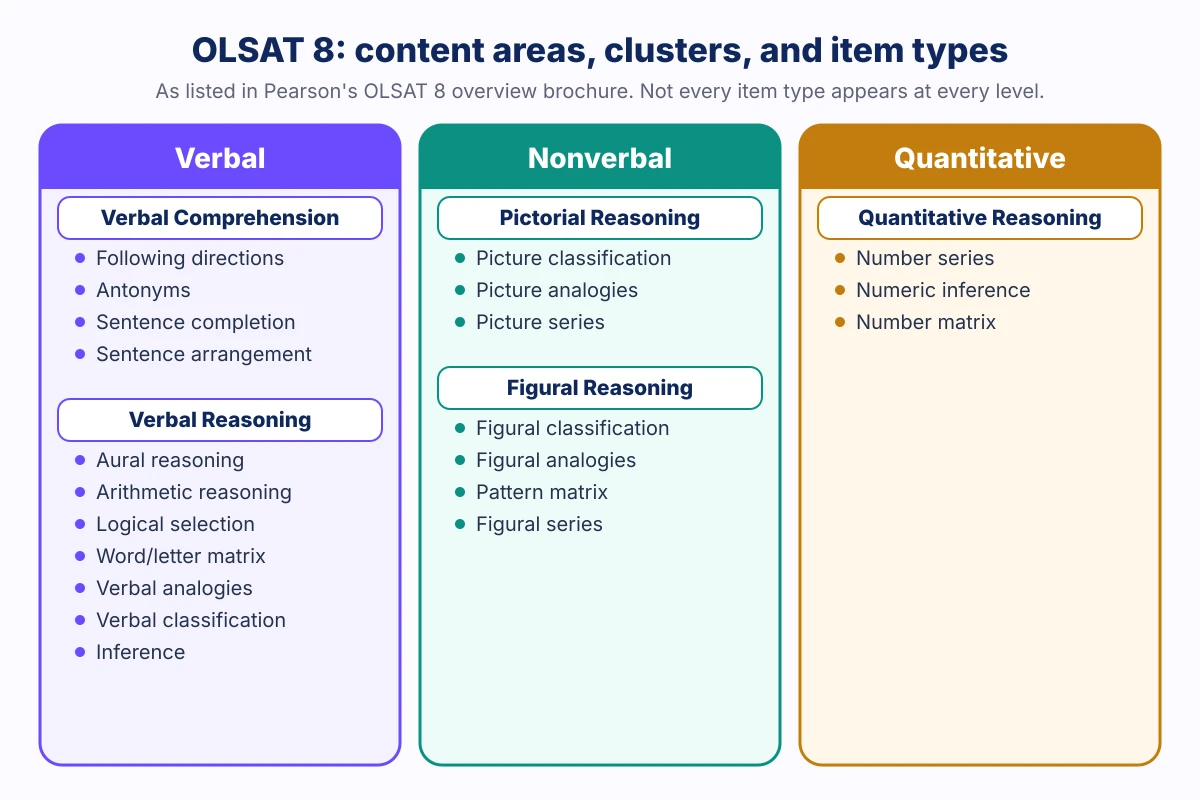
Pearson groups OLSAT-8 items into three content areas and five clusters. Not every item type appears at every level. The youngest children see more picture-based questions, while older students see more questions built on words, letters, and numbers.
Verbal comprehension
These items check how well a child understands language: following spoken directions, choosing opposites (antonyms), finishing a sentence, and putting scrambled words into a sentence.
Verbal reasoning
Here the child uses language to reason. Item types include aural reasoning (listening and choosing a picture), arithmetic reasoning (short word problems), logical selection (choosing what something always has or must be), word and letter matrices, verbal analogies, classification, and inference.
Pictorial and figural reasoning
The nonverbal clusters use pictures of real objects (pictorial) or abstract shapes (figural). Children find the picture that does not belong, complete an analogy, continue a series, or fill in the missing cell of a pattern matrix.
Quantitative reasoning
Number series, numeric inference, and number matrices ask children to find a rule that connects numbers. These items rely more on spotting patterns than on computation speed.
How OLSAT-8 scores are reported
Pearson's product page lists these score types: School Ability Index (SAI), percentile rank, stanine, and normal curve equivalent (NCE) by age, plus percentile rank, stanine, and NCE by grade. When a school gives the OLSAT-8 together with the Stanford 10 achievement test, it can also print an achievement/ability comparison.
Two details trip up many parents. First, a percentile rank is a position in a comparison group, not the share of questions answered correctly. An 88th percentile means your child scored as well as or better than about 88 percent of the comparison group. Our guide to gifted test percentiles explains why the top of that scale stretches. Second, age norms and grade norms can give different results. A child who is young for the grade can have a higher age percentile than grade percentile on the same answers. LAUSD's 2024 parent presentation states that students are "scored based on their chronological age, not grade-level."
Many reports show separate verbal and nonverbal results next to the total. LAUSD's 2024 criteria, for instance, look at Total, Verbal, and Nonverbal age percentile ranks, and a strong score on any one of the three can count.
How districts use the OLSAT-8: two examples
Pearson publishes the test, but each district decides who takes it, at what grade, and which scores lead to a placement. Two California districts show how much this can differ.
| Los Angeles Unified (2024 parent presentation) | Manhattan Beach Unified (2025-26 GATE page) | |
|---|---|---|
| Who is tested | Universal screening of second graders, Level C | Grade 3 during the school day; grades 4-7 by voluntary after-school sign-up |
| Format and time | Paper, at school, 60 questions, about 82 minutes, usually two sittings | Paper, 40 minutes per level, given in March |
| Main score used | Age percentile rank (Total, Verbal, or Nonverbal) | School Ability Index |
| Qualifying rule | 95 or above for the High Achievement category; 90-94 counts for students with certain meal codes or at CEP schools | 135 or above identifies a student; 130-134 also qualifies with "exceeding" results in both ELA and math on the CAASPP |
| Other paths | A 99 on any of the three scores triggers automatic referral for an Intellectual Ability evaluation | Students who do not qualify in grade 3 may retest once in grade 4 or 5 and once in grade 6 or 7 |
Notice that LAUSD treats the OLSAT-8 as a screener for one category and says "only an intellectual assessment" can identify a student as highly gifted. That pattern is common: a group test opens a door, and other evidence decides what happens next. Our LAUSD GATE identification guide covers the full process there, and the GATE test guide compares the tests California districts use. Rules change from year to year, so read your own district's current notice before relying on any number above.
OLSAT-8 compared with CogAT and NNAT3
The OLSAT-8 is one of three group ability tests parents meet most often. The CogAT from Riverside Insights has three separate batteries (verbal, quantitative, and nonverbal) and reports a score for each. The NNAT3 from Pearson uses only shape-and-color matrix puzzles, with no words at all. The OLSAT-8 sits between them: it mixes verbal, picture, figure, and number items in one test. If your district gives two of these tests in different years, expect the scores to differ somewhat. They measure overlapping but not identical skills, and each has its own norm group.
Practice questions in a similar style
These questions were written by FocusPlay as original practice in the general style of OLSAT-8 item types. They are not real test items and should not be used to estimate a score.
Read the "Read aloud" line to younger children, the way a teacher reads directions in a group session. For kindergarten through grade 2, one or two questions at a sitting is plenty.
Question 1: Following directions (verbal comprehension)
Read aloud: Look at the shapes. Point to the square that is next to the star.
Text description: five shapes in a row. A is a circle, B is a square, C is a triangle, D is a square, E is a star.
Show answer
D. There are two squares. Square B sits between the circle and the triangle. Square D is the only square beside the star.
Question 2: Sentence arrangement (verbal comprehension)
Read aloud: These words make a sentence when you put them in the right order. The capital letter shows the first word, and the period shows the end. Which word comes third?
late · Our · was · bus .
- A) late
- B) was
- C) bus
- D) Our
Show answer
B, was. The sentence is "Our bus was late." "Our" starts with a capital, so it comes first, and "was" is the third word.
Question 3: Arithmetic reasoning (verbal reasoning)
Read aloud: Listen to the story. Rosa has 4 bags. Each bag has 3 shells in it. She gives 5 shells to her brother. How many shells does Rosa have now?
- A) 7
- B) 12
- C) 9
- D) 2
Show answer
A, 7. Four bags of 3 shells make 12 shells. After she gives away 5, Rosa has 12 - 5 = 7.
Question 4: Logical selection (verbal reasoning)
Read aloud: Which one does a bicycle always have?
- A) a bell
- B) a basket
- C) wheels
- D) a light
Show answer
C, wheels. Many bikes have a bell, a basket, or a light, but some do not. Every bicycle has wheels. The word "always" is the clue.
Question 5: Picture series (pictorial reasoning)
Read aloud: Look at the candles in the top row. They change from one box to the next. Which candle goes in the empty box?
Text description: top row shows a tall candle, a shorter candle, then a short candle, then an empty box. Choices: A a candle taller than the first, B a medium candle, C two short candles, D a very short candle.
Show answer
D. The candle gets shorter by the same amount in each box, as if it were burning down. The next step is the very short candle.
Question 6: Figural analogy (figural reasoning)
Read aloud: The first two boxes go together in a certain way. Find the picture that goes with the third box in the same way.
Text description: a big circle with a small square inside changes into a big square with a small circle inside. Then a big triangle with a small circle inside changes into the missing picture.
Show answer
A. The outside shape and the inside shape trade places. A big triangle around a small circle becomes a big circle around a small triangle.
Question 7: Figural series (figural reasoning)
Read aloud: Watch where the dot goes in each square. Which square comes next?
Text description: the dot moves from the top-left corner to the top-right corner to the bottom-right corner. Choices: A top-left, B top-right, C bottom-left, D center.
Show answer
C. The dot travels clockwise around the corners, one corner per step. After the bottom-right corner comes the bottom-left corner.
Question 8: Number matrix (quantitative reasoning)
Read aloud: The numbers in each row follow the same rule. Which number belongs where the question mark is?
| 2 | 3 | 6 |
| 4 | 5 | 20 |
| 3 | 7 | ? |
- A) 10
- B) 21
- C) 24
- D) 18
Show answer
B, 21. In each row, the first number times the second gives the third: 2 × 3 = 6 and 4 × 5 = 20, so 3 × 7 = 21. Adding does not work, because 2 + 3 is 5, not 6.
What parents can do before test day
Show your child a handful of sample questions a week or two ahead so the format is not a surprise. A six-year-old who has never seen a "which one comes next" row of pictures may freeze on the first one; a child who has tried three at the kitchen table usually does not. After that, stop. Weeks of drilling can make a child anxious and does little for the reasoning the test is trying to sample.
Everyday habits matter more. Read aloud and talk about words ("What's the opposite of arrive?"). Play board games that involve planning. Ask "how did you know?" when your child solves a puzzle, which builds the habit of checking a rule. Short sessions with pattern activities, logic games, FocusPlay's learning games, or our free worksheets keep reasoning practice playful.
On the morning of the test, a normal breakfast and an ordinary goodbye work better than a pep talk about scores. If your child has a documented disability, ask the school early which accommodations are allowed; LAUSD's 2024 presentation lists extended time and repeated directions among the changes that invalidate an OLSAT-8 result there.
When the report arrives, look at the verbal and nonverbal results as well as the total, and compare them with what you see at home and in class. A single score from one morning is not a full picture of a child, and most programs combine it with other measures. If you are unsure what a result means or whether a retest is possible, email the school's gifted coordinator and ask for the written criteria and the next testing window. Our guide to gifted testing for kids walks through the rest of the process.
Frequently asked questions
What does the OLSAT-8 test measure?
The OLSAT-8 measures reasoning skills linked to school learning: verbal, nonverbal, and quantitative. Pearson describes it as an indicator of how well a student learns, not what the student has already learned. Questions include following directions, analogies, classification, series, and arithmetic reasoning.
What OLSAT-8 level will my child take?
Pearson's levels are A for kindergarten, B for grade 1, C for grade 2, D for grade 3, E for grades 4-5, F for grades 6-8, and G for grades 9-12. A district can choose a different level, so the testing notice from your school is the best guide.
How long is the OLSAT-8?
Pearson lists the completion time as varying by level, with a maximum of 75 minutes. District schedules differ: LAUSD's 2024 second-grade plan gave Level C as 60 questions over about 82 minutes in two sittings, while Manhattan Beach Unified lists 40 minutes per level.
What is a good OLSAT-8 score?
A percentile rank of 50 is average for the child's age. Gifted cutoffs are set by districts, not by Pearson. LAUSD's 2024 rules used an age percentile rank of 95 or higher for its High Achievement category, and Manhattan Beach Unified identifies students with a School Ability Index of 135 or higher.
Is the OLSAT-8 an IQ test?
No. It is a group ability test that schools often use for screening. An individual intelligence test given by a psychologist, such as the WISC-V, is a different kind of assessment. LAUSD's 2024 presentation notes that only an intellectual assessment can identify a student as highly gifted.
Can my child prepare for the OLSAT-8?
A few sample items help a child understand the format and feel calmer on test day. Long drill sessions are not needed and can backfire. Everyday reading, conversation, puzzles, and math games build the same reasoning skills in a healthier way.
Sources
- Pearson: Otis-Lennon School Ability Test, Eighth Edition (product page)
- Pearson: OLSAT 8 overview brochure
- Los Angeles Unified School District: Spring 2024 OLSAT-8 second-grade administration, parent presentation
- Manhattan Beach Unified School District: GATE identification
Last updated: November 20, 2026. This article is for information only and is not affiliated with or endorsed by the test publishers. District rules change; confirm current details with your school or district.
Explore Focusplay learning games