Working Memory and Math: Why Children Lose Their Place
A child may understand the math and still forget an instruction, skip a step, or lose track of an intermediate answer. Visible supports can protect the reasoning without reducing the rigor.
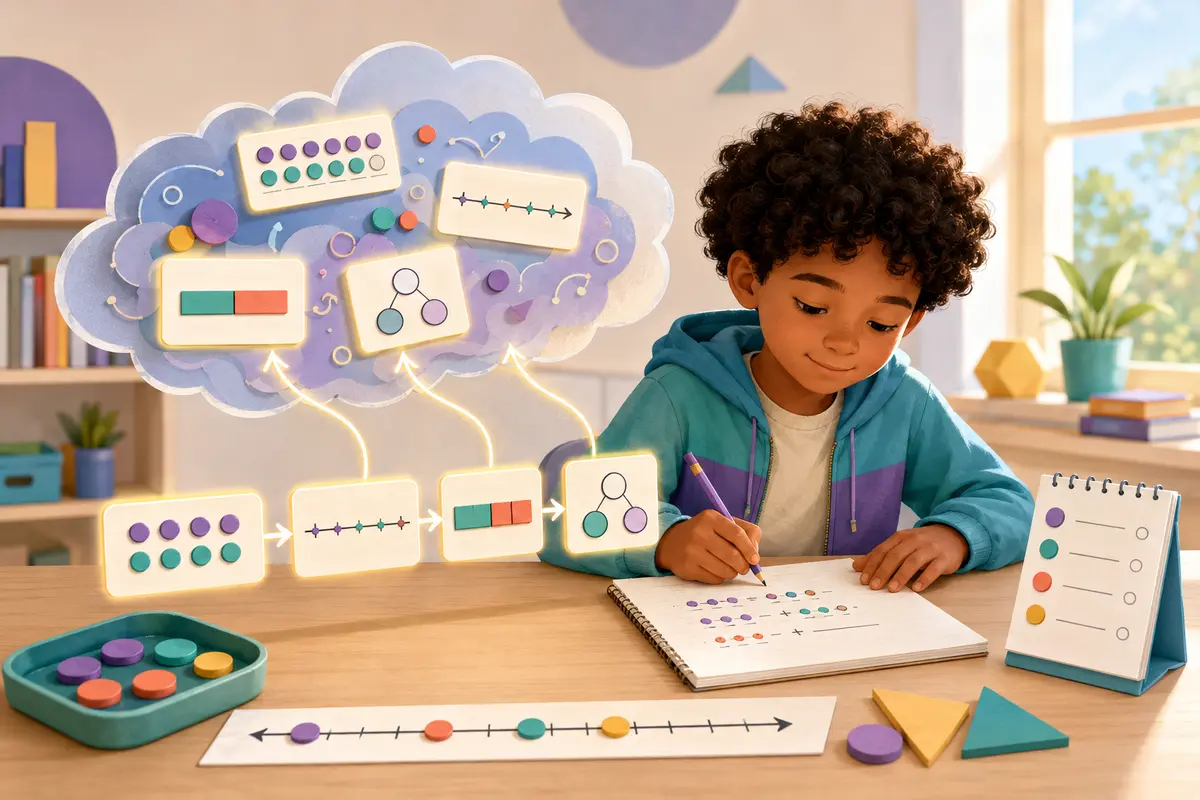
A child solves 7 × 6 correctly but forgets what to do with the answer. Another begins a word problem with the right operation, then leaves out an important number. A middle schooler understands an equation when each step is shown but becomes lost when expected to hold the entire process in mind.
These errors can look careless. Sometimes they reflect an unfinished mathematical skill. At other times, the learner understands the idea but is carrying more information than they can manage comfortably at once.
What is working memory?
Working memory is part of the broader set of skills often called executive function. The Center on the Developing Child at Harvard University describes executive-function skills as helping people focus attention, manage information, make decisions, plan, and switch between tasks. It identifies working memory, mental flexibility, and self-control as related components of this system.
Working memory is not the same as remembering information for weeks or years. Long-term memory helps a learner recall that 6 × 7 = 42. Working memory helps the learner hold 42 while deciding how it fits into the next part of a problem.
It is also not a label that explains every mistake. Attention, reading comprehension, mathematical knowledge, language, fatigue, anxiety, and unclear instructions can produce similar behavior. One worksheet or game round cannot identify a working-memory weakness.
Where hidden memory demands appear
Multi-step calculations
A learner may need to remember a partial product, regrouped digit, sign, or previous result while performing the next calculation.
Word problems
The child must identify relevant information, understand the situation, select an operation, and remember what the question asks.
Mental math
Mental calculation deliberately removes written support. That can be useful when efficient strategies are already familiar, but it can overload a learner who is still constructing the method.
Following directions
“Choose two numbers, find their product, compare it with the target, and explain your strategy” contains several actions. A learner may understand every action individually but forget the sequence.
Switching representations
Moving from a picture to an equation, a table to a graph, or a story to a diagram requires the learner to preserve the mathematical relationship while changing formats.
Navigating an interface
Remembering what to drag, where to place it, and when to submit can compete with the learning task. If controls are unfamiliar, the result may reveal interface difficulty rather than mathematical understanding.
Working-memory load or a skill gap?
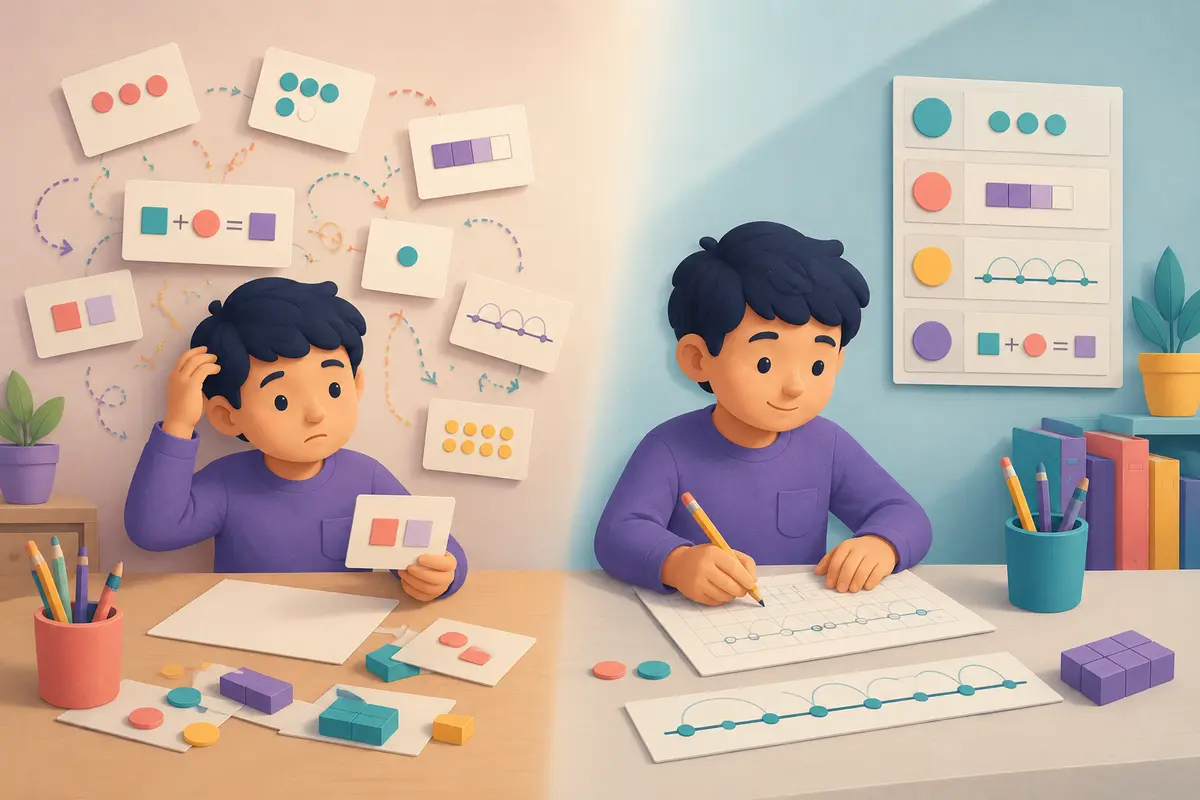
The two can overlap. Look at the pattern, then test one support at a time.
| What you observe | Memory load may be involved | A skill gap may be involved |
|---|---|---|
| The child begins correctly but loses the sequence | Often | Possibly |
| Performance improves when steps remain visible | Often | Possibly |
| The learner succeeds with scratch paper but not mentally | Often | Not necessarily |
| The child forgets the question while calculating | Often | Not necessarily |
| The underlying idea is unclear even with visual support | Less likely to be the only issue | More likely |
| The same misconception appears in several formats | Possibly | More likely |
| Errors rise sharply when extra instructions are added | Often | Possibly |
This is not a diagnostic checklist. If showing the steps, shortening the instruction, or providing a visual representation immediately improves performance, unnecessary memory load may have been part of the problem.
Seven ways to reduce unnecessary load
Put the steps where the learner can see them
Do not require a child to remember a long procedure when memory is not the skill being assessed. A short checklist—find the important numbers, choose the operation, solve, check the question—preserves the sequence while leaving the mathematics to the learner.
Give one direction at a time
Begin with “Find two numbers that make 24.” After the learner responds, ask for the explanation. Breaking apart a long instruction can reveal whether the difficulty lies in the mathematics or in retaining the full direction.
Keep important information visible
Leave the target, rule, diagram, units, worked example, number line, or place-value chart available when it is needed throughout the task. The IES mathematics guidance recommends well-chosen concrete and visual representations. A support should clarify the relationship, not crowd the page.
Encourage external recording
Writing is external memory. The learner can circle relevant numbers, cross out completed steps, draw groups, record partial products, label a diagram, or keep a running total. The work does not need to be elaborate; it needs to keep useful information available.
Use consistent language and controls
If the same action is described differently each time, the learner must first decide whether the rule has changed. Clear, repeated language and familiar interaction patterns allow more attention to remain on the skill.
Separate accuracy, reasoning, and speed
A learner who is still remembering a process should not also be expected to perform it rapidly. Check understanding, strategy choice, accuracy, and explanation before adding speed. Timed practice is one possible fluency tool—not a requirement for every task.
Pause for a strategy review
Ask: “Where did you almost lose your place?” “What did you write down so you would not forget?” or “What will you do first next time?” For grades 4–8, the IES problem-solving guide strongly recommends helping students monitor and reflect on their process.
Examples by grade band
Kindergarten through Grade 2
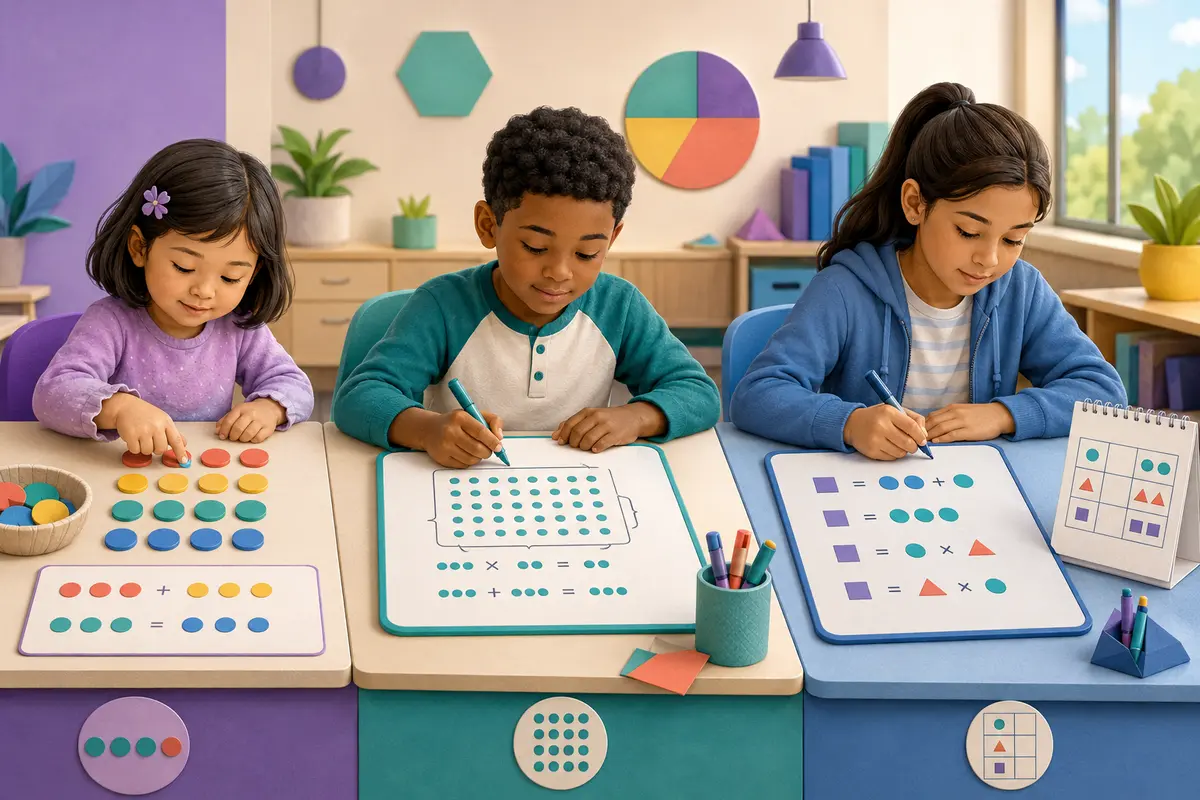
Keep both groups visible and ask one question at a time: “How many are here?” then “How many are in the other group?” and finally “Which has more?” Touching, moving, or marking objects can prevent repeated restarts.
Grades 3 through 5
A learner solving 24 ÷ 4 may know division but struggle to hold several facts in mind. Make the relationship visible as 4 × ___ = 24, use an array, and record the answer to one step before returning to the problem.
Grades 6 through 8
Encourage one transformation per line, visible negative signs, labeled quantities, tables for proportional relationships, marked completed information, and substitution to check a final answer. These are tools for organizing complex reasoning, not childish supports.
What support should not become
Support can be useful without turning every task into a sequence in which the adult reads every instruction, chooses every strategy, points to every number, and checks the answer before submission.
The goal is not to test how much information a child can hold while learning a new mathematical idea. The goal is to help the learner organize and perform the process with increasing independence.
Do memory games automatically improve math?
Memory games can provide enjoyable practice with locations, sequences, patterns, or rules. They should not automatically be described as a treatment for math difficulty or proof that academic performance will improve.
Research on computerized working-memory training and transfer to other abilities has produced mixed findings. A large meta-analysis found improvement on tasks similar to those trained but no convincing evidence of reliable far transfer to arithmetic when compared with active controls. Broader benefits should be measured rather than assumed.
A memory activity practices the memory demands contained in that activity. Direct mathematics instruction and practice remain important when mathematics is the intended outcome.
Using Focusplay thoughtfully
Focusplay includes grade-organized activities across math, brain, memory, logic, attention, language, and creativity. Depending on the activity, learners encounter short rounds, clear goals, immediate feedback, familiar controls, visual supports, and progress records available to authorized adults.
These features can help an adult observe patterns without treating one result as a diagnosis. Does the learner succeed when the target remains visible? Do errors increase when several rules are active? Does repeating the instruction help? Can the learner explain the strategy afterward?
Focusplay records results and progress patterns, but it does not replace a full educational or clinical assessment. Learn more about how Focusplay works, explore the K–8 learning areas, or read How to Help a Child With Math Without Giving the Answer.
When to ask for additional support
Talk with the child’s teacher when the learner regularly forgets short instructions across subjects, loses track during most multi-step tasks, shows a persistent gap between oral understanding and independent work, needs substantially more prompting than classmates, or experiences significant distress around schoolwork.
A teacher can compare the pattern with classroom expectations and instructional history. If needed, the school or another qualified professional can determine whether targeted assessment is appropriate. Similar behavior can have several explanations; support should be based on the full pattern, not one game, score, or observation.
Make the thinking visible
When a child loses their place, repeating “Pay attention” may not solve the actual problem. Make the goal visible. Shorten the instruction. Record intermediate answers. Use a stable representation. Let the learner complete one decision at a time.
These changes do not remove mathematical reasoning. They protect it from being hidden behind unnecessary memory demands. A child who can see where they are is in a much better position to decide where to go next.