Worked Examples for Kids: A Practical K–8 Guide
A worked example shows not just the answer, but the path to it. Used well, it gives children a visible model to study before they solve a closely related problem on their own.
Key takeaways
- Choose an example that closely matches the new problem.
- Make the reasoning visible, not only the final answer.
- Ask for explanation instead of copying.
- Alternate examples with problems the child solves.
- Fade the model when the learner can explain and apply the method.
What is a worked example?
A worked example is a fully or partly solved model that displays the decisions and steps needed for a task. In mathematics, it might show how to compare two fractions, calculate a percentage, or solve an equation. In writing, it could show how a vague sentence becomes precise through revision. The important feature is that the route from question to answer is visible.
This is different from simply revealing an answer key. An answer key confirms a result; a worked example exposes the method. The learner should be able to point to a step and say what changed, why it changed, and how that move helps reach the goal.
Why can solved examples help?
New multistep tasks can place heavy demands on working memory because a learner must hold the goal, relevant facts, rules, and intermediate results at once. A clear example keeps the steps available for inspection. This does not remove thinking; it directs attention toward the structure of the solution. See our guide to working memory and math for more ways to keep reasoning visible.
The U.S. Institute of Education Sciences recommends interleaving worked example solutions with problem-solving exercises in its guide on organizing instruction and study. The New South Wales Department of Education likewise recommends worked examples when students are learning new content or skills, followed by a gradual move toward independent problem solving. These recommendations support a useful balance: model, think, try, and then reduce help.
The Look–Explain–Hide–Try–Compare routine
1. Look at the whole example
Start with one legible model, not a crowded page of solutions. Identify the question, the goal, the information given, and the final answer. If the task uses a diagram, labels should sit close to the part they explain.
2. Explain the purpose of each step
Ask short questions: “What changed here?” “Why was that operation chosen?” “How does this step connect to the goal?” A child can annotate with arrows, colors, or a few words. If explanation stalls, model one sentence and invite the child to complete the next.
3. Hide part of the solution
Cover the last step and ask the child to predict it. Next, use a completion problem with one step missing. This turns the example from something to copy into something to reconstruct. Keep the hidden portion small enough that the learner can still use the visible structure.
4. Try a closely related problem
Change the numbers, words, or shapes while keeping the underlying method stable. A near match helps the learner recognize which features matter. Avoid jumping immediately to a much harder variation; that tests transfer before the method is secure.
5. Compare and fade
Place the attempt beside the example. Compare steps before checking the final answer: What matched? Where did the paths separate? What should be revised? On the next problem, remove a label or prompt. Eventually, put the example away. This is the same supportive stance described in our guide to helping with math without giving the answer.
Worked examples by grade band
| Grade band | Example to study | Next problem |
|---|---|---|
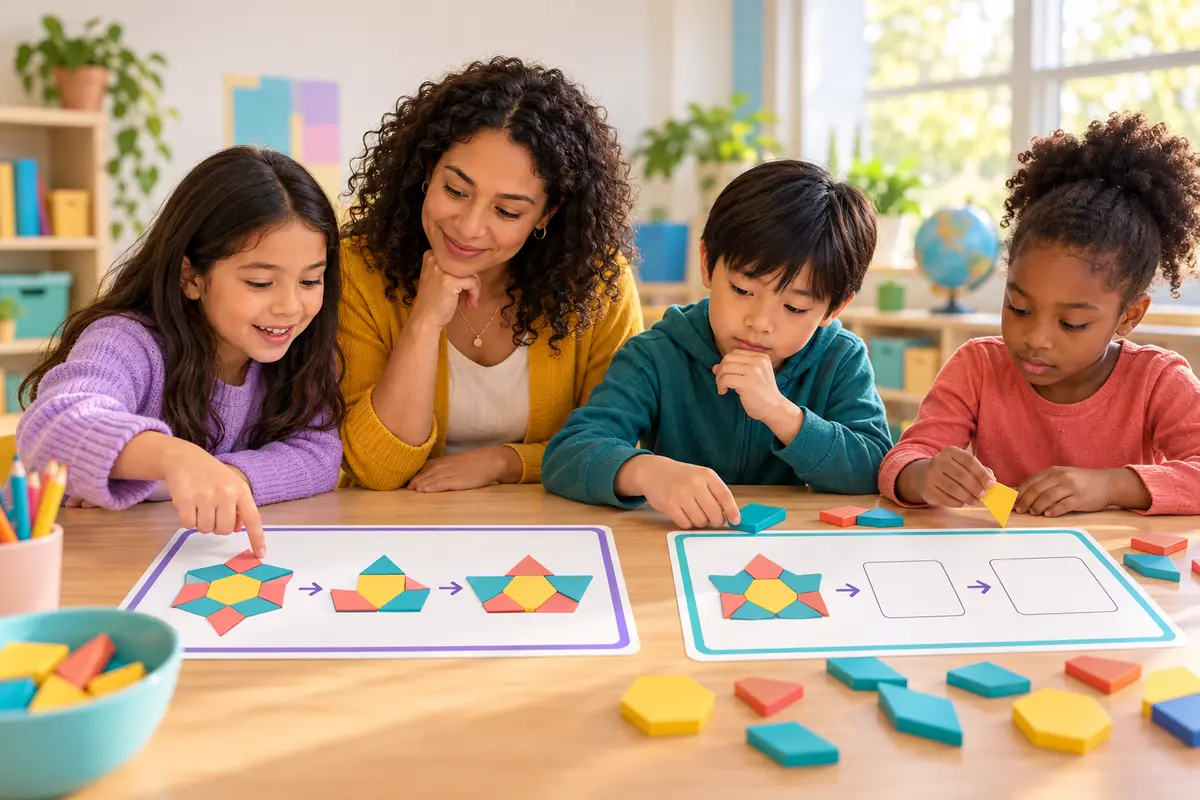
| K–2 | A completed arrangement of shapes grouped by color and number | Build a new arrangement using the same grouping rule |
| Grades 3–5 | An annotated fraction comparison using equal-size visual models | Compare a new pair and explain which visual clue matters |
| Grades 6–8 | A solved ratio, percent, or equation with a reason beside each step | Solve a near-match, then identify the step that stays the same |
The same structure works beyond math. A teacher can show a paragraph with revision notes, a science response that connects evidence to a claim, or a grammar example that labels how parts of a sentence function. Choose a model that reveals the thinking students are expected to use.
Common mistakes to avoid
- Showing only polished work: Label the decisions so the method is visible.
- Asking children to copy: Add prediction, explanation, or a missing step.
- Using a mismatched example: Keep the first practice problem structurally close to the model.
- Leaving support in place too long: Fade prompts once the child can explain and use them.
- Removing support too quickly: Return to one clearer example when errors show that the method is not yet understood.
Connect examples to purposeful practice
Worked examples are a bridge, not the destination. After a child studies, explains, and applies a model, use a short independent task or game round to practise the same idea. FocusPlay’s K–8 learning games can provide one playful practice option; follow it with a simple question such as, “Which move was most like the example?”
Frequently asked questions
What is a worked example in teaching?
A worked example is a model that shows both a problem and the steps used to solve it. Learners study why each step works before trying a closely related problem.
Do worked examples make children passive?
They can if children only copy. Ask learners to explain a step, predict what comes next, cover part of the solution, and then solve a similar problem so the example becomes active study.
How many worked examples should a child study?
There is no universal number. Use enough examples for the child to explain the method, then alternate examples with similar problems and reduce support as accuracy and understanding improve.
Are worked examples only for math?
No. They can model a science explanation, a writing revision, a grammar analysis, or a multistep procedure whenever the reasoning and sequence are made visible.
Sources
- Institute of Education Sciences, What Works Clearinghouse: Organizing Instruction and Study to Improve Student Learning
- Institute of Education Sciences: Assisting Students Struggling with Mathematics—Intervention in the Elementary Grades
- New South Wales Department of Education: Cognitive Load Theory in Practice