How to Give Kids Multi-Step Directions: A K–8 Guide
When a child completes the first action and forgets the rest, the solution is often a clearer system—not a louder reminder.
Key takeaways
- Describe what to do, not only what to stop doing.
- Separate actions and preserve their order with gestures, pictures, or a short list.
- Check understanding before assuming the child refused.
- Reduce prompts gradually so support leads toward independence.
Why multi-step directions are demanding
A direction such as “Put your paper in the folder, return the book, and meet me at the table” combines listening, remembering, ordering, and action. Working memory—one component of executive function—helps a learner hold and use information while doing something else. The Harvard Center on the Developing Child's executive function overview describes working memory alongside mental flexibility and self-control.
That does not mean every forgotten instruction signals an executive-function problem. The wording may be vague, the routine may be unfamiliar, the room may be noisy, or the child may not know a key term. Clear directions reduce avoidable load and make it easier to see what actually needs teaching.
The Connect–Chunk–Show–Check–Fade routine
1. Connect before directing
Move close enough to be heard, use the child's name if needed, and pause competing conversation. State the context briefly: “We are getting ready to leave.” Avoid giving important directions from another room or while the child is absorbed in a different task.
2. Chunk the sequence into observable actions
Replace “Get organized” with actions someone can see: “Close the notebook. Put it in the blue folder. Place the folder in your backpack.” Use a neutral tone and remove extra explanation from the middle of the sequence.
3. Show the order
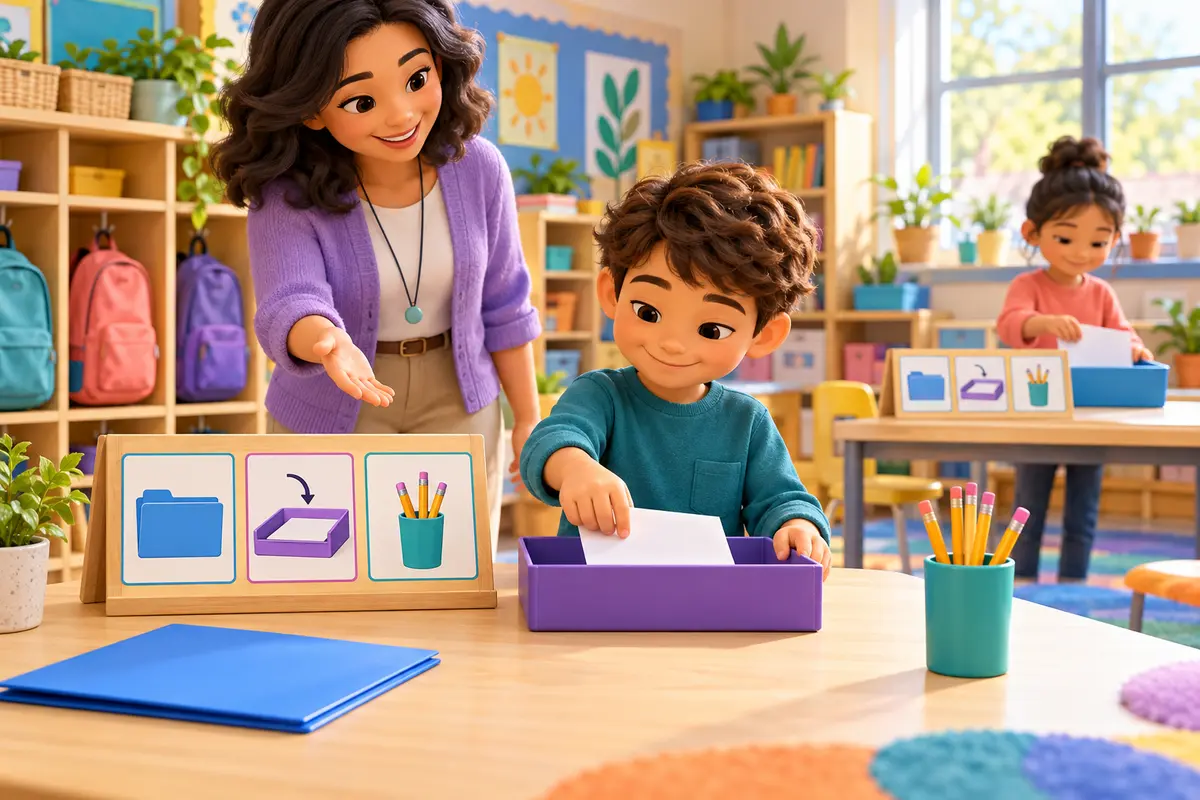
Point to the materials, hold up fingers, draw three quick boxes, or provide a checklist. A visual does not have to be elaborate. Its job is to preserve the sequence after the spoken words disappear.
4. Check the first move
Instead of asking, “Did you hear me?” try, “What will you do first?” The child can say, point, or begin. If the starting action is wrong, restate only the missing information and let the child try again.
5. Fade the support
Once the routine is accurate, remove one prompt at a time. A three-picture strip might become a two-word checklist and later a single cue such as “pack up.” If performance drops, briefly restore the last support that worked.
Adjust the format by grade band
| Grade band | Helpful format | Example |
|---|---|---|
| K–2 | One or two familiar actions, paired with an object, gesture, or picture. | “Book on shelf, then sit on the rug.” |
| Grades 3–5 | A short numbered list with materials and a visible finish. | “1. Title the page. 2. Solve 1–5. 3. Put it in the green tray.” |
| Grades 6–8 | A concise written sequence, deadline, and quality check the student can manage independently. | “Open the lab file, record three observations, then submit the chart before cleanup.” |
These are starting points, not tests of what every child “should” do. Familiar routines require less support than new tasks, and busy settings require more external structure than quiet ones.
Three common direction makeovers
From vague to visible
Instead of: “Clean everything up.” Try: “Blocks in the bin, paper in recycling, then chairs under the table.” Name the categories and the finish.
From repeated talking to a stable cue
If the same morning routine requires many reminders, photograph or draw the steps once. Point to the cue rather than adding new wording each time. Consistent language makes the routine easier to learn.
From correction to brief feedback
Notice the completed action specifically: “You checked the list and brought both materials.” The December 2024 What Works Clearinghouse K–5 behavior guide recommends modeling and teaching clear expectations, reminding students, and acknowledging expected behavior.
What to do when the child does not follow through
Check four possibilities before adding more consequences: Did the child hear the direction? Understand the words? Know how to do each action? Remember the order? Then reduce the task to the first workable step.
The CDC's guidance on giving directions, written for toddlers and preschoolers, emphasizes age-appropriate, specific statements, one direction at a time, a neutral tone, and gestures when useful. Older learners also benefit from precision, but they can take increasing responsibility for recording and checking their own sequence.
Connect directions to Focusplay
Before a Focusplay activity, ask the child to identify the first action and the finish. Afterward, use one brief reflection: “Which direction helped you know what to do?” For longer school tasks, combine this routine with chunking strategies. For classroom cleanup or lesson changes, pair it with a consistent transition routine. Focusplay games can provide a low-pressure setting for reading a direction, acting, checking, and trying again.
Frequently asked questions
Why can a child follow one step but not several steps?
A multi-step direction requires the child to hold information, preserve its order, and act while ignoring distractions. Missing a later step does not automatically mean defiance; the direction may need to be shorter, visible, or taught.
Should children repeat directions back?
A brief restatement, gesture, or point to a checklist can confirm understanding. Ask what the child will do first rather than demanding a perfect recital of every word.
How many steps should a child be able to follow?
There is no universal number for every age or situation. Begin with a sequence the child can complete accurately, then add complexity while adjusting for familiarity, language, distractions, and available visual support.
When should families or teachers seek extra support?
Consider discussing the pattern with the child's teacher, pediatrician, or another qualified professional when difficulty following clear, practiced directions is persistent across settings or regularly interferes with safety, learning, or daily routines.
Sources
- Centers for Disease Control and Prevention: Steps for Giving Good Directions (August 8, 2024)
- Center on the Developing Child at Harvard University: InBrief—Executive Function
- What Works Clearinghouse: Teacher-Delivered Behavioral Interventions in Grades K–5 (December 2024)