Classroom Transition Strategies: A Practical K–8 Guide
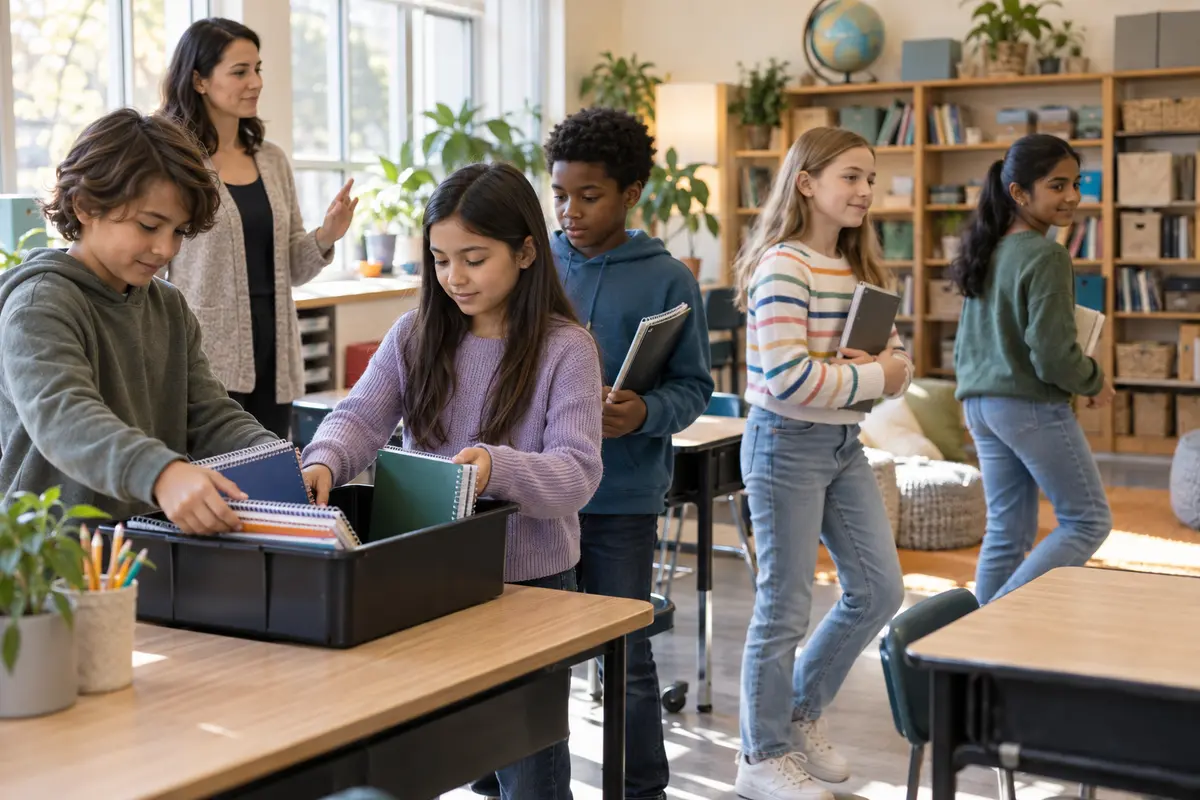
The most useful classroom transition strategies make four actions explicit: notice the cue, close the current task, move or reorganize safely, and begin one visible next step.
Key Takeaways
- Use the same brief cue for the same kind of transition.
- Teach how to close the current activity, not only where to go next.
- Make safe movement, materials, voice level, and the first new action observable.
- Practice the routine when the class is calm and acknowledge specific actions.
- Measure one class-level behavior and adjust the environment before adding pressure.
Why classroom transitions deserve direct teaching
A transition is a change in activity, place, materials, group, or level of attention. It may be as small as moving from independent reading to partner talk or as complex as returning devices, collecting notebooks, and forming lab groups. Students are solving several questions at once: Is the old task finished? What should I carry? Where do I go? What happens when I get there?
When any answer is vague, repeated reminders can fill the room. A better starting point is to make the routine observable and teach it. The U.S. Department of Education’s What Works Clearinghouse classroom behavior guide recommends examining the conditions around a problem, modifying the learning environment, and explicitly teaching and reinforcing new skills. The Center on PBIS Tier 1 guidance likewise emphasizes positively stated expectations, taught routines, and data-informed decisions.
The Cue–Close–Move–Begin routine
Use these four words as a planning check. They help the teacher design each part instead of treating “transition” as one broad instruction.
1. Cue: signal the change once, clearly
Choose a cue students can notice without needing to watch the teacher continuously. It might be a brief spoken phrase, a chime, a projected symbol, or a consistent hand signal. Pair it with the destination or next activity: “Close math; meet with your reading group.” Avoid stacking several new directions onto the cue.
Teach what the cue means during a calm moment. Then check understanding by asking students to explain the first action. If a signal works only after it is repeated five times, the class may need a clearer cue, a more visible location, or more practice—not a louder voice.
2. Close: define how the current task ends
Many transitions stall because “finish” is undefined. Tell students whether to submit, save, bookmark, photograph, stack, or leave the work in place. Give unfinished work a known destination. Decide who handles shared materials and where each item belongs.
A short closing routine also protects the learning that just happened. After a Focusplay learning game, for example, students can name one strategy before closing the device. The related Notice–Explain–Try–Check reflection routine offers a fuller way to review an error when time allows.
3. Move: make the route and roles safe
“Go to groups” can hide many decisions. Identify where each group begins, which route keeps traffic moving, what students carry, and what voice level fits the task. If materials create a bottleneck, move the materials, assign one collector per group, or stagger one part of the route.
Keep expectations positive and concrete: “Walk on the outside path and keep the center aisle open.” This tells students what to do. It is more useful than a list of possible mistakes. The PBIS classroom teaching matrix brief provides a method for defining routines across classroom activities and settings.
4. Begin: post the first visible action
The transition is not complete when students reach a chair. It is complete when they can begin. Put one low-ambiguity action on the board, table, or task card: open to a page, copy the question, sort three examples, read the prompt, or place game pieces at the starting position.
The first action should be accessible without a second round of whole-class directions. Later steps can follow, but the launch should be visible. This reduces idle waiting for students who arrive first and helps the teacher support anyone who needs a different cue.
Teach the routine before timing it
Demonstrate one transition, name what to notice, and let students rehearse it without academic pressure. Ask, “What made that easy to follow?” and revise the route or material location when students identify friction. The Center on PBIS describes effective classroom practice as predictable, positive, and guided by data; student input can help make a routine workable within that framework.
Give specific feedback after practice: “The table captains returned the bins, and everyone could use the aisle.” This connects acknowledgment to the procedure. Avoid public rankings of the slowest students or making the whole class restart because one learner needs support. Speed is not the same as safety, independence, or readiness to learn.
Adjust the routine by grade band
| Grade band | Useful supports | Student ownership |
|---|---|---|
| K–2 | One sensory cue, picture sequence, labeled material homes, short demonstration | Carry one item, follow one route, point to the first task |
| Grades 3–5 | Posted steps, group roles, consistent unfinished-work location | Check the close routine, collect shared materials, begin independently |
| Grades 6–8 | Agenda preview, subject-specific close routine, clear entry task | Plan needed materials, use passing time safely, start without a second prompt |
These are starting points, not age limits. A learner may benefit from advance notice, more space, or a quieter route at any grade. Provide support privately and evaluate whether it increases access and independence. Classroom routines are instructional supports, not diagnoses or treatments.
Five common transition problems—and what to change
- Students do not respond to the cue. Check whether they can detect it, know its meaning, and distinguish it from ordinary classroom sound.
- Cleanup takes over. Reduce the number of material locations, label destinations, or assign specific roles.
- A traffic jam forms. Change the route, move a supply station, or release groups by location rather than by perceived behavior.
- Students arrive but wait. Display one first action that does not depend on another explanation.
- The routine works only with repeated prompting. Re-teach one step, then fade only the prompt students no longer need.
When a transition reliably includes movement, keep it purposeful and safe. For a separate activity designed to reset attention, see movement breaks for kids; a movement break and a classroom transition can overlap, but they serve different planning goals.
Use a small data check
Pick one observable indicator for several days: materials reach the correct place, the walkway stays open, or most students begin the posted entry task after the cue. Record a simple yes/no or brief count for the class, not a public student leaderboard. If the indicator does not improve, ask which part—Cue, Close, Move, or Begin—needs reteaching or redesign.
A transition can succeed without being the fastest. Ask whether students know what to do, can do it safely, and can begin the next task with appropriate support.
Frequently Asked Questions
What are classroom transition strategies?
Classroom transition strategies are taught cues, routines, and environmental supports that help students finish one activity, move or reorganize safely, and begin the next task.
How long should a classroom transition take?
There is no universal target. Choose a realistic expectation for the activity, room, age group, and access needs, then improve clarity before trying to reduce time.
What if some students need more transition time?
Provide an earlier cue, a visual sequence, a closer materials location, or an assigned route while keeping the destination and first step clear. Support can differ without publicly ranking students.
Should teachers use timers or music for transitions?
A timer or short music cue can be a neutral signal if students understand it and it does not create pressure. It should support the routine, not turn movement into a race.
How can teachers measure whether a transition is improving?
Track one observable class-level indicator for several days, such as whether materials are put away correctly or most students begin the posted first step after the cue. Use the pattern to adjust instruction or the environment.
Sources
- What Works Clearinghouse: Reducing Behavior Problems in the Elementary School Classroom (released September 2008; page reviewed September 15, 2026).
- Center on PBIS: Tier 1 (accessed September 15, 2026).
- Center on PBIS: Classroom PBIS (accessed September 15, 2026).
- Center on PBIS: Creating a Classroom Teaching Matrix (updated August 12, 2022; accessed September 15, 2026).