Chunking Strategies for Kids: A Practical K–8 Learning Guide
Chunking helps children organize many separate details into a few meaningful groups that are easier to understand, use, and check.
Key Takeaways
- Group information by a real relationship, such as purpose, sequence, pattern, or category.
- Keep the complete learning goal visible while working through one group at a time.
- Ask the learner to explain why items belong together.
- Adjust chunk size according to familiarity, not grade alone.
- Remove supports gradually only when the learner can reconstruct the whole task.
What is chunking?
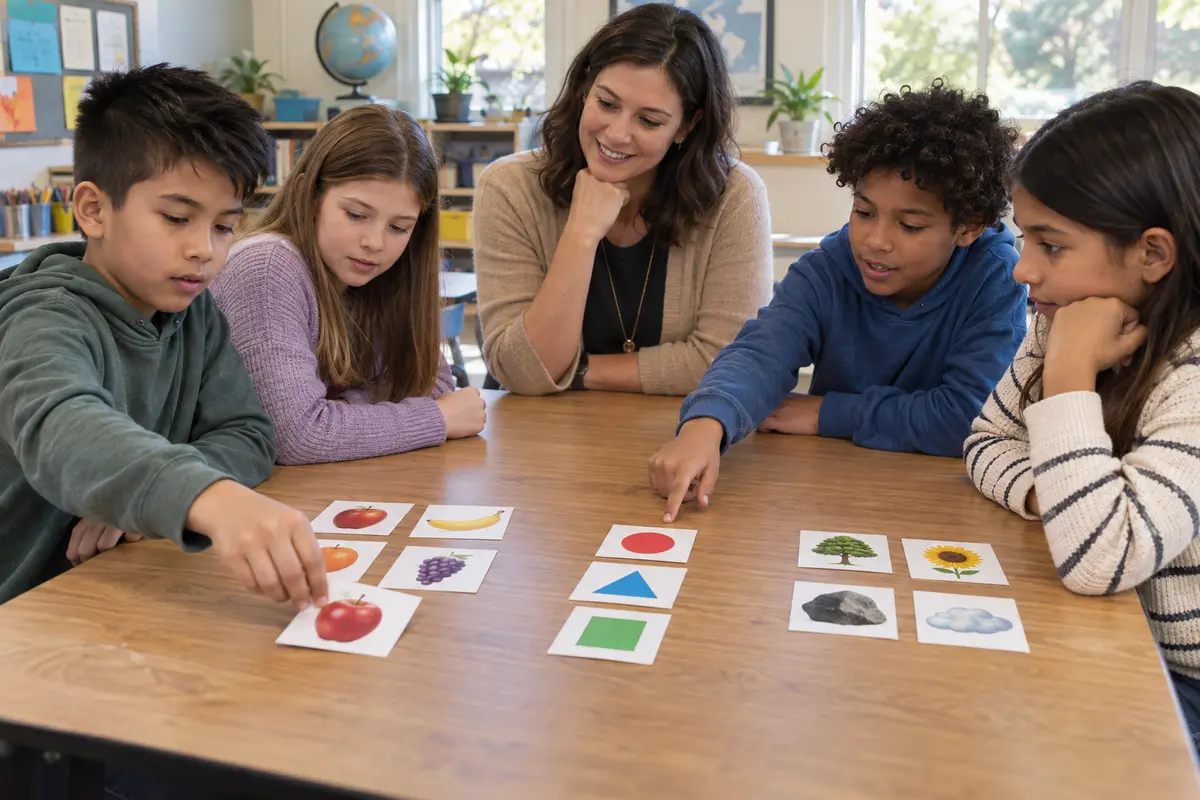
Chunking is the process of organizing separate pieces of information into meaningful units. Four unrelated words are four separate items; four animal names placed under one category become a group with an organizing idea. A long direction can become three phases. A paragraph can become a claim, evidence, and conclusion. The content remains, but its structure becomes more visible.
This matters because learning often requires a child to hold information in mind while doing something with it. The Harvard Center on the Developing Child’s executive function guide describes executive function skills as supporting planning, focused attention, switching gears, and managing information. CAST’s 2024 UDL guidance on organizing information and resources describes working memory as a temporary “scratch pad” and recommends tools such as categories, templates, checklists, and note-taking guides when memory demand is not the learning goal.
Chunking is not a treatment or a promise to expand memory capacity. It is an instructional support that can make relationships easier to see and unnecessary load easier to manage.
The Name–Group–Label–Use–Check routine
1. Name the whole task
State what the learner is trying to accomplish: follow a six-step direction, understand a paragraph, learn eight vocabulary words, solve a multi-part problem, or prepare for a quiz.
2. Group related information
Choose a relationship that fits the content. Items may belong together because they happen in the same phase, share a category, form a pattern, answer the same question, or serve the same purpose. If the rule feels arbitrary, the group may not help.
3. Label each group
Give every group a short cue: “Get ready,” “Solve,” “Check,” or “Main idea,” “Evidence,” “Conclusion.” A useful label should help the learner predict what belongs inside. Pictures, colors, gestures, or symbols can serve as labels when words add extra difficulty.
4. Use one chunk at a time
Cover the other groups, move a marker, check off one phase, or say the group label before starting. The learner should still know where the current chunk fits inside the whole task.
5. Check and reconnect
After using the groups, reconstruct the full sequence or idea. Ask what the groups have in common, whether anything was lost, and whether a different grouping would work better. This final step turns the organizer into a thinking strategy rather than a permanent crutch.
Six practical chunking strategies for kids
1. Chunk multi-step directions by phase
Instead of presenting six actions as one stream, group them into preparation, action, and review. For example: “Get your notebook and pencil; solve questions one through three; check the signs and submit.” Ask the child to repeat the three phase labels before beginning.
2. Chunk reading by purpose
Divide a short text into sections based on meaning, not equal length. One section might introduce the topic, another give evidence, and a third explain the result. After each section, write a three-to-five-word gist. The reading comprehension questions guide offers prompts for connecting those sections into a complete understanding.
3. Chunk vocabulary into word families
Group words by meaning, word part, context, or contrast. “Predict,” “prediction,” and “predictable” reveal a shared base, while “enormous,” “tiny,” and “average” can be organized on a size continuum. Use the grouping rule in a sentence or example instead of memorizing an isolated list. For more options, see these vocabulary games for kids.
4. Chunk numbers by structure
Look for place value, friendly combinations, repeated groups, or known facts. A learner might see 8 + 7 as 8 + 2 + 5, or 36 × 4 as 30 × 4 plus 6 × 4. The goal is to preserve the mathematics and make the relationship visible—not to require one preferred method.
5. Chunk notes into questions and answers
Turn a page of notes into a few headings, each followed by two or three essential details. Then cover the details and use the heading as a retrieval cue. This pairs organization with the low-pressure Recall–Check–Correct–Return approach in the retrieval practice guide.
6. Chunk game information before a move
Before choosing, sort what is visible into “goal,” “useful clues,” and “options.” In a logic activity, a learner might group possibilities into still possible and ruled out. In a memory activity, locations might be grouped by row, corner, or category. Use this only when the game naturally contains information worth organizing.
Adjust chunking by grade band
| Grade band | Useful starting support | Example |
|---|---|---|
| K–2 | Two or three picture-based groups with an adult model | Sort a routine into “get ready,” “do,” and “clean up” |
| Grades 3–5 | Short labels, colors, or boxes the learner helps create | Group a paragraph into topic, details, and takeaway |
| Grades 6–8 | Student-selected headings, outlines, or concept maps | Organize study notes by question, evidence, and connection |
These are starting points, not limits. Prior knowledge changes what counts as one meaningful unit. A familiar process may fit into a single chunk, while a new idea may need to be separated into smaller groups.
Common chunking mistakes
- Dividing by length alone: three equal sections are not useful if the ideas do not belong together.
- Hiding the whole task: learners need to see how each part contributes to the goal.
- Using adult-made labels forever: invite the learner to rename and reorganize groups.
- Changing content and format together: when possible, preserve the learning target while adjusting organization.
- Removing support too quickly: fade a checklist or organizer after the learner can rebuild the structure.
Use chunking without lowering the learning goal
Chunking can change access without changing the intellectual work. CAST recommends organizing information and using scaffolds when working-memory demand is not central to the task. Its guidance on connecting prior knowledge to new learning also suggests advance organizers, concept maps, models, and explicit cross-curricular connections.
Start by asking what the task is intended to measure. If the goal is historical reasoning, a timeline or grouped source notes may remove irrelevant organizational burden. If the goal itself is remembering an unprompted sequence, keep that goal intact and use chunking during teaching or practice rather than during the final demonstration.
Using chunking with Focusplay
Choose a grade-appropriate option from the Focusplay learning games. Before a round, ask whether the information can be grouped by category, location, sequence, or purpose. Afterward, ask the learner to explain the grouping rule and whether it helped. The article on working memory and math provides related ideas for making steps and intermediate information visible.
Practice the same organizing idea in another small context and let the learner decide when chunking is useful.
Frequently Asked Questions
What is chunking for kids?
Chunking is organizing separate pieces of information into a smaller number of meaningful groups. The relationship inside each group—not simply making the task shorter—is what makes the strategy useful.
What is an example of chunking in learning?
A learner might turn six directions into three phases: gather materials, complete the task, and check the result. Each phase can contain two related actions.
How large should a chunk be?
There is no universal size. Start with a group the learner can explain and use accurately, then combine or separate information based on familiarity and task difficulty.
Is chunking the same as simplifying the work?
No. Chunking changes how information is organized and presented; it does not have to remove the learning goal or reduce the quality of the task.
Can chunking improve working memory?
Chunking can reduce unnecessary demands by organizing information into meaningful units, but it is a support strategy rather than a guaranteed way to increase a child’s underlying working-memory capacity.
Sources
- Harvard Center on the Developing Child: A Guide to Executive Function (reviewed September 18, 2026).
- CAST UDL Guidelines 3.0: Organize Information and Resources (2024; reviewed September 18, 2026).
- CAST UDL Guidelines 3.0: Connect Prior Knowledge to New Learning (2024; reviewed September 18, 2026).