How to Help Kids Remember What They Learn: A K–8 Guide
Rereading can feel familiar without showing what a child can recall independently. A short attempt to remember, followed by checking and another review later, makes learning gaps visible and gives practice using the knowledge.
Key takeaways
- Retrieval means bringing information to mind before looking at the source.
- Use speaking, drawing, sorting, or explaining—not only quizzes.
- Check answers promptly so mistakes are not left uncorrected.
- Return to important knowledge across more than one day.
- Use results to choose what needs teaching or practice next.
What is retrieval practice?
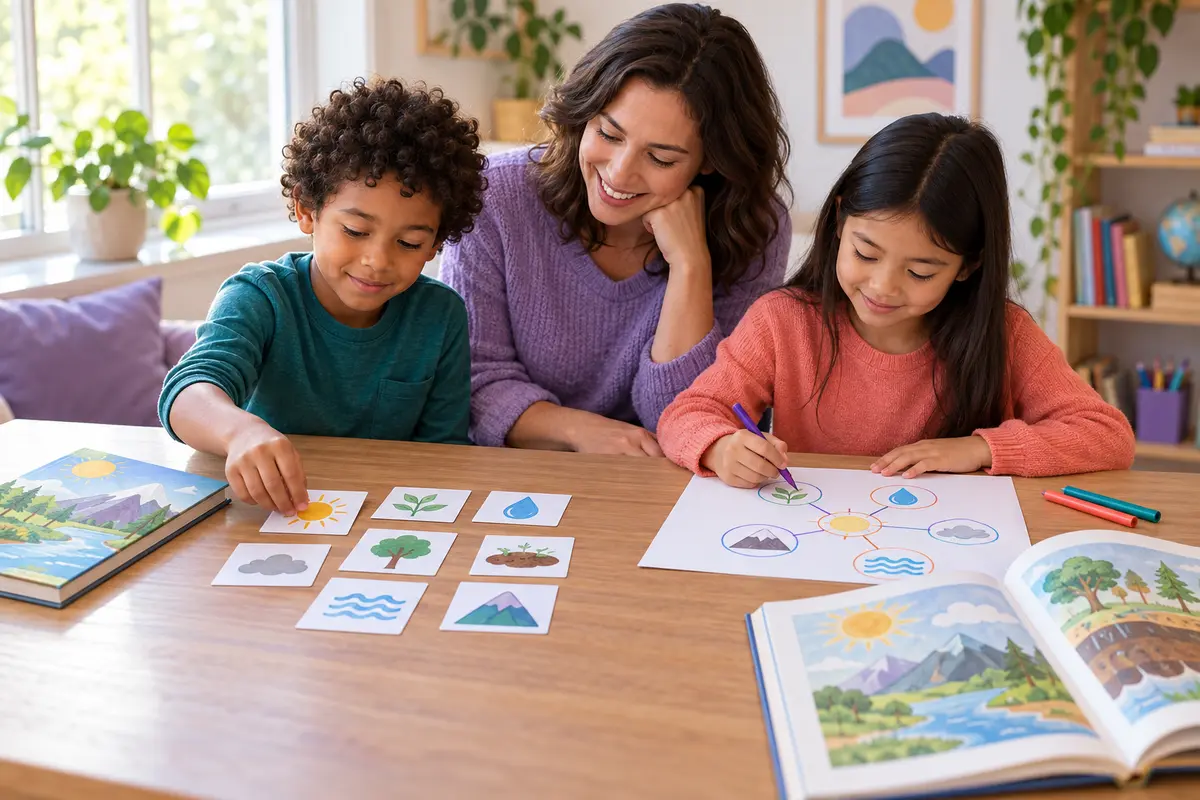
Retrieval practice is an attempt to recall previously learned information without first reopening the book, notes, or answer key. It may look like listing three facts, drawing a process, retelling a paragraph, sorting picture cards, completing a few problems, or explaining how two ideas connect.
The aim is not to prove that learning is finished. The attempt tells the learner and adult what is accessible now, what is incomplete, and what needs another explanation or later review. This is different from copying or rereading, where the information remains visible throughout the task.
What does the evidence say?
The U.S. Department of Education’s What Works Clearinghouse recommends spacing learning over time and using quizzes that require active retrieval to re-expose students to key content. It also recommends using quizzes to identify what still needs to be learned and asking explanatory questions that support deeper understanding.
A frequently cited experiment indexed by PubMed found that recalling studied passages supported later retention more than repeated study under the delayed-test conditions examined. That does not mean every quiz format works equally well for every child or subject. The Education Endowment Foundation notes that cognitive-science approaches are promising, while much of the positive evidence comes from small or controlled studies and questions remain about everyday classroom implementation.
The Recall–Check–Correct–Space routine
1. Recall: close the source and try
Choose a small, clearly defined target: vocabulary from yesterday, steps in a math strategy, the main events of a chapter, or the parts of a plant. Put notes away briefly. Ask the child to say, sketch, write, sort, or demonstrate what they remember.
2. Check: compare with a reliable model
Open the source, worked example, diagram, or teacher feedback. Mark what matches, what is missing, and what is inaccurate. Checking should be neutral and specific. A partially correct response still provides useful evidence about which connection needs support.
3. Correct: rebuild the answer
Have the child produce the corrected idea rather than only read it. They might redraw the missing arrow, explain the corrected term, solve the step again, or retell the sequence in order. For unfamiliar procedures, first return to a clear model such as the ones described in our guide to worked examples.
4. Space: schedule another short recall
Revisit the same important knowledge after a delay instead of repeating it many times in one sitting. A simple plan might review it later that day, a few days later, and again the following week. Adjust the gap: shorten it when recall is consistently unsuccessful and lengthen it when recall is accurate and well explained.
Examples for kindergarten through grade 8
| Learning goal | Recall prompt | Check and correct |
|---|---|---|
| K–2 story sequence | Arrange three picture cards from memory and retell the events. | Reopen the story, move cards, and retell the corrected order. |
| Grades 2–5 vocabulary | Draw an example and explain the word without using a glossary. | Compare with the definition; add one missing feature. |
| Grades 3–6 mathematics | Explain the steps of a familiar strategy, then solve one item. | Compare with a worked model and redo the first incorrect step. |
| Grades 5–8 science or history | Create a small concept map from memory. | Use notes to add missing links and remove unsupported ones. |
How to keep retrieval low stakes
Do not turn every response into a grade, speed contest, or public comparison. Give private think time, accept more than one response format, and allow a cue when a learner is stuck. The useful question is “What should we strengthen next?” rather than “Who remembered the most?”
Difficulty should be productive, not overwhelming. If nearly everything is inaccessible, reduce the amount, provide a category or first step, and reteach where necessary. Retrieval is practice after instruction; it is not a substitute for explaining new content.
Common mistakes to avoid
- Only asking isolated facts: Include comparison, sequence, cause, strategy, and explanation prompts.
- Skipping feedback: Always provide a way to check and correct important answers.
- Repeating the same items immediately: Include later opportunities so recall is not based only on short-term familiarity.
- Testing content that was not taught clearly: Reteach before expecting independent retrieval.
- Making recall stressful: Keep practice predictable, brief, and separate from punishment or embarrassment.
Connect retrieval to reading and play
After reading, ask for the main idea and two supporting details before reopening the text; our summarizing guide offers a structured follow-up. After a FocusPlay learning game, ask the child to explain the rule, recall a successful strategy, and predict when that strategy would help again.
Frequently asked questions
What is retrieval practice for children?
Retrieval practice is a low-stakes attempt to bring previously learned information to mind without first looking at the answer. Children might explain, sketch, list, sort, or answer a few questions, then check and correct their recall.
How long should a retrieval-practice session be?
Keep it brief enough that attention stays on recalling and correcting. A few focused prompts can be sufficient; the amount should match the child’s age, the material, and the purpose of the review.
What should happen when a child cannot remember?
Offer a small cue, let the child try again, then reveal and explain the answer. Record the item for a later review without treating the gap as a failure.
Is retrieval practice the same as a test?
It can use quiz questions, but its purpose is practice and information for next steps, not a grade. It should be low stakes, followed by checking, and used alongside teaching, examples, discussion, and application.
Sources
- U.S. Department of Education, What Works Clearinghouse: Organizing Instruction and Study to Improve Student Learning
- Education Endowment Foundation: Cognitive Science Approaches in the Classroom
- Education Endowment Foundation: Why Bother With Retrieval?
- Roediger and Karpicke: Test-Enhanced Learning (PubMed)