How to Help Kids Summarize a Text: A K–8 Guide
Summarizing is not retelling everything in fewer words. It is deciding what the text is mainly about, selecting the information a reader truly needs, and connecting those ideas accurately.
Key takeaways
- Begin with meaning before asking for a written paragraph.
- Separate essential ideas from interesting but optional details.
- Adjust the summary method for stories and informational text.
- Use oral rehearsal, pictures, or notes before full sentences.
- Check accuracy against the source, not memory alone.
What does it mean to summarize a text?
A summary gives a compact account of a text’s central meaning and most important points. It leaves out examples, repetition, description, and minor events unless one is necessary to understand the main idea. A strong summary can stand on its own, but it does not add opinions or information that the source never stated.
Retelling and summarizing are related but different. A retelling may walk through many events in order. A summary makes a stricter decision about what must remain. That decision is why children often need explicit modeling, discussion, and repeated practice rather than the instruction “make it shorter.”
Why teach a clear routine?
The Institute of Education Sciences recommends teaching comprehension strategies directly in the K–3 grades, including helping students use a text’s structure and discuss its meaning. For grades 4–9, its What Works Clearinghouse guide recommends routines for determining the gist of short sections, asking and answering questions, building relevant knowledge, and monitoring comprehension. A summary routine brings several of these actions together without treating one formula as suitable for every text.
Summarizing also reveals what a learner thinks is important. If a child keeps one vivid detail but misses the central idea, an adult can respond to that specific misunderstanding. Our guide to reading comprehension questions offers prompts for finding evidence before a summary is written.
The Gist–Select–Connect–Condense–Check routine
1. Gist: say what the section is mostly about
Work with one manageable section. Ask the child to complete: “This part is mostly about…” For a story, name the character’s main situation or goal. For informational text, name the topic plus the author’s most important point about it. If the answer is too broad, ask, “What did we learn about that topic here?”
2. Select the ideas a reader must know
List a few candidate details, then sort them into essential, helpful, and extra. A useful test is: “If we remove this, can a reader still understand the central idea?” Keep information that changes the meaning, explains a cause, or completes the main sequence.
3. Connect the selected ideas
Put the essentials in a sensible order. Stories often follow situation, important action, and outcome. Informational text may use sequence, cause and effect, comparison, problem and solution, or main idea and evidence. Signal words such as because, however, and as a result can show the relationship without creating a list of disconnected facts.
4. Condense in the child’s own words
Close or cover the source after the key ideas are chosen. Let the child explain the meaning aloud, then write from that explanation. Combine repeated ideas and replace long examples with a category. If the child copies a full sentence, ask for the same meaning as if explaining it to a classmate.
5. Check against the source
Reopen the text and verify three things: Is the central idea present? Are the statements accurate? Is anything important missing? Then remove one detail that is not essential. A summary should become clearer during checking, not merely shorter.
Adapt the task by grade band
| Grade band | Useful starting point | Summary goal |
|---|---|---|
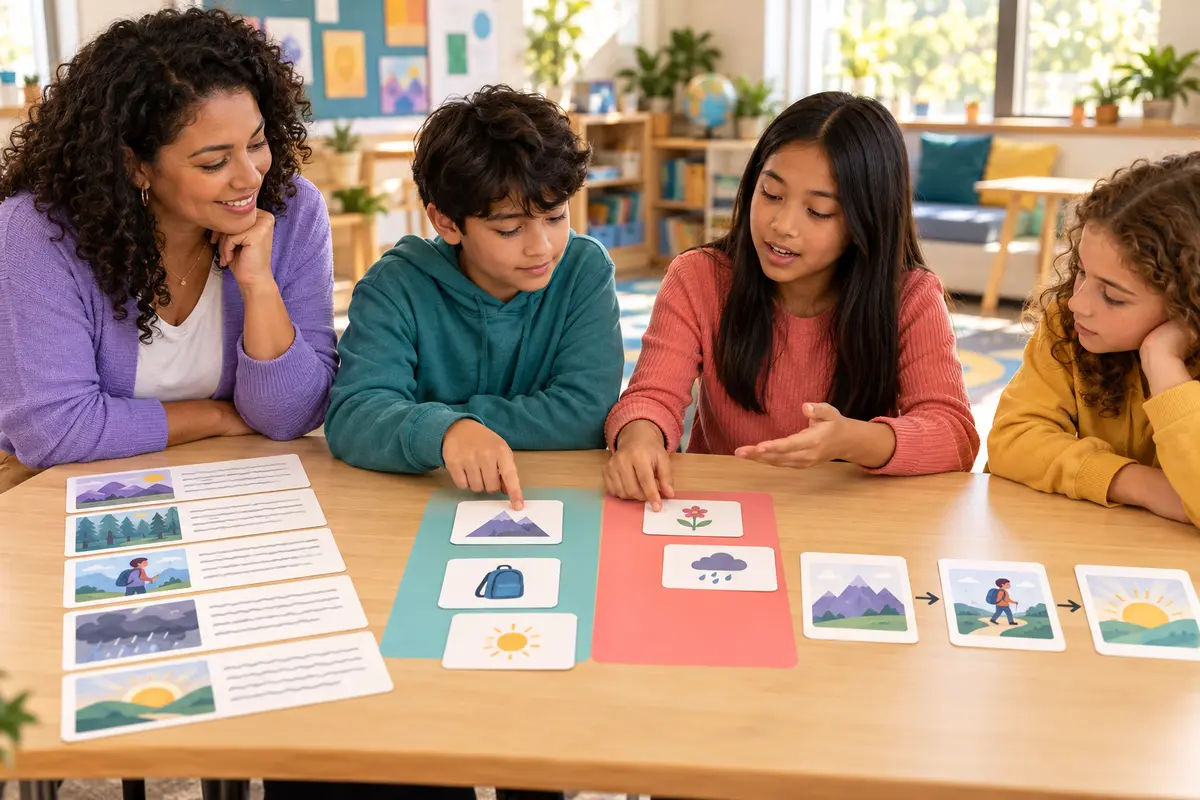
| K–2 | Read aloud, picture sequence, or very short passage | Orally name who or what the text is about and one or two important events or facts |
| Grades 3–5 | One paragraph or short section with notes | Write a few connected sentences with the main idea and essential support |
| Grades 6–8 | Several sections, a chapter excerpt, or content-area text | Combine section gists, show relationships, and omit repeated evidence |
Adjust the reading length, vocabulary support, and writing demand to the learner. Oral explanation can show comprehension even when writing still requires support.
Story summaries and informational summaries
For a story
Focus on the main character or group, the central goal or problem, the actions that change the situation, and the outcome. Include setting only when it affects what happens. Avoid turning every scene into a separate sentence.
For informational text
Use the heading and text structure to locate the main idea. Keep the strongest facts, reasons, or steps that explain it. Definitions may be essential; examples usually are not. If unfamiliar vocabulary blocks meaning, preview key words using the approaches in our vocabulary activities guide.
Common summarizing problems
- The summary includes everything: Set a small idea limit before writing.
- It is only one vague sentence: Add the two points a reader needs to understand the gist.
- It copies the source: Rehearse orally with the text covered.
- It adds an opinion: Move personal reactions to a separate response.
- It lists facts without relationships: Identify the text structure and add precise connecting words.
Make summary practice purposeful
Keep practice short and tied to real reading: a story page, science section, game instruction, or class article. After a FocusPlay learning game, ask the child to summarize the goal, one useful strategy, and what changed during play. The point is not a perfect paragraph every time; it is learning to identify and communicate what matters most.
Frequently asked questions
What makes a good summary for kids?
A good summary states the central idea, includes only the most important supporting points, follows a clear order, uses the child’s own words, and stays accurate to the text.
How long should a child’s summary be?
There is no single correct length. It should be much shorter than the source while still explaining the central idea and essential points; the text’s length and complexity should guide the target.
Should children quote the text in a summary?
Usually, children should paraphrase in their own words. A brief key term or necessary phrase may remain, but copying whole sentences can hide whether the child understands the meaning.
What if a child includes every detail?
Ask which details a reader must know to understand the text’s central idea. Sort information into essential, helpful, and extra groups, then draft from the essential group first.
Sources
- Institute of Education Sciences, What Works Clearinghouse: Improving Reading Comprehension in Kindergarten Through 3rd Grade
- Institute of Education Sciences, What Works Clearinghouse: Providing Reading Interventions for Students in Grades 4–9
- Institute of Education Sciences, What Works Clearinghouse: Improving Adolescent Literacy