Elaboration Strategies for Kids: A K–8 How-and-Why Guide
A remembered fact becomes more useful when a child can connect it, explain it, and test the explanation.
Key takeaways
- Teach or review essential facts before asking for a deep explanation.
- Ask one purposeful question at a time and allow thinking time.
- Accept speech, drawing, objects, or writing as ways to explain.
- Check explanations against a reliable source; a confident answer can still be inaccurate.
What is elaboration in learning?
Elaboration means adding meaningful connections to new information. A child moves beyond “Plants need light” to explain how light supports growth, connect that idea to a classroom plant, compare a shaded plant with a sunny one, or predict what might happen if light is removed.
The Institute of Education Sciences practice guide on organizing instruction and study recommends helping students build explanations with deep questions. It names prompts such as why, why not, how, what if, comparison, and evidence questions. Importantly, the guide says these prompts are most useful after learners have basic knowledge of the topic.
Why “how” and “why” need support
A deep question is not automatically helpful. “Why?” can feel like a quiz when the child lacks vocabulary, background knowledge, or a starting point. It may also invite guessing. Good elaboration pairs a clear prompt with something the learner can inspect: a diagram, demonstration, paragraph, worked example, timeline, or set of objects.
A major research review indexed by the National Library of Medicine rated elaborative interrogation and self-explanation as promising but noted limits in evidence across educational settings. That is a reason to use the strategy thoughtfully—not to make unsupported promises. Accuracy checks and normal instruction still matter.
Teach Know–Ask–Explain–Check–Apply
1. Know the starting facts
Ask for a brief recall: “What does a seed need to begin growing?” If the child cannot retrieve the essentials, review the page, model, or demonstration first. Our retrieval practice guide shows how to keep recall low pressure.
2. Ask one deep question
Choose a question that matches the goal: cause (“What made this happen?”), mechanism (“How does it work?”), comparison (“How are these alike?”), evidence (“What supports that?”), or transfer (“Would it still work if…?”).
3. Explain with a visible connection
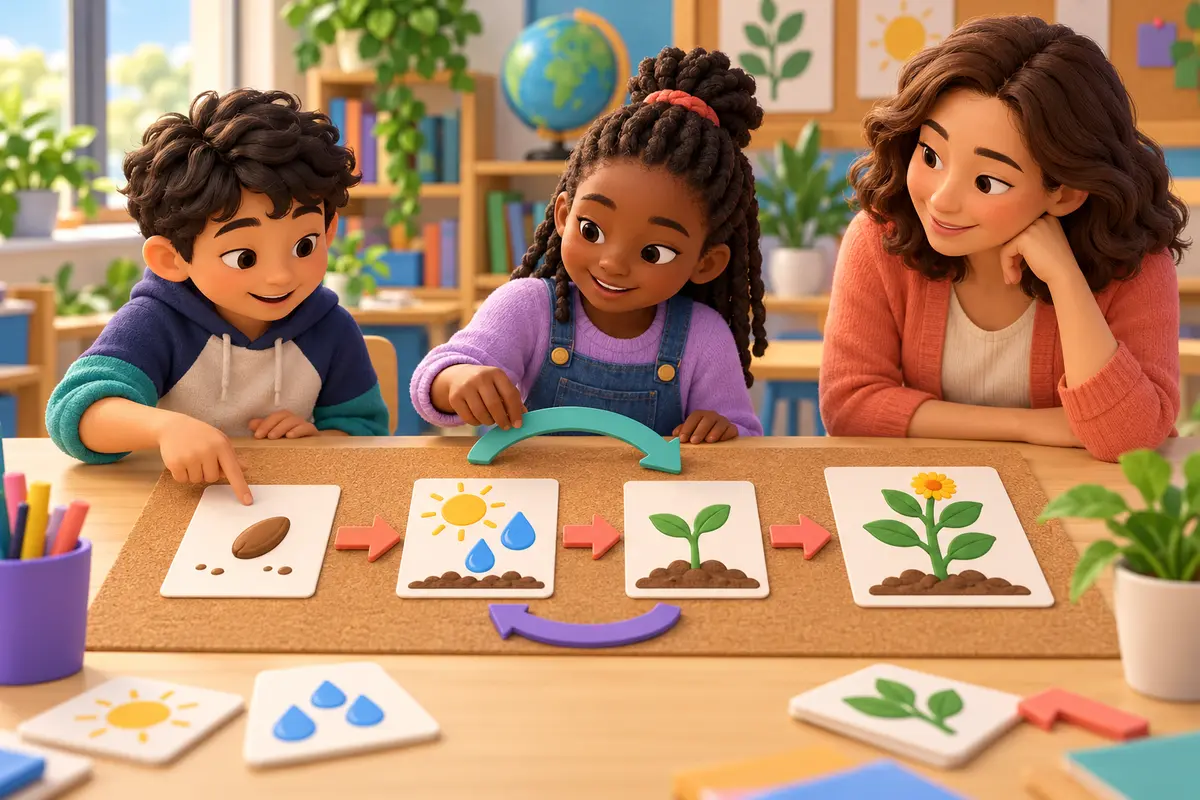
Have the child point, draw an arrow, arrange cards, act out a sequence, or speak in a complete thought. A useful frame is: “I think ___ because ___.” Younger children can finish a sentence the adult starts.
4. Check the explanation
Return to the source, evidence, or example. Ask, “Which part supports your idea?” Correct the connection without dismissing the whole attempt. Children can also use the Answer–Reason–Show–Check routine in our guide to explaining their thinking.
5. Apply the idea somewhere new
Change one feature: “Would the same explanation fit a plant kept in darkness?” A small variation reveals whether the child understands the relationship or only remembers the original wording.
How-and-why examples by grade band
| Grade band | Example prompt | Helpful support |
|---|---|---|
| K–2 | “How did the character solve the problem?” | Sequence three picture cards and retell with because. |
| 3–5 | “Why does multiplying by 10 change place value this way?” | Connect a place-value chart, words, and an example. |
| 6–8 | “What evidence best explains this historical change?” | Compare two sources and identify cause, evidence, and limitation. |
Five low-prep elaboration activities
Cause-and-effect cards
Place three to five picture or sentence cards in order. Ask the child to add arrows and explain what each arrow means.
Odd one out—with two answers
Show four related items. Ask which does not belong and why. Then request a different defensible choice. This also supports cognitive flexibility.
Example and non-example
Give one example and one near miss of a concept. Ask which defining feature separates them. This works for polygons, complete sentences, habitats, and historical claims.
Because chain
Write a fact, then add two carefully checked “because” links. Stop if a link becomes speculation; return to the source and repair it.
Change one condition
After an explanation, change one variable and predict the effect. Ask what stays the same, what changes, and why.
Common mistakes to avoid
Do not fire a series of questions faster than the child can think. Avoid using “Why did you do that?” as both a behavior correction and a learning prompt; the emotional meaning is different. Do not reward length over accuracy. A short causal link supported by evidence is more useful than a long invented answer.
The IES guide gives deep explanatory questions a strong evidence rating, while still emphasizing modeling, background knowledge, and feedback. An IES overview for pre-K through grade 9 likewise places deep questions within developmentally appropriate instruction, not as a stand-alone shortcut.
How FocusPlay fits
After a familiar FocusPlay activity, choose one question rather than turning play into an interview: “Why did that strategy work?” or “How would the result change if the rule changed?” Let the child show the explanation with game pieces, a sketch, or words. The goal is to make one useful connection while curiosity is still active.
Explore FocusPlay learning gamesFrequently asked questions
What is elaboration in learning?
Elaboration is the process of connecting a new idea to causes, examples, evidence, comparisons, or prior knowledge so the learner builds an explanation instead of repeating a fact alone.
Which questions help children elaborate?
Useful prompts include: Why is this true? How does it work? What caused it? How is it similar to or different from something we know? What evidence supports the explanation? What would change if one condition changed?
What should an adult do when a child says “I don’t know”?
Supply one missing fact, show a concrete example, or offer two possible connections. Then ask the child to choose, complete, or correct the explanation. Elaboration works best when enough background knowledge is available.
Can elaboration replace retrieval practice?
No. Retrieval asks learners to bring information to mind, while elaboration asks them to connect and explain it. A short recall attempt followed by one how-or-why question can use both strategies together.