How to Help Kids Explain Their Thinking: A K–8 Guide
A correct answer shows what a child decided. An explanation reveals the path: what the child noticed, connected, tested, or changed.
Key takeaways
- Separate the answer from the reason: both provide useful information.
- Ask one focused follow-up instead of repeating “Why?”
- Accept multiple ways to explain, especially for younger learners.
- Choose high-value moments rather than requiring an explanation after every item.
What is self-explanation?
Self-explanation means trying to explain how new information connects to something already known or how the steps in a solution fit together. It can happen aloud, in writing, through a diagram, or quietly before a child shares one part. It is more than repeating a rule from memory.
The U.S. Department of Education's What Works Clearinghouse practice guide gives strong-evidence status to asking deep explanatory questions across K–12. It recommends prompts that invite explanations rather than only short answers. The University of Wisconsin–La Crosse teaching guide adds an important caution: explaining does not automatically create understanding, so adults should model the process and provide feedback when a learner is stuck.
The Answer–Reason–Show–Check routine
1. Answer
Let the child state a first answer, prediction, or claim. Do not require a long explanation before the idea has formed. In reading, this might be “The character is worried.” In mathematics, it might be “The total is 36.”
2. Reason
Ask for one reason with a specific prompt: “What made you think that?” “Which rule did you use?” or “What changed from the first example?” A focused question is easier to answer than a broad “Explain everything.”
3. Show
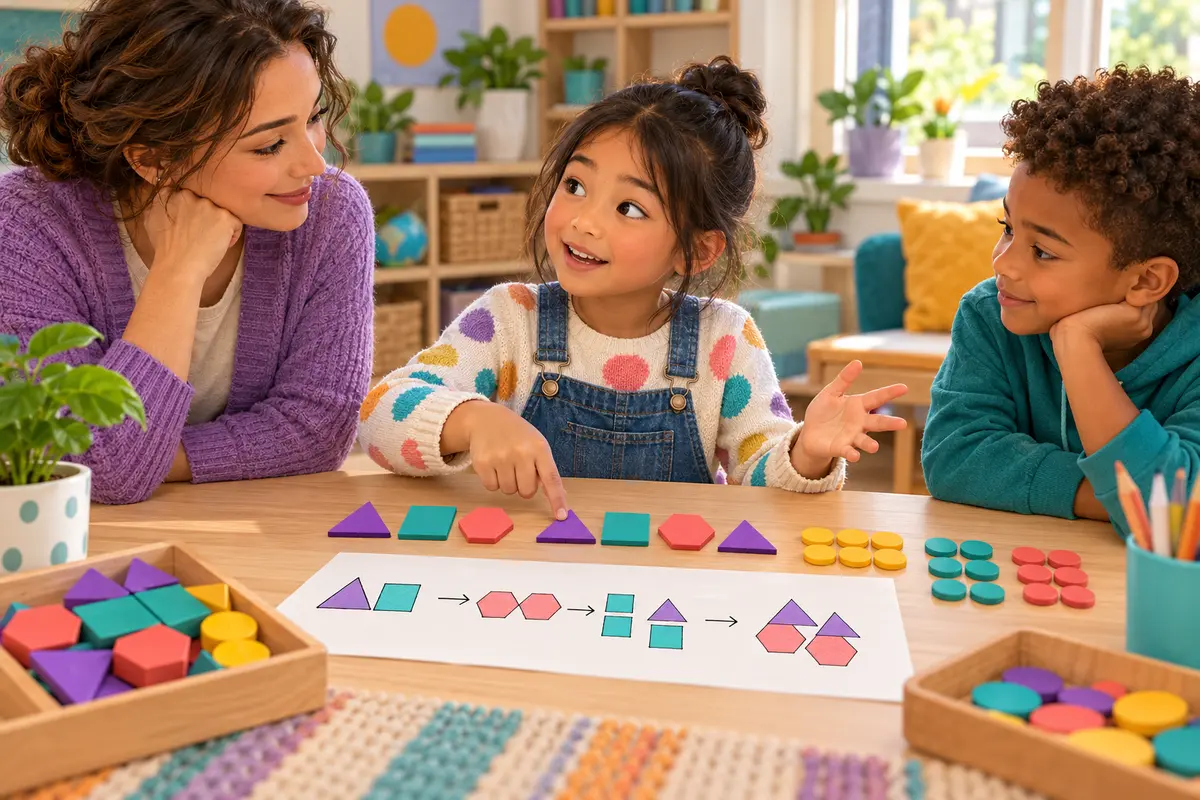
Invite evidence or a representation. A learner might point to a sentence, move counters, sketch a number line, compare two patterns, or give a counterexample. Showing reduces the language load and gives the adult something concrete to discuss.
4. Check
Ask whether the explanation matches the answer and all available evidence. Useful prompts include “Does that rule work for the next case?” and “Which part of the text supports your idea?” Checking may confirm the reasoning or reveal a precise place to revise.
Examples across subjects
| Subject | Answer | Reason, show, and check |
|---|---|---|
| Mathematics | “Three groups of four make 12.” | Build the groups, connect them to multiplication, then count to verify. |
| Reading | “The setting feels unsafe.” | Point to two details, explain their effect, and check for conflicting evidence. |
| Science | “The shadow will move.” | Connect the prediction to the light source, draw it, then observe and revise. |
| Logic or games | “This piece belongs here.” | Name the rule, place the piece, and test whether the rule works elsewhere. |
Adapt explanations by grade band
Kindergarten–Grade 2
Use objects, pictures, and short sentence stems: “I chose ___ because ___.” Ask the child to point or build before speaking. Model a compact example, then invite imitation with different materials. One clear connection is enough.
Grades 3–5
Ask learners to compare two methods or identify the step that matters most. Encourage diagrams, annotated examples, and partner explanations. If language becomes a barrier, let the child rehearse with a partner before sharing with the group.
Grades 6–8
Request evidence, assumptions, and limits: “When would this method not work?” or “What evidence would change your claim?” Students can critique a sample explanation, revise an incomplete one, or connect a procedure to the underlying concept.
Prompts that lead to better explanations
- Notice: What did you notice first?
- Connect: What does this remind you of?
- Compare: How is this method different from the other one?
- Evidence: What can you point to or show?
- Revise: Which part would you change after checking?
Avoid rapid-fire questioning. Give thinking time, listen without finishing the sentence, and respond to the idea rather than the child's confidence. If the explanation is incomplete, narrow the task: ask for one step, one clue, or one connection.
Common mistakes to avoid
Do not turn explanation into a performance test. Children who are learning English, have language differences, or simply think more easily with materials may understand more than they can immediately say. Accepting a drawing or demonstration keeps the focus on reasoning. Also avoid asking for explanations only after wrong answers; that can make explaining feel like a punishment.
Model uncertainty honestly: “I thought this rule worked, but this example does not fit. I need to revise it.” This shows that an explanation is a tool for checking ideas, not a way to prove that the speaker was right all along.
Connect the routine to Focusplay
After a Focusplay challenge, choose one item—not the whole session—and ask the child to use Answer–Reason–Show–Check. A learner can point to visual details, describe a pattern, or replay a move. Pair the routine with worked examples when a model is available, or use these reflection questions after a game. Explore Focusplay learning games for short, age-appropriate reasoning opportunities.
Frequently asked questions
What does “explain your thinking” mean for a child?
It means showing how an answer or idea was reached. A child can use words, drawings, objects, gestures, examples, or equations; the explanation does not have to be a formal speech.
Should children explain every answer?
No. Choose a few important or interesting problems. Explaining every routine answer can become tiring and may reduce the time available for practice.
What if the answer is correct but the explanation is unclear?
Treat the correct answer and the explanation as separate information. Acknowledge what is correct, then ask one focused prompt such as “What did you notice first?” or invite the child to show the step with objects.
Can young children explain their thinking without writing?
Yes. Young children can point, sort, act out, draw, build, or finish a sentence stem. The goal is to make a connection or step visible, not to require advanced writing.
Sources
- What Works Clearinghouse: Organizing Instruction and Study to Improve Student Learning
- University of Wisconsin–La Crosse: Self-explanation teaching guide