Creative Thinking for Kids: A Simple Idea-Building Routine
Creative thinking becomes easier to teach when children can see the process: make several different possibilities, choose with a purpose, test one, and improve it.
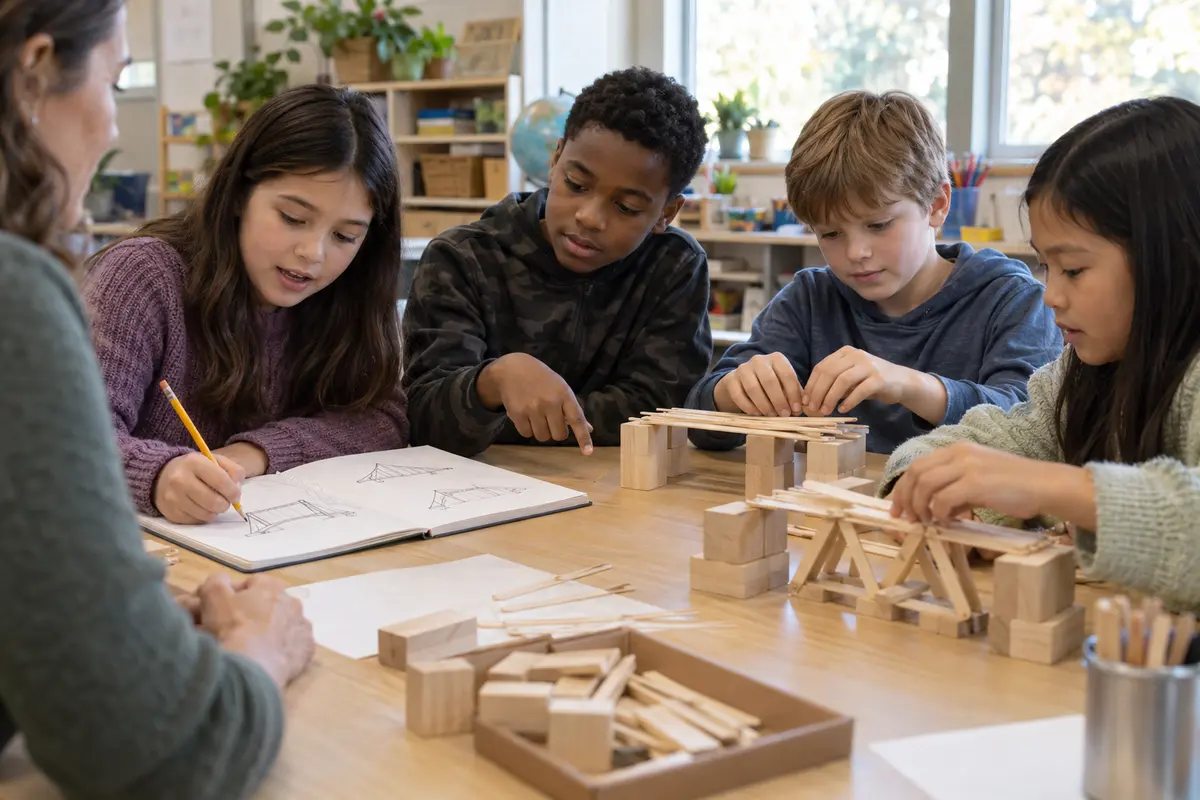
Key takeaways
- Keep the goal clear while leaving more than one possible answer or route.
- Ask for ideas that differ in approach, not just color or decoration.
- Separate idea generation from evaluation so early judgment does not stop exploration.
- Use one or two visible criteria to choose a promising idea.
- Treat revision as part of creating, not proof that the first attempt failed.
What creative thinking looks like in learning
Creative thinking is not limited to drawing, performance, or unusually imaginative children. A learner uses it when inventing two endings to a story, finding different ways to represent a number, designing a fair test, improving a block structure, or proposing several solutions to a classroom problem.
The OECD’s PISA creative thinking framework organizes the process around generating diverse and original ideas, then evaluating and improving them. The National Core Arts Standards use a compatible sequence: generate and conceptualize, organize and develop, then refine and complete artistic work. These frameworks support a useful teaching principle: creativity includes both opening possibilities and shaping one into a stronger result.
That balance matters. “Anything goes” can leave a child unsure how to begin, while a task with one expected product gives little room to make decisions. A productive creative challenge has boundaries that clarify the goal and freedom that allows different responses.
The Imagine–Vary–Choose–Improve routine
1. Imagine: open the possibility space
Begin with a prompt that names a purpose without prescribing the solution: “Design a bridge that spans this gap,” “Show three ways a character could solve the conflict,” or “Represent 24 so another person can see its factors.” Confirm materials, safety rules, and any required features. Then give quiet thinking time before discussion.
If the page stays blank, offer a starting lens rather than an answer: “What could you change about the shape, order, material, viewpoint, or rule?” A learner may draw, list, act, speak, or build the first thought.
2. Vary: make the ideas genuinely different
Ask for three possibilities that take different routes. Three bridges with different colors are visually varied, but they may rely on the same structural idea. A flat beam, an arch, and a triangular truss represent different approaches. In writing, the main character could ask for help, change the goal, or use an overlooked clue.
3. Choose: use purpose, not preference alone
Make the decision criteria visible. A bridge may need to span 12 inches and hold ten counters. A story ending may need to fit the character and resolve the main problem. A classroom storage idea may need to be safe, quick, and possible with available space.
Young children can choose with one question: “Which idea is most stable?” Older learners can compare two criteria or name a trade-off: “This design uses fewer materials, but the wider base may be steadier.” The aim is not to identify a universally best idea; it is to connect a choice to the goal.
4. Improve: revise one meaningful feature
Test the chosen idea, invite a partner to ask one question, or compare it with the criteria. Then revise one feature. The bridge may need cross-bracing. The explanation may need evidence. The game rule may need to prevent an unfair advantage.
Keep the revision focused enough to finish. “Make it better” is vague; “change one feature so it stands for 20 seconds” gives the learner a usable target.
Six low-prep creative thinking activities
- Many uses: Choose a safe everyday object and list uses that belong to different categories—tool, organizer, game piece, model, or storytelling prop.
- Constraint switch: Solve a familiar task, then change one condition: use fewer pieces, remove one material, make it portable, or design for a different user.
- Multiple representations: Show the same number, pattern, word, or scientific relationship with objects, a diagram, a sentence, and a symbol.
- Story fork: Pause a story at a decision point. Generate three plausible choices, predict consequences, and write or act out one path.
- Rule designer: Invent a simple sorting, movement, or card-game rule. Let someone test it, notice ambiguity or unfairness, and revise the wording.
- Improve the ordinary: Pick a routine object or process—bookmark, backpack pocket, homework station, cleanup system—and redesign it for one specific need.
Adjust the challenge by grade band
| Grade band | Useful challenge | Adult prompt |
|---|---|---|
| Kindergarten–Grade 2 | Build, act, sort, or draw two to three concrete possibilities with one clear rule. | “Can you make another one that works in a different way?” |
| Grades 3–5 | Generate three approaches, compare one or two criteria, test, and revise a feature. | “What is different about the strategy, and how will you test it?” |
| Grades 6–8 | Work with competing criteria, explain trade-offs, combine useful elements, and document revision. | “Which constraint shaped your choice, and what evidence would change your plan?” |
Grade labels are starting points. Reduce reading, materials, choices, or steps when those features hide the creative decision. Increase depth by adding a meaningful constraint or asking for evidence—not by making the timer faster.
Feedback that keeps ownership with the learner
Praise that labels a child as “so creative” gives little information about what worked. Describe the process instead: “Your three ideas use different structures.” “You chose the arch because it matched the strength goal.” “The test showed where the design bent, and you changed that joint.”
When a learner asks, “Is this right?” return to the purpose: “Which requirement does it meet? What still needs testing?” When an idea is not feasible, separate the imaginative contribution from the next decision: “The floating platform is an interesting direction. With the materials we have, what feature could you keep?”
Connect creative thinking with Focusplay
Focusplay organizes short, grade-aware activities across math, brain, attention, memory, logic, language, creativity, and other available learning areas. Depending on the activity, learners work with clear goals, familiar controls, immediate feedback, and grade-matched difficulty. A digital activity can provide the prompt or test; a short conversation can make the learner’s decisions visible.
Before a round, name one process goal: “Try more than one approach before choosing.” Afterward, ask what changed and why. Explore Focusplay’s K–8 learning areas, see how Focusplay works, or pair idea generation with the Journal’s guides to logic games and vocabulary games. One game result should not be treated as a diagnosis or a complete measure of creativity.
Frequently asked questions
What is a simple creative thinking activity for kids?
Give a familiar object or problem a clear goal, ask for three genuinely different ideas, choose one using a simple criterion, test it, and make one revision.
Does creative thinking mean there are no rules?
No. Useful constraints can focus attention and make alternatives easier to compare. Keep the goal firm while leaving more than one possible route.
How can adults respond without taking over?
Ask what the learner is trying to achieve, what makes the ideas different, what evidence supports a choice, and what one change could improve it.
Should creative activities be timed?
Usually not while learners are exploring a new kind of challenge. A short time boundary can keep a session manageable, but speed should not define idea quality.
How do creative thinking activities change by grade?
Younger learners can act, draw, or build alternatives with concrete materials. Older learners can work with multiple criteria, trade-offs, evidence, and purposeful revision.
Make possibility and revision equally visible
Creative thinking is not only the spark at the beginning. It is also the disciplined work of varying an approach, choosing for a reason, noticing what a test reveals, and making a useful change. Keep the challenge open enough for ownership and specific enough for decisions. Then ask children to show how the idea evolved—not merely the final product.