How Often Should Kids Practice Math? A Realistic K–8 Routine
The best routine is not the one with the most minutes. It is the one your family can return to—without every session becoming a negotiation.
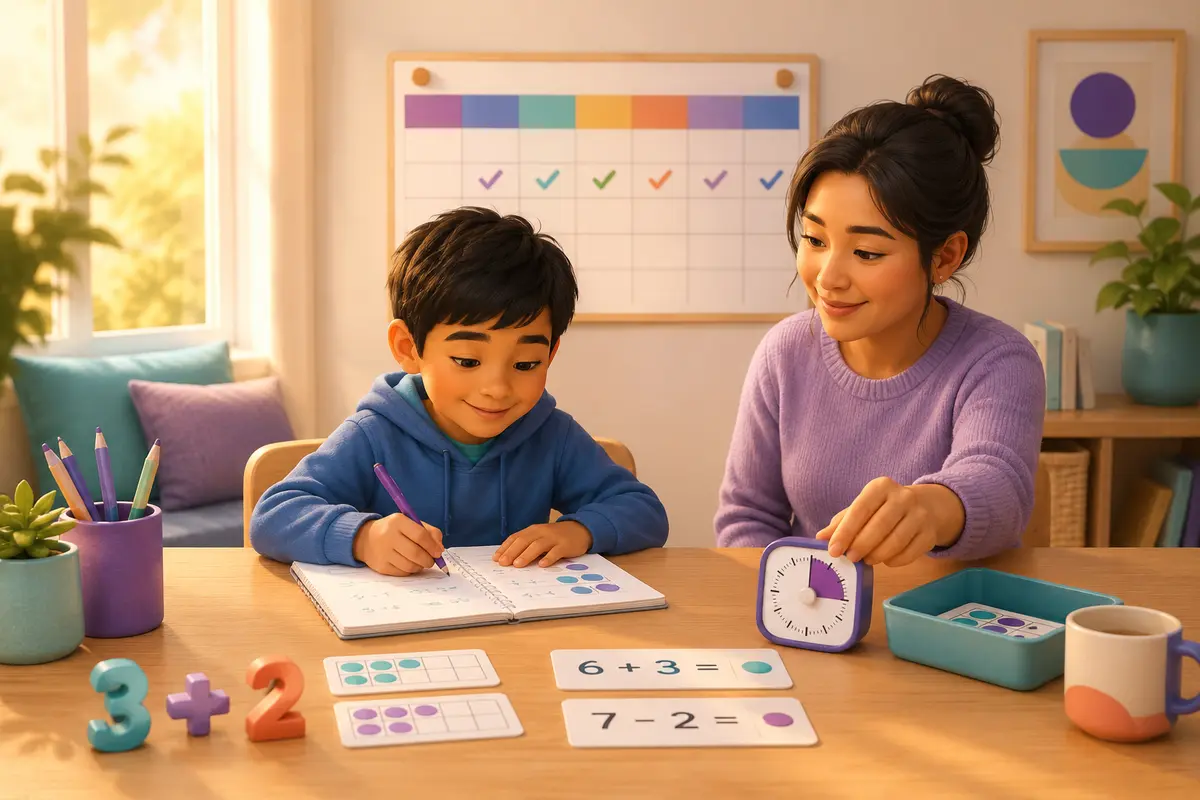
“Practice math every day” sounds simple at school pickup. By evening, it is competing with homework, dinner, activities, tired siblings, and bedtime. A routine that looked reasonable on paper can quickly become the least popular part of the day.
So how much is enough? There is no single correct number for every child. Age, current understanding, school workload, attention, and the purpose of practice all matter.
For many families, three to five brief sessions spread across the week will feel more realistic than one long weekend block.
Why spacing matters
Learning is shaped not only by the total minutes, but also by when those minutes happen. The Institute of Education Sciences recommends revisiting important content after a delay and using low-stakes questions that require active retrieval. A learner who returns to an idea on Wednesday has to rebuild it, not simply keep it in short-term memory from Monday.
Compare one 60-minute Sunday session with four 15-minute sessions on different days. The total is the same, but the second routine creates several chances to remember, apply, check, and revisit.
Spacing is not magic, and it cannot replace clear teaching. It simply gives learning more than one chance to stick.
A practical starting point by grade
These are family-friendly starting ranges, not research-prescribed dosages. They describe optional focused practice outside regular classroom instruction and homework.
| Grade band | Starting session | Possible rhythm | Main purpose |
|---|---|---|---|
| K–Grade 2 | 8–15 minutes | 3–5 times weekly | Make counting, patterns, number relationships, and early operations visible. |
| Grades 3–5 | 12–20 minutes | 3–5 times weekly | Strengthen facts, operations, strategy choice, and multi-step reasoning. |
| Grades 6–8 | 15–25 minutes | 3–5 times weekly | Revisit concepts, build fluency, and practice flexible problem solving. |
Some days need less. A child who has already completed demanding homework may not need another digital session. Another learner may happily continue past the range. The quality of attention matters more than reaching a number on a timer.
Practice is not first-time instruction
If a child has never understood equivalent fractions, presenting more fraction questions is unlikely to solve the problem. They may need an explanation, a visual model, and guided examples before independent practice is useful.
Before starting, ask: Has this skill been taught? Can the child explain the goal? Do they have a strategy to try? Is the activity practicing the math rather than testing unfamiliar instructions?
A simple three-part session
Start with something familiar
Spend the first few minutes recalling a skill the learner has met before: counting, addition combinations, multiplication facts, fraction equivalence, integer operations, or a familiar logic pattern. Familiar should feel reachable, not mindless.
Choose one current target
One clear skill beats a fast tour through several unrelated topics. A Grade 4 learner might connect multiplication and division; a Grade 6 learner might compare fractions and decimals. The target can appear visually and symbolically without increasing every difficulty at once.
Finish with one question
Reflection can take thirty seconds: “What strategy helped?” “Where did you slow down?” “What mistake did you catch?” For grades 4–8, monitoring and reflecting on problem solving is a recommendation supported by strong evidence in the IES practice guide.
Should the same skill appear every day?
Return to the same relationship, but not always in the same costume. A useful rhythm is:
- Introduce: learn the idea with explanation and visual support.
- Repeat: use it again while the method is familiar.
- Space: return after a day or two.
- Mix: place it beside a related skill.
- Apply: meet it in a puzzle, word problem, or new representation.
A third grader learning multiplication might use arrays on Monday, equations on Wednesday, missing factors on Friday, and related division facts on Sunday. The mathematics stays connected while the decisions change.
A weekly routine that leaves room for life
| Day | Focus | Example |
|---|---|---|
| Monday | Familiar skill | One short activity using material learned previously. |
| Wednesday | Current skill | Practice connected to current classroom work. |
| Friday | Reasoning or logic | Use the same idea in a pattern, puzzle, or problem. |
| Weekend | Learner’s choice | Choose between two appropriate activities and end with one reflection question. |
If you miss a day, do not double the next session. Continue at the next reasonable opportunity. Consistency should make practice easier to return to, not turn it into a punishment.
Signs the activity is too hard
- The learner cannot explain the goal.
- Guessing replaces examination of the problem.
- An adult must direct almost every move.
- Instructions keep accumulating and accuracy falls.
- The learner cannot connect the task to anything previously learned.
The cause may be math, reading load, memory demand, unfamiliar controls, distracting visuals, or time pressure. Simplify one thing at a time so you can see what helps.
Signs it may be too easy
- The learner answers accurately without a new decision.
- The same memorized action works regardless of the question.
- The outcome is completely predictable.
- The learner can explain and apply the strategy consistently.
More challenge does not have to mean larger numbers or a faster timer. Ask the learner to explain why a method works, compare two strategies, find an incorrect example, or predict the result before moving.
What if attention runs out?
A shorter successful session is usually more useful than a longer session full of reminders and conflict. Choose the activity before sitting down, state one goal, remove extra tabs and materials, and agree on the boundary in advance.
“We’ll complete one focused round. Then we’ll decide whether a second round makes sense.”
Do not add minutes simply because the learner was distracted. First ask whether the goal was clear and the difficulty was appropriate.
Does practice need to be timed?
No. Timed activity can help build fluency when the learner already understands the math, but it is not the definition of good practice. The 2021 IES elementary mathematics guide includes timed activities alongside systematic instruction, mathematical language, visual representations, number lines, and feedback.
Reduce time pressure when the goal is learning a new concept, comparing strategies, or solving a multi-step problem. Accuracy, reasoning, and strategy use still matter when speed is practiced.
Using Focusplay for spaced practice
Focusplay’s short rounds and grade-organized learning areas make it possible to choose one target, finish a manageable activity, and return on another day. Use immediate feedback to notice strategy use; use the authorized adult view to look for patterns across completed activities.
For help matching a game to the learner, read How to Choose Math Games by Grade Level. Focusplay should complement—not replace—teacher instruction, conversation, physical manipulatives, written work, or professional support when difficulty persists.
The best routine is one you can repeat
Choose one clear target. Keep the session short enough for real thinking. Return after time has passed. Notice how the learner reasons, not only whether the last answer is correct.
Then stop—and come back another day.