Exit Tickets for Kids: A Practical K–8 Formative Check
A useful exit ticket does more than ask whether a lesson felt easy. It captures one small piece of learning and points toward a specific next step.
The U.S. Institute of Education Sciences (IES) describes formative assessment as evidence used to inform ongoing teaching and learning; its examples include observations, questioning, and exit tickets. A short response becomes useful when the prompt matches the learning target and the adult uses the evidence.
Use a Check–Explain–Next routine
- Check one target. Choose the most important idea or skill from the lesson. Ask for a response that can show it directly.
- Explain the thinking. Add a brief “How do you know?” or “Show one step.” This helps distinguish a lucky answer from a usable understanding.
- Choose the next move. Before collecting responses, decide what different patterns will mean: extend, model again, practice a smaller step, or ask a follow-up question.
This decision-first approach matches an IES assessment guide: start with the question you need evidence to answer, recognize what the assessment cannot tell you, and consider what other evidence is needed. One response should not become a diagnosis or permanent label.
Exit ticket examples by grade band
K–2: show, choose, and tell
After a story, ask, “Which event happened first? Tell me one clue.” In math, let the child build or draw a pair that makes ten. An adult may record an oral response so writing does not hide content knowledge.
Grades 3–5: solve, compare, and justify
Try: “Place 3/4 on this number line and explain how you chose the location.” For reading, ask for the main idea plus one supporting detail. For a learning game, ask, “Which clue helped you most, and why?” These prompts collect both an answer and a small piece of reasoning.
Grades 6–8: apply, connect, and question
Offer a fresh example. Ask students to identify the claim best supported by a source, predict what changes with one variable, or compare two methods. “What evidence would you need next?” checks the limits of a conclusion.
Write prompts that produce usable evidence
- Match the target. If the goal is reasoning, do not assess only vocabulary recall.
- Keep the reading load fair. Use plain directions, a diagram, or read-aloud when reading is not the target.
- Ask for a small explanation. One sentence, labeled model, selected clue, or spoken reason is enough.
- Avoid confidence scales alone. “I understand” can accompany a demonstration, not replace one.
- Plan a response rule. Decide what common answers will prompt you to do next.
The IES Practical Measurement toolkit includes short surveys, checklists, rubrics, exit tickets, and quizzes among tools educators can design, evaluate, refine, and use in a repeated improvement cycle. The key word is refine: if a prompt produces confusing answers, improve the prompt instead of assuming every learner misunderstood.
Sort responses into instructional next steps
Read for patterns rather than points:
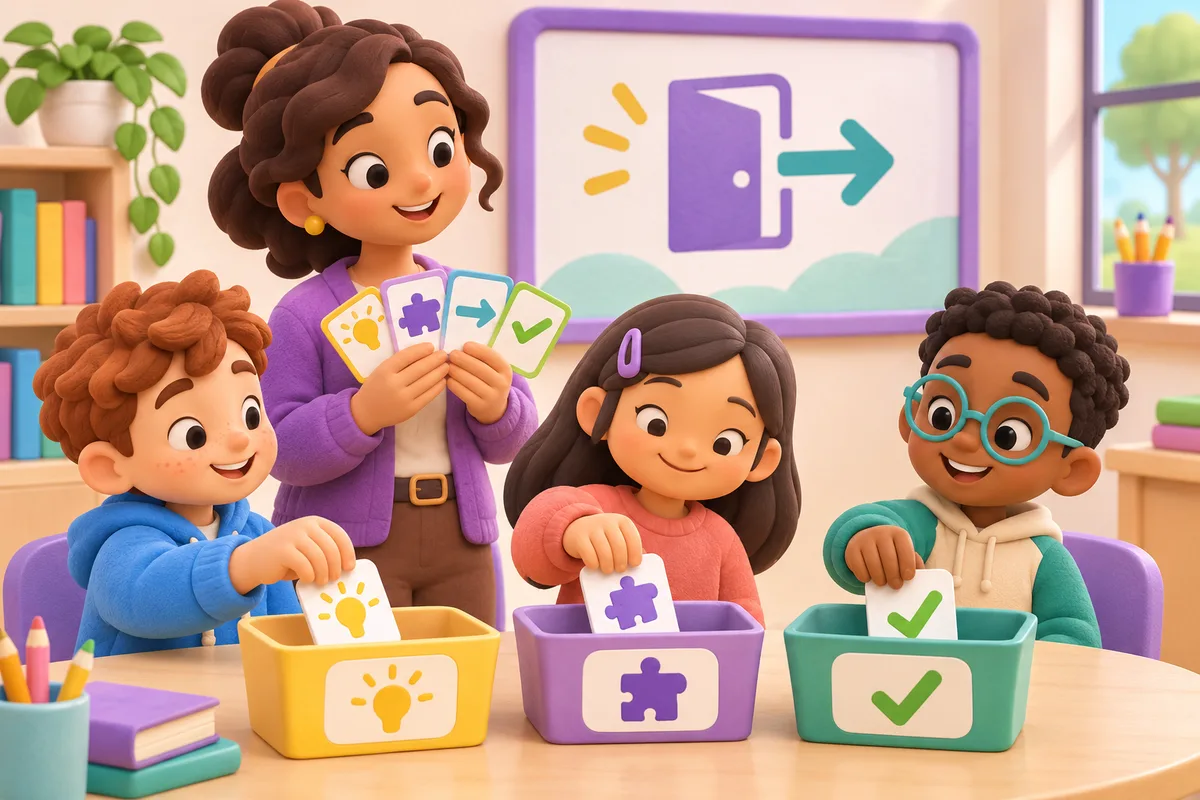
- Ready to extend: the response and explanation fit. Offer a transfer question.
- Needs one more model: the learner misses a step or relationship. Model that piece and try a parallel prompt.
- Needs clarification: the answer may reflect a misconception, unclear wording, language access, or haste. Ask a follow-up.
The What Works Clearinghouse guide on using student achievement data recommends making data part of an ongoing cycle of instructional improvement. For an exit ticket, that cycle can be small: collect, notice a pattern, adjust the next lesson, and check again.
Common exit ticket mistakes
- Grading every response: fear of losing points can hide honest uncertainty. Keep routine checks low stakes.
- Asking too much: a five-problem worksheet is usually a separate assignment, not a quick exit check.
- Collecting without responding: if nothing changes, learners quickly see the ticket as paperwork.
- Overinterpreting one answer: tiredness, language, unclear directions, or time pressure can affect a single response.
- Using the same format every day: alternate writing, drawing, selecting, building, or speaking so the format does not become the obstacle.
Use exit tickets at home and after play
Families can use the same idea without recreating school. After homework, ask, “Show me the hardest step and what you tried.” After reading, invite a one-sentence summary. After a Focusplay activity, ask the child to demonstrate one rule or explain one successful choice. Pair this with our guides to explaining thinking and reflecting after learning games.
Keep the conversation brief and responsive. If the child shows understanding, stop or extend by choice. If the response is unclear, use a worked example, manipulative, or fresh attempt rather than repeating the same prompt louder.
Practical takeaway
For tomorrow’s lesson, write one prompt tied to one learning goal. Add a quick explanation cue, then prepare three next moves: extend, model, or clarify. Collect the responses without a score, scan for patterns, and open the next lesson with the support the evidence suggests.
Frequently asked questions
What is an exit ticket for kids?
An exit ticket is a brief response collected near the end of a lesson or activity. It gives the learner a chance to show current understanding and gives the adult evidence for choosing a next instructional step.
Should exit tickets be graded?
Usually they work best as low-stakes formative checks rather than scored assignments. The purpose is to reveal current thinking and guide what happens next, although a teacher can record completion or use a simple rubric when appropriate.
How many questions should an exit ticket have?
One to three focused prompts are usually enough. Each prompt should connect directly to the lesson goal and to a decision the teacher or parent can make from the response.
Can kindergarten students use exit tickets?
Yes. Young children can point to a picture, sort an example, draw one idea, act out an answer, or explain orally while an adult records the response. Reading and writing demands should not hide the target skill.
What should an adult do with exit ticket results?
Sort responses by the kind of next step they suggest: ready to extend, needs one more example, or shows a specific misconception. Confirm patterns with observation, discussion, or later work before making a high-stakes conclusion.
Sources
- Institute of Education Sciences: Understanding the Educational Assessment Landscape
- REL Southwest: Practical Measurement for Continuous Improvement in the Classroom
- What Works Clearinghouse: Using Student Achievement Data to Support Instructional Decision Making
- REL Central: Formative Assessment and Elementary School Student Academic Achievement