Compare and Contrast for Kids: A Practical K–8 Routine
Good comparisons do not collect random similarities and differences. They examine both items through the same useful lens.
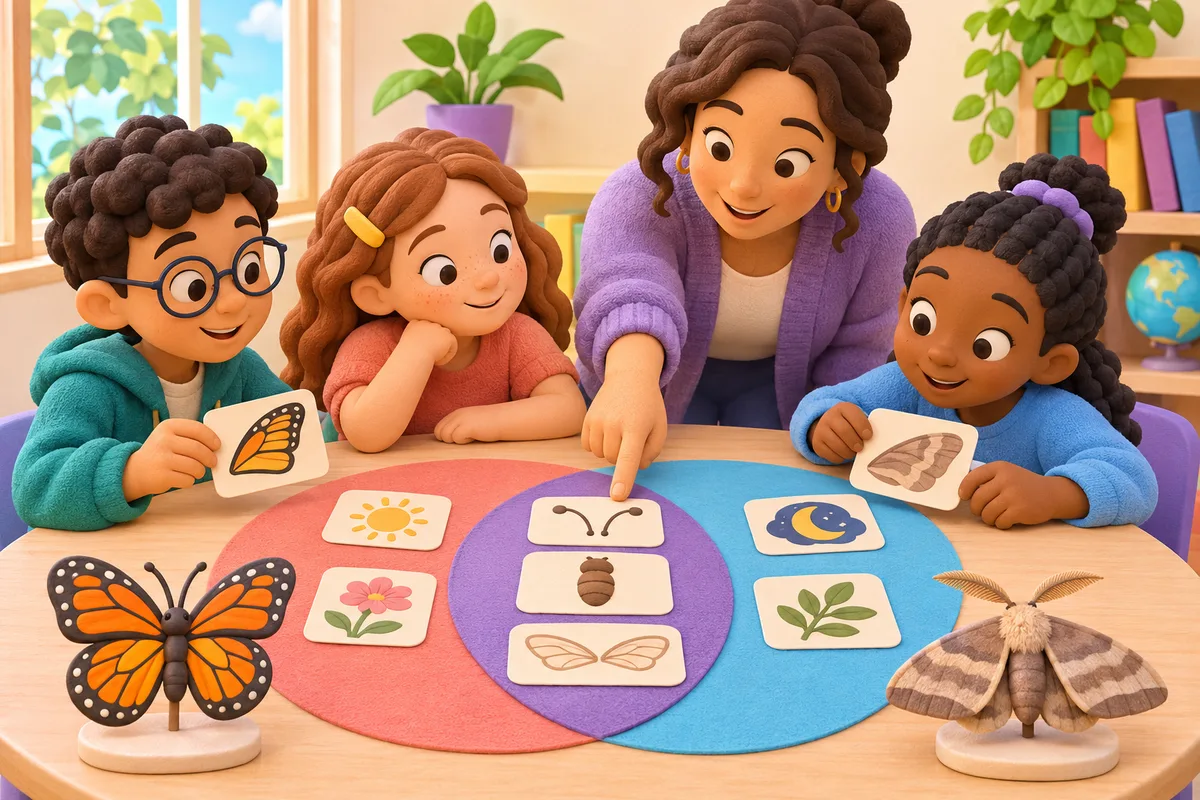
Compare and contrast is both a reasoning move and a common informational-text structure. The U.S. What Works Clearinghouse recommends teaching young readers to identify and use text organization, including compare-and-contrast structure, to understand and remember content. The goal is not merely to spot words such as both or however; learners need to recognize the relationship between ideas.
Use a Same–Different–Evidence routine
- Set the comparison. Name the two items and the feature you will examine: purpose, structure, strategy, evidence, effect, or another shared criterion.
- Find one meaningful similarity. Complete the sentence, “Both ___ and ___.” Check that the point is relevant to the learning goal.
- Find one meaningful difference. Use the same feature for both sides: “___ does this, whereas ___ does that.”
- Add evidence. Point to a detail, example, number, quotation, picture feature, or step that supports each claim.
- Explain why it matters. State what the comparison helps you understand, choose, predict, or solve.
Compare-and-contrast examples across K–8
K–2: visible features and familiar categories
Compare a spoon and a fork by material, shape, and use. After two stories, compare the main characters’ problems or choices. Let children sort picture cards, point, draw, or answer orally before asking for complete sentences. A partly completed organizer can reduce writing demands.
Grades 3–5: texts, processes, and strategies
Compare two habitats using climate, resources, and animal adaptations. In math, solve one problem with a drawing and an equation, then compare what each representation makes easy to see. In reading, locate one detail from each text before writing a similarity or difference.
Grades 6–8: claims, systems, and tradeoffs
Compare two historical accounts by claim, evidence, perspective, and omitted information. Contrast proportional and nonproportional relationships using tables and graphs. When comparing two solution strategies, ask which is more efficient under specific conditions—not which is always “best.”
Choose the right comparison tool
- Venn diagram: useful for a small number of shared and unique features.
- Side-by-side table: best when every row names a criterion and both columns need evidence.
- Double-bubble map: helpful for brainstorming related characteristics around two central ideas.
- Sentence frame: useful for speaking or writing: “Both ___ and ___, but ___ whereas ___.”
- Evidence chart: adds a source, quotation, number, or example beside every comparison point.
The IES guide for teaching academic content and literacy to English learners notes that graphic organizers can make relationships among facts and concepts visible. It recommends modeling how to complete and read an organizer, explaining why information is important, and initially providing some parts in advance. The organizer is a scaffold, not the reasoning itself.
Teach signal words without turning them into a shortcut
Signal words can help: both, alike, similarly, unlike, however, whereas, than, and in contrast. The IES K–3 toolkit specifically warns teachers not to rely only on clue words because they may be missing. Ask, “What relationship is the author showing?” A passage can also shift structures—for example, comparing two solutions before explaining their effects.
Start with a familiar, clear example. Model your thinking aloud, complete a table together, and then use a less obvious text. Gradually remove leading prompts such as “How are they different?” and move toward “How did the author organize this information?”
Common comparison mistakes
- Listing unrelated facts: “Cats have whiskers; dogs can run” is not a fair contrast. Compare the same feature.
- Choosing only surface details: Color and size may matter, but purpose, strategy, evidence, or effect often produces deeper reasoning.
- Writing without evidence: Require one supporting detail for every important point.
- Overloading the Venn diagram: When facts become crowded, switch to a criterion-by-criterion table.
- Treating difference as judgment: Different does not automatically mean better or worse.
Practice at home, in class, and through play
Use short comparisons during ordinary activities: two book characters, two ways to organize a backpack, or two strategies for the same problem. After a Focusplay round, ask the learner to compare a successful choice with an unsuccessful one using clue, action, and result. Keep the reflection to one useful distinction.
Comparison works naturally with reading-comprehension questions, explaining thinking, and visual note-taking. The repeated habit is simple: choose a criterion, examine both sides, and cite evidence.
Practical takeaway
Pick two familiar items today. Draw a three-column table labeled first item, shared criterion, and second item. Compare purpose, one feature, and one effect. Ask the child to support each row with something observable or stated in a source, then finish with: “This comparison helps me understand…”
Frequently asked questions
What does compare and contrast mean for kids?
Compare means to examine how two or more things are alike, and contrast means to examine how they are different. A strong comparison uses the same feature or criterion for both items and supports each point with evidence.
What is a simple compare-and-contrast example?
A child might compare a butterfly and a moth by looking at when each is active, how the antennae look, and where the wings rest. The learner should discuss each feature for both animals rather than listing unrelated facts.
Is a Venn diagram always the best comparison tool?
No. A Venn diagram is useful for a few shared and unique features. A side-by-side table is often clearer when learners must compare the same criteria in detail, and a paragraph frame is useful when the final goal is writing.
Which signal words show compare and contrast?
Words such as both, alike, similarly, unlike, however, whereas, and in contrast can signal a comparison. Children should also examine the relationships in the text because signal words may be absent or used in another way.
How can I help a child move beyond surface differences?
Choose a meaningful criterion before comparing, such as purpose, strategy, evidence, structure, or effect. Ask what the similarity or difference changes, and require one detail from the object, text, problem, or source.
Sources
- What Works Clearinghouse: Improving Reading Comprehension in Kindergarten Through 3rd Grade
- IES K–3 Reading Comprehension Toolkit: Informational Text Structures
- IES Practice Guide: Teaching Academic Content and Literacy to English Learners
- IES Practice Guide Slides: Reading Interventions for Students in Grades 4–9