Fraction Sense Activities for Kids: A K–8 Guide
Fraction sense grows when children can build a fraction, place it, compare it, explain it, and connect it to another representation—not only follow a calculation rule.
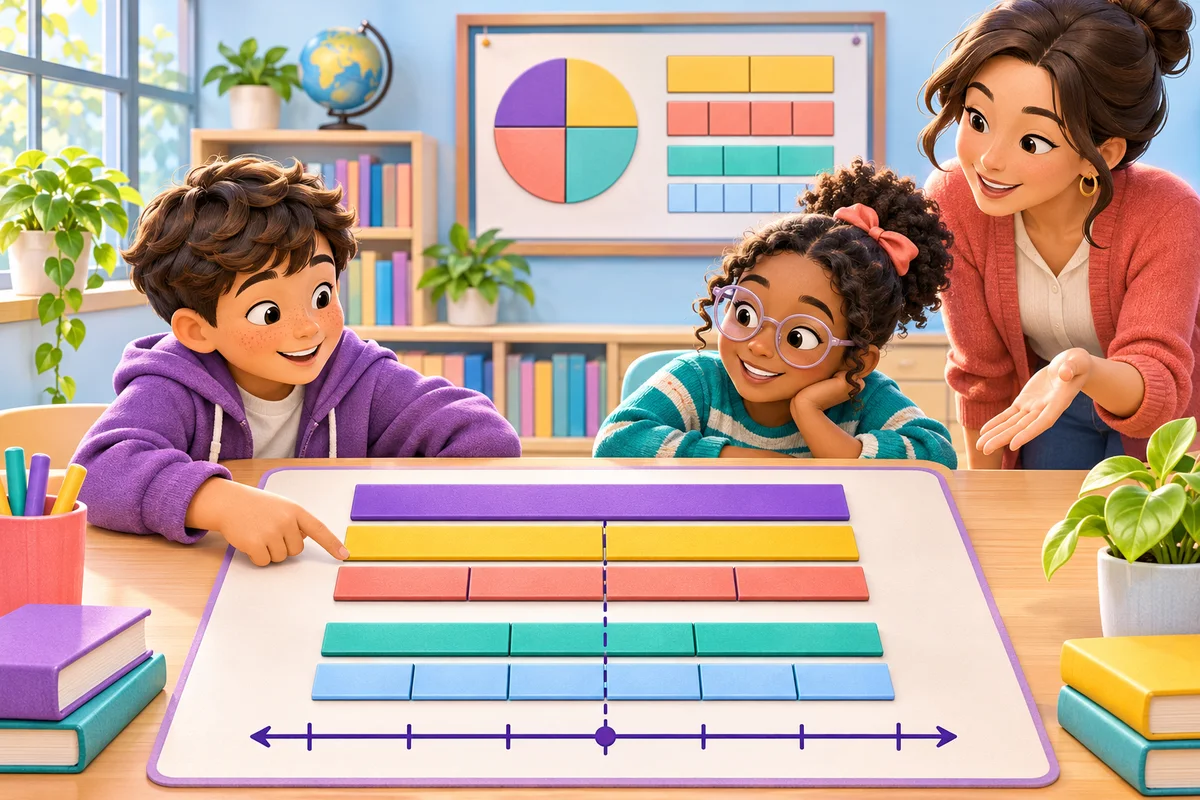
The U.S. Department of Education’s K–8 fractions practice guide recommends helping learners see fractions as numbers and using number lines as a central representation. The guide rates the evidence for this recommendation as moderate. The National Academies likewise emphasizes connecting fraction symbols with physical, pictorial, decimal, percentage, measurement, division, and ratio meanings.
A simple Build–Place–Compare–Explain–Connect routine
- Build: Make the fraction with paper, blocks, counters, a measuring cup, or a drawing. Keep the whole clearly defined.
- Place: Mark the fraction on a number line. Ask how far it is from 0 and which benchmark it is near.
- Compare: Put it beside another fraction. Decide which is greater before calculating.
- Explain: Say what the numerator and denominator describe in this model.
- Connect: Show the same value another way—an equivalent fraction, decimal, percentage, division expression, or real situation.
Seven fraction sense activities
1. Fold the same whole in different ways
Best for K–3. Give two equal paper strips. Fold one into halves and the other into fourths. Shade one-half on the first, then ask how many fourths cover the same length. Repeat with thirds and sixths. Always compare equal-size wholes; otherwise a larger “half” can look bigger simply because its paper is bigger.
2. Walk a human number line
Best for grades 2–5. Mark 0 and 1 on the floor, then add ½. Hand learners cards such as ¼, ¾, 2/4, and 4/4. Before standing in a place, each learner predicts whether the fraction is below, above, or equal to ½. Extend the line past 1 so improper fractions are treated as ordinary numbers, not exceptions.
3. Play “closer to 0, ½, or 1?”
Best for grades 3–6. Reveal a fraction such as 3/8, 7/10, or 11/12. Learners choose the nearest benchmark and explain without finding a decimal. For 7/10, a child might reason that it is two-tenths above ½ and three-tenths below 1. Benchmarking makes estimation part of every fraction problem.
4. Build an equivalence ladder
Best for grades 3–6. Stack equal-length strips divided into halves, thirds, fourths, sixths, eighths, and twelfths. Find endpoints that align. Record pairs such as ½ = 3/6, then explain why multiplying the numerator and denominator by the same number changes the name but not the location or amount.
5. Solve the missing-whole puzzle
Best for grades 2–7. Show a strip and say, “This piece is 2/3 of the whole.” Ask learners to reconstruct the whole. This reverses the usual task and reveals whether a child understands that a fraction depends on the unit. Use tiles, paper, or drawings, then invite more than one valid representation.
6. Sort claims: always, sometimes, or never
Best for grades 4–8. Discuss statements such as “A larger denominator means a smaller fraction,” “Multiplying makes a number larger,” or “Two different fractions can share one point.” Learners test examples and counterexamples. This activity surfaces whole-number rules that do not transfer automatically to rational numbers.
7. Match fractions, decimals, and percentages
Best for grades 5–8. Create cards for values such as ¼, 0.25, 25%, one shaded quarter, and a point one-quarter of the way from 0 to 1. Learners make matching sets and justify each connection.
Adjust the challenge by grade band
- K–2: Use equal sharing, equal parts, fair and unfair partitions, and everyday language. Formal notation can wait until the idea is visible.
- Grades 3–5: Emphasize unit fractions, number lines, benchmarks, equivalence, comparison, and fractions greater than one.
- Grades 6–8: Connect fractions with division, decimals, percentages, ratios, negative rational numbers, and operations. Ask for estimates before exact answers.
The IES elementary mathematics intervention guide also recommends number lines for relative magnitude and for connecting fractions with decimals and operations. The goal is not to replace procedures; it is to give procedures a structure learners can check.
Common mistakes to watch for
- Changing the whole: Compare fractions only after confirming the wholes are the same size.
- Counting pieces instead of judging size: More pieces mean smaller pieces when the whole stays fixed.
- Staying only with circles and pizzas: Add strips, sets, measurements, and number lines so one picture does not become the definition.
- Teaching the rule before the reason: Ask for a model and estimate before symbolic calculation.
FocusPlay’s short math and reasoning activities can complement this work when adults ask children to predict, explain, and connect a game result to a model. Explore our guides to math manipulatives, estimating before solving, and interleaved math practice.
Practical takeaway
Choose one fraction, one model, and one number line. Ask the learner to build it, place it, compare it with ½, explain it, and give it another name. That five-step conversation is more informative than a page of disconnected rules.
Frequently asked questions
What is fraction sense?
Fraction sense is the ability to interpret a fraction as a number, estimate its size, compare it with benchmarks, recognize equivalent forms, and connect it to models, decimals, percentages, or real situations.
When should children start learning fractions?
Young children can explore equal sharing and equal parts informally. Formal fraction notation and number-line work usually become more prominent in elementary school, then expand into operations, ratios, decimals, and percentages in later grades.
Why are number lines useful for teaching fractions?
A number line shows that a fraction has one location and a measurable distance from zero. It also makes magnitude, order, equivalence, fractions greater than one, and connections to decimals and percentages visible.
What if a child always chooses the fraction with the larger denominator?
Return to equal-size wholes and unit fractions. Build or draw one-half and one-eighth of the same whole, then place both on a number line. Ask which part is larger and why creating more equal pieces makes each piece smaller.
Should children memorize fraction rules?
Procedures matter, but they should be connected to meaning. Before asking a child to apply a rule, use a model, number line, estimate, or explanation so the child can judge whether the result is reasonable.
Sources
- What Works Clearinghouse: Developing Effective Fractions Instruction for Kindergarten Through 8th Grade
- REL Midwest: Teaching Fractions Toolkit
- What Works Clearinghouse: Assisting Students Struggling with Mathematics
- National Academies: Adding It Up—Representing and Operating with Rational Numbers
- Common Core State Standards for Mathematics