Cooperative Games for Kids: A K–8 Guide to Learning Together
Cooperative games give children a shared problem to solve. This guide shows parents and educators how to choose, run, and reflect on those games without turning play into a lecture.
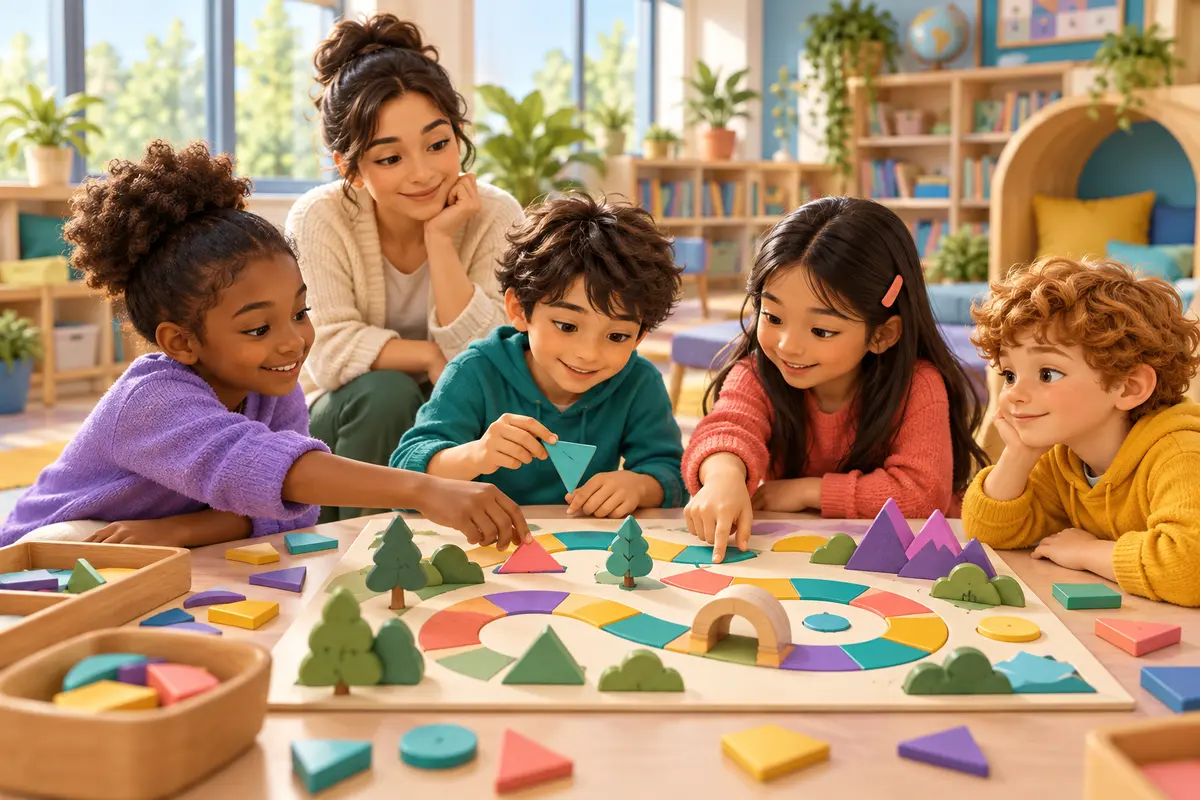
Key takeaways
- Choose a goal that requires more than one contribution.
- Keep rules few enough that children can focus on one another.
- Use Plan–Play–Pause–Reflect to support the group without controlling it.
- Adjust roles, time, and materials before assuming a child “cannot cooperate.”
Why use cooperative games?
Cooperative games turn social and thinking skills into actions children can see: asking for a piece, remembering a shared rule, explaining an idea, waiting while someone tests it, and changing course when a plan fails. A game does not automatically teach these skills, but it can create a repeatable place to practice them.
The Center on the Developing Child at Harvard University describes age-appropriate games and activities as ways to practice attention, working memory, self-control, and flexible problem-solving. The National Association for the Education of Young Children likewise connects play with self-regulation, language, cognitive, and social competencies for younger learners. These sources support offering playful practice—not promising that one game will produce a particular outcome.
The Plan–Play–Pause–Reflect routine
1. Plan the shared goal
State what everyone is trying to accomplish in one sentence: “Build a bridge that holds all six blocks,” or “Get every explorer to the finish before the timer ends.” Ask each player to name one useful role or first move. Keep the goal observable so the group can tell whether a strategy worked.
2. Play with light adult support
Let children make real decisions. Instead of fixing a weak plan, ask, “What information does the team need?” or “Who has not had a chance to add an idea?” If the game uses turns, make them easy to track with a shared token or a clockwise order.
3. Pause for a strategy check
Pause only when it helps: the group is stuck, one voice is dominating, or the original plan no longer fits. Name the situation neutrally—“We have three pieces left and two spaces to fill”—then invite a short adjustment. A pause is not a penalty.
4. Reflect briefly
End with one concrete question: “Which idea helped the team most?” “When did you change the plan?” or “What role should we rotate next time?” Reflection should be shorter than the game. For a deeper debrief, try these learning-game reflection questions.
Five cooperative game ideas
| Game | Shared challenge | Useful adjustment |
|---|---|---|
| Silent sequence | Arrange picture cards into a logical order with gestures only. | Allow one spoken planning minute for younger players. |
| One-table tower | Build a stable tower while each player controls a different material. | Limit pieces rather than racing the clock. |
| Clue circle | Solve a mystery when each player holds one clue. | Require every clue to be shared before guessing. |
| Shared path | Create a route that connects all landmarks on a homemade map. | Add a rule such as avoiding water or using exactly ten tiles. |
| Team story | Create one coherent story, adding one event at a time. | Keep three anchor cards visible: character, goal, and setting. |
Adapt the game by grade band
Kindergarten–Grade 2
Use visible goals, short rounds, and concrete materials. Model one helpful phrase—“Can I add to your idea?”—and offer jobs such as builder, piece finder, or rule reminder. Repeat the same game so the social routine becomes familiar.
Grades 3–5
Add planning choices and mild constraints. Children can compare two strategies, rotate roles between rounds, or record a simple team plan. If disagreements grow, separate idea generation from choosing: collect options first, then test or vote.
Grades 6–8
Use challenges with incomplete information, trade-offs, or several possible solutions. Let students divide responsibilities and defend a choice with evidence. Avoid making the most confident student the permanent leader; roles such as skeptic, summarizer, tester, and connector distribute thinking.
When cooperative play is not working
Look at the design before labeling the child. The goal may be vague, the group too large, the reading demand too high, or one role too powerful. Reduce the number of players, provide a visual turn cue, pair spoken directions with a model, or give each child information the team genuinely needs. A child may also need a break or a lower-noise setting.
Do not force public reflection after a tense round. Reset privately, change one condition, and try again later. The aim is supported participation, not compliance for its own sake. The U.S. Institute of Education Sciences notes that structured opportunities for students to engage with one another can be part of building positive relationships; structure is what makes “work together” teachable rather than vague.
Connect cooperative play to Focusplay
After a Focusplay activity, siblings, classmates, or an adult and child can replay one challenge as a team: one person notices details, another explains a possible rule, and the group agrees on the answer. Keep the exchange modest and let the child retain agency. Browse Focusplay learning games for age-appropriate starting points, then use one reflection question to connect the game strategy to schoolwork.
Frequently asked questions
What is a cooperative game for kids?
A cooperative game asks players to work toward one shared goal instead of defeating one another. Children may still take turns or have different roles, but everyone succeeds or revises the plan together.
How many children should play a cooperative game?
Two to four players is a manageable starting point because each child has frequent chances to contribute. Larger groups can work when roles, materials, and turn order are clear.
What if one child takes over the game?
Pause and add a simple participation rule, such as one idea from each player before the team chooses. Give the child a defined role without making that role the only decision-maker.
Do cooperative games replace competitive games?
No. Cooperative and competitive games create different experiences. A balanced play routine can include both, while adults choose the format that fits the group, goal, and moment.
Sources
- Center on the Developing Child at Harvard University: Activities Guide—Enhancing and Practicing Executive Function Skills
- National Association for the Education of Young Children: Play
- Institute of Education Sciences: How to Build Positive Relationships with Students